LV
Autobiography Collection

Collections

Personal writings across generations. Discover diaries, life stories, memoirs and letters.

241collections

241 collections

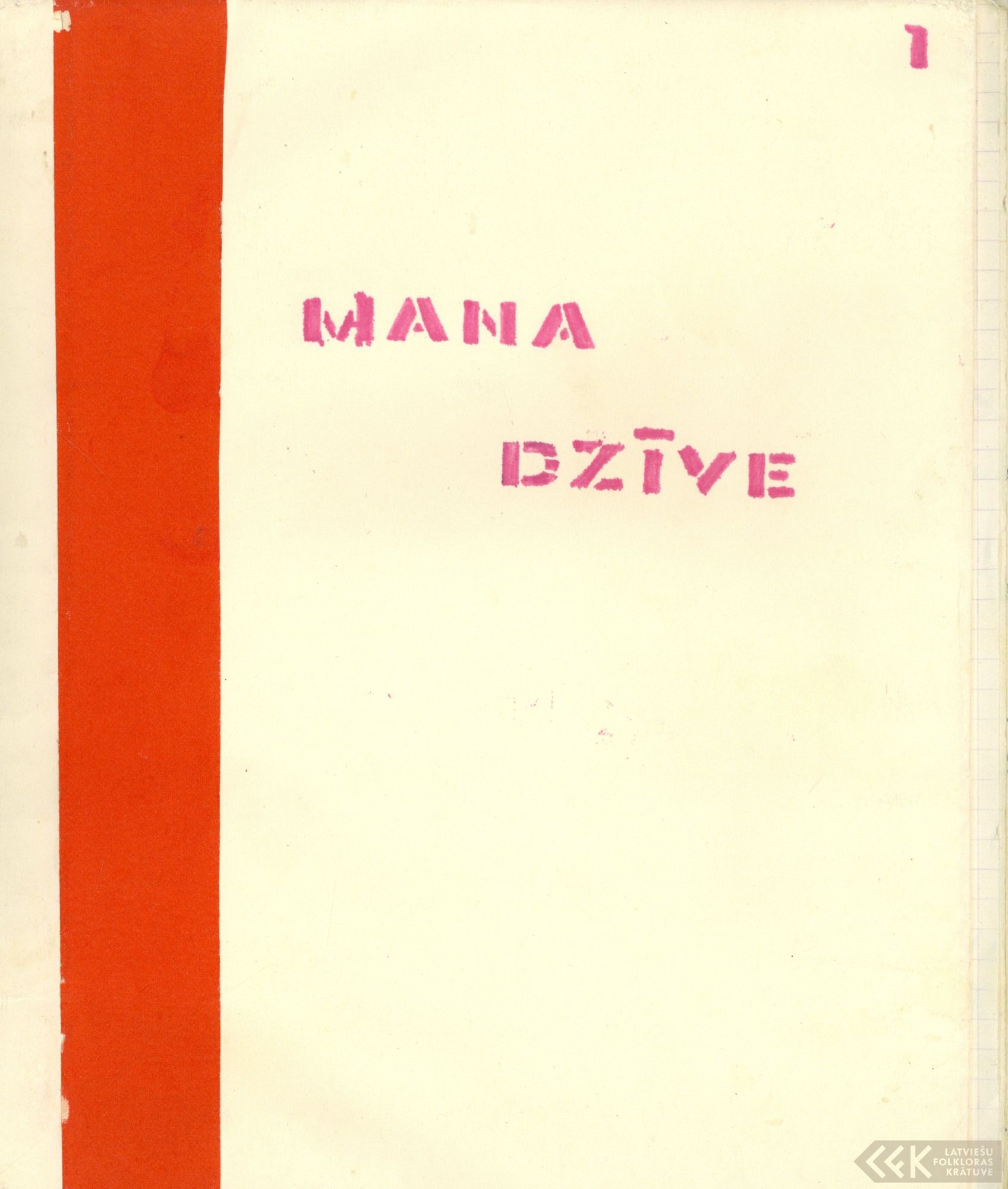
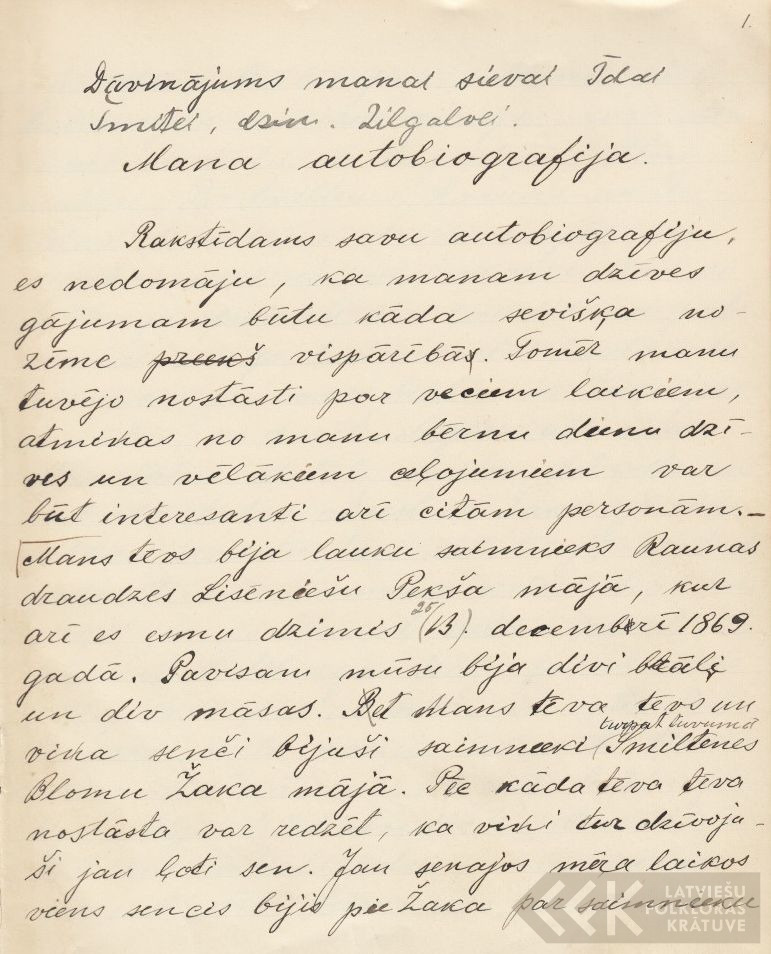
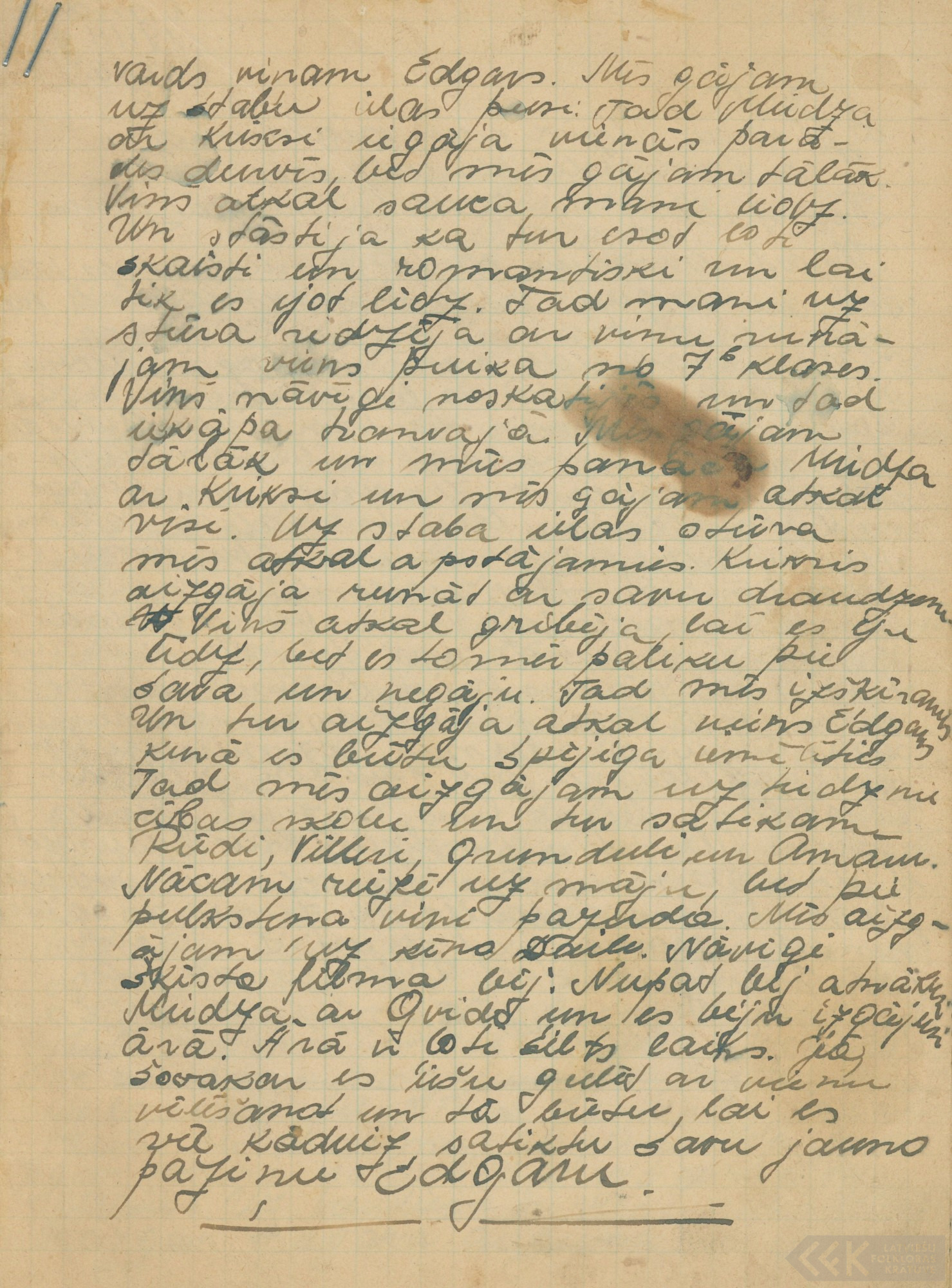
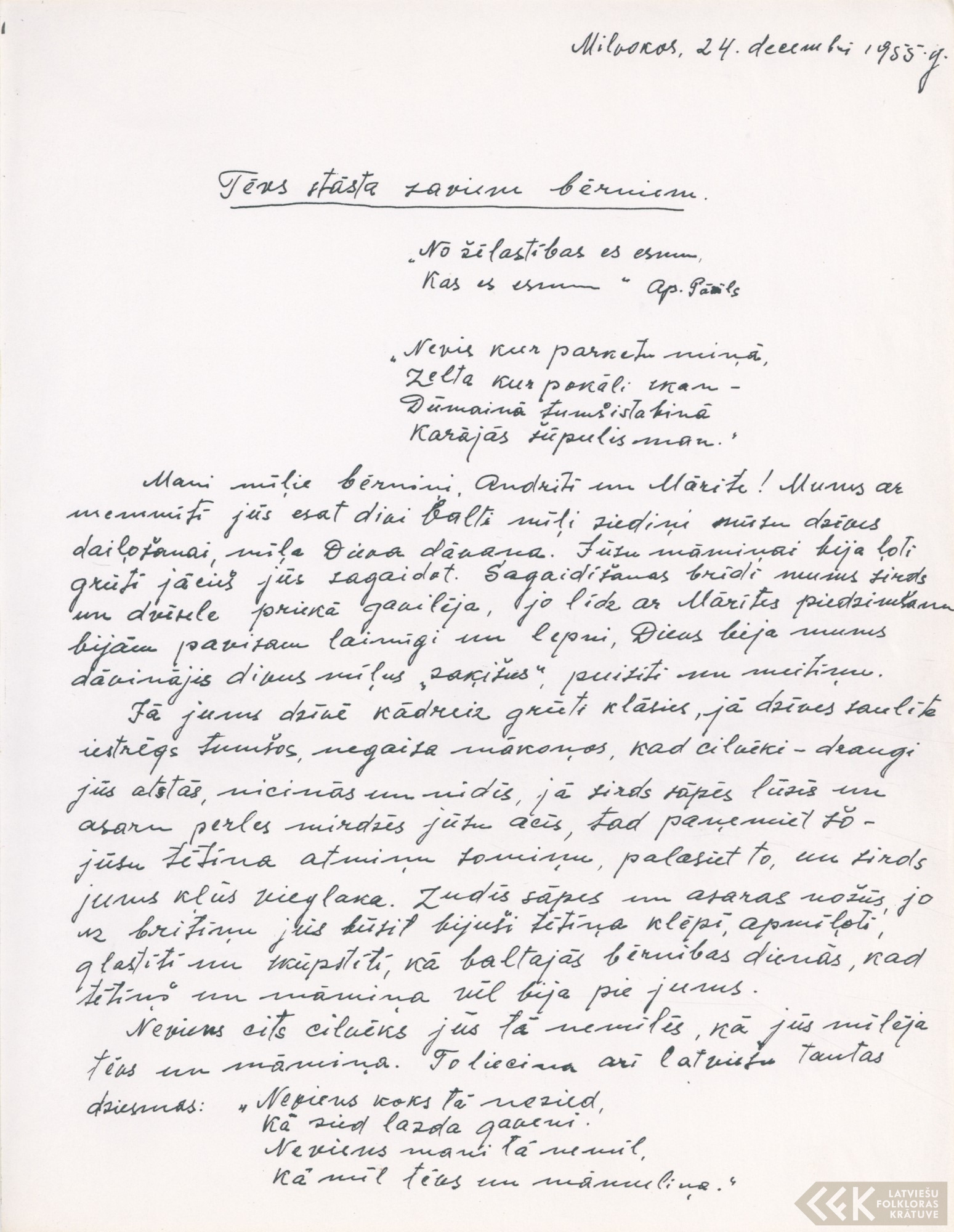
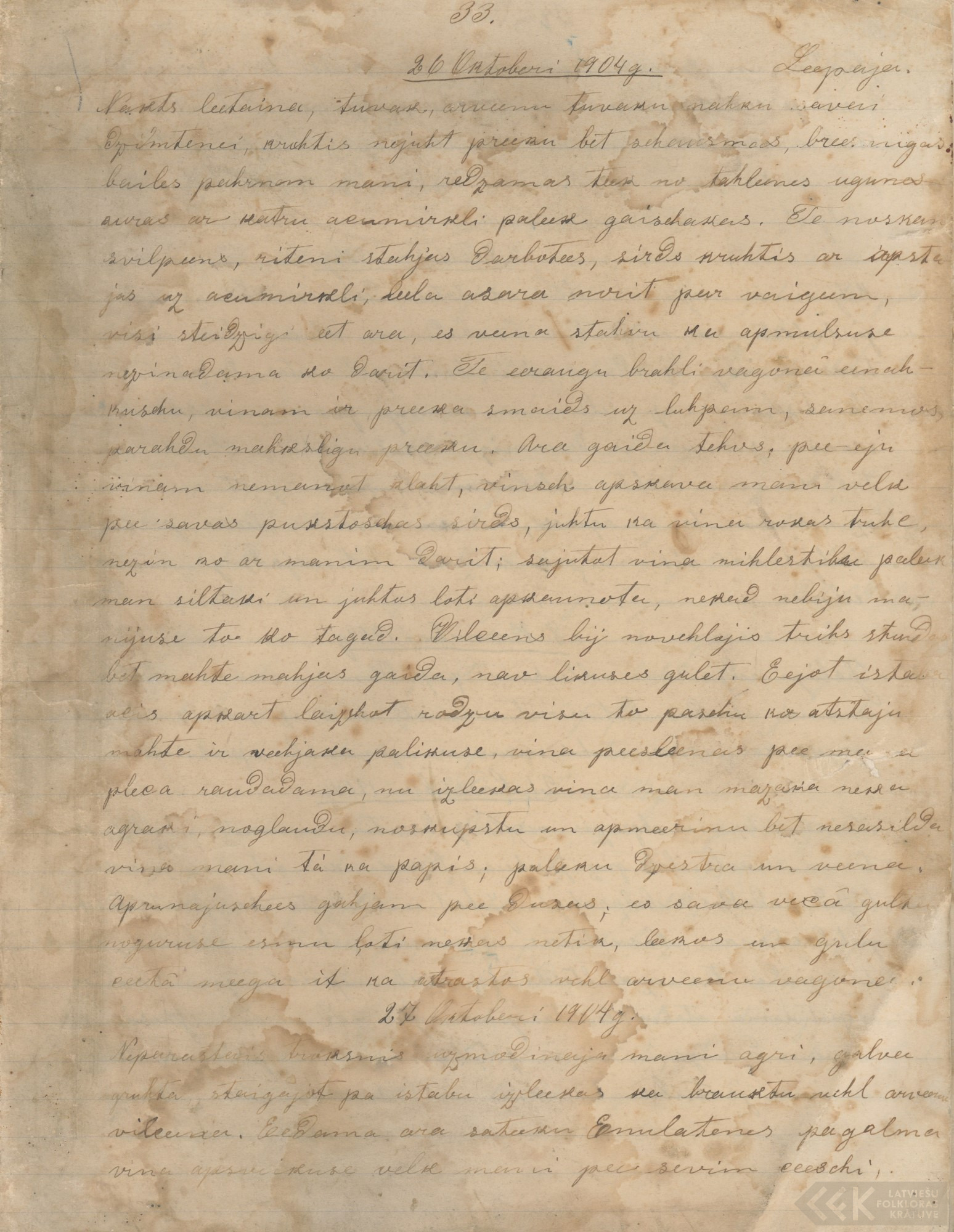
First manuscript page: Life story of Ādams Purmalis
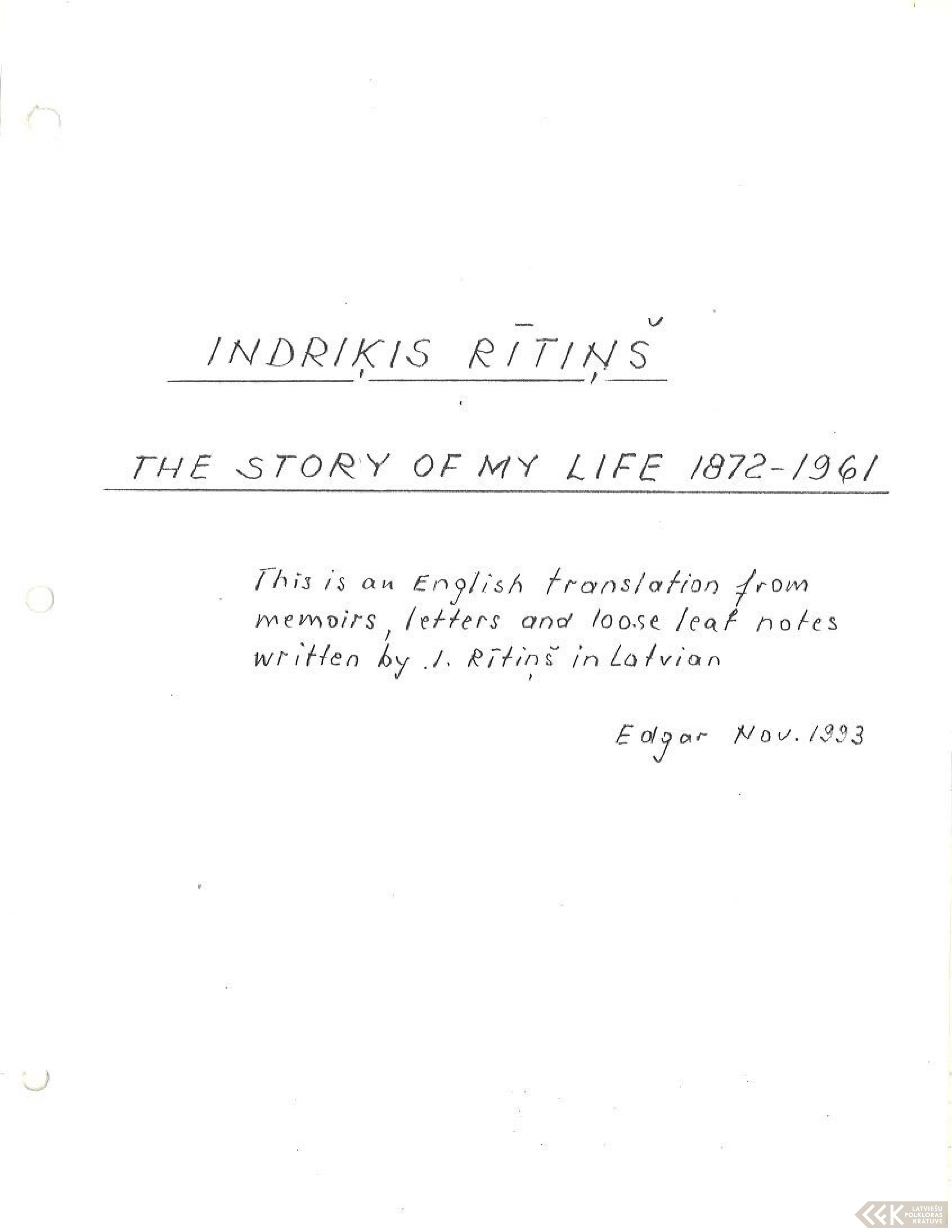
LFK Ak 11900–1914

Life story of Ādams Purmalis

Mazsalaca farmer Ādams Purmalis (1846–1917) autobiography.

Author: Ādams Purmalis

Explore collectionClose details

The life story of Ādams Purmalis (1846–1917), a Latvian farmer born in the mid-19th century, preserved in a manuscript of nearly 400 pages. It depicts life in the Mazsalaca area during the second half of the 19th century and the early 20th century, with particular attention to childhood, youthful experiences, courtship and marriage, social life, and farming and household affairs. The manuscript offers valuable insights into the everyday lives, customs and local cultural history of the people of northern Vidzeme. The life story was published as a book with commentary by Sanita Reinsone in 2008. In 2011, a stage adaptation, "Ādama stāsts" (Adam’s Story), was performed at the Latvian National Theatre.

Open on garamantas.lv (opens in a new tab)
First manuscript page: Diaries of Emīls Pudelis
LFK Ak 21912–1938

Diaries of Emīls Pudelis

Diaries of Emīls Pudelis (1893–1969) — Mazsalaca farmer, Latvian rifleman, and participant in the Latvian War for Independence; kept from 1 July 1912 to 31 May 1938. The diary records each day’s work and what it entailed, as well as other daily activities and important events at home and in the surrounding area, near and far.

Author: Emīls Pudelis

Explore collectionClose details

Diaries of Emīls Pudelis (1893–1969) — Mazsalaca farmer, Latvian rifleman, and participant in the Latvian War for Independence; kept from 1 July 1912 to 31 May 1938. The diary records each day’s work and what it entailed, as well as other daily activities and important events at home and in the surrounding area, near and far.

Open on garamantas.lv (opens in a new tab)
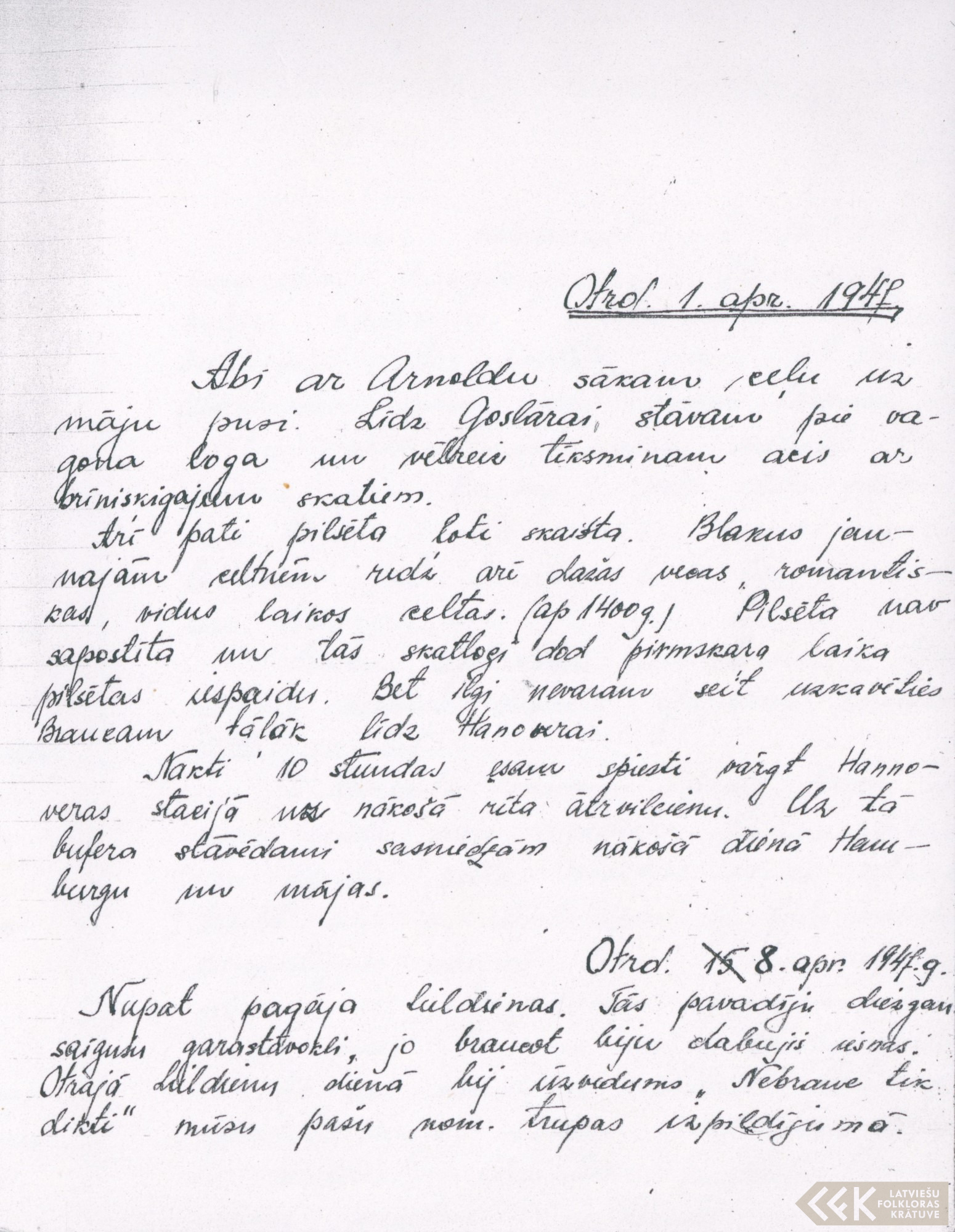
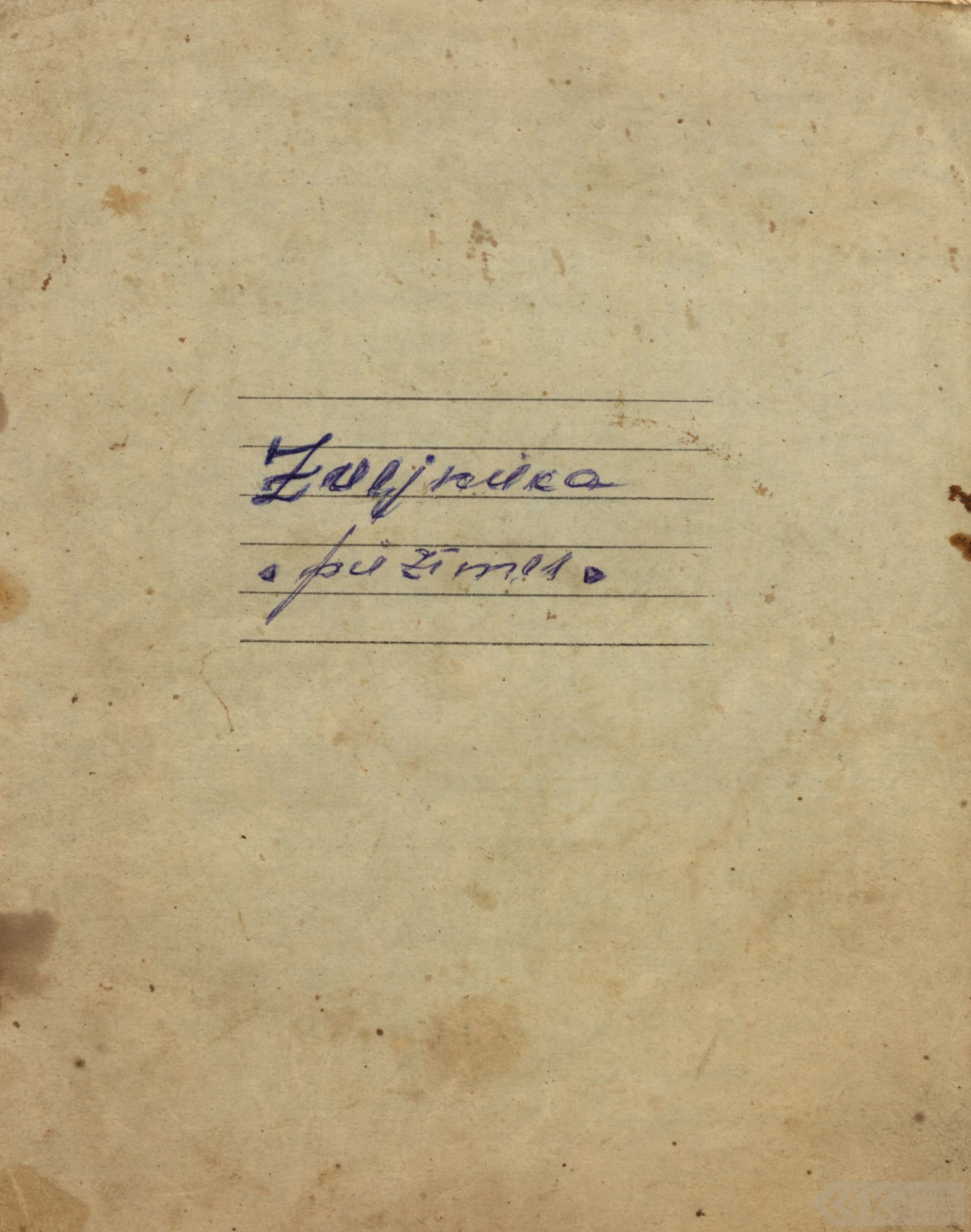
First manuscript page: A Short Life Story of Unknown Man. Started in August 1944
LFK Ak 31944–1947

A Short Life Story of Unknown Man. Started in August 1944

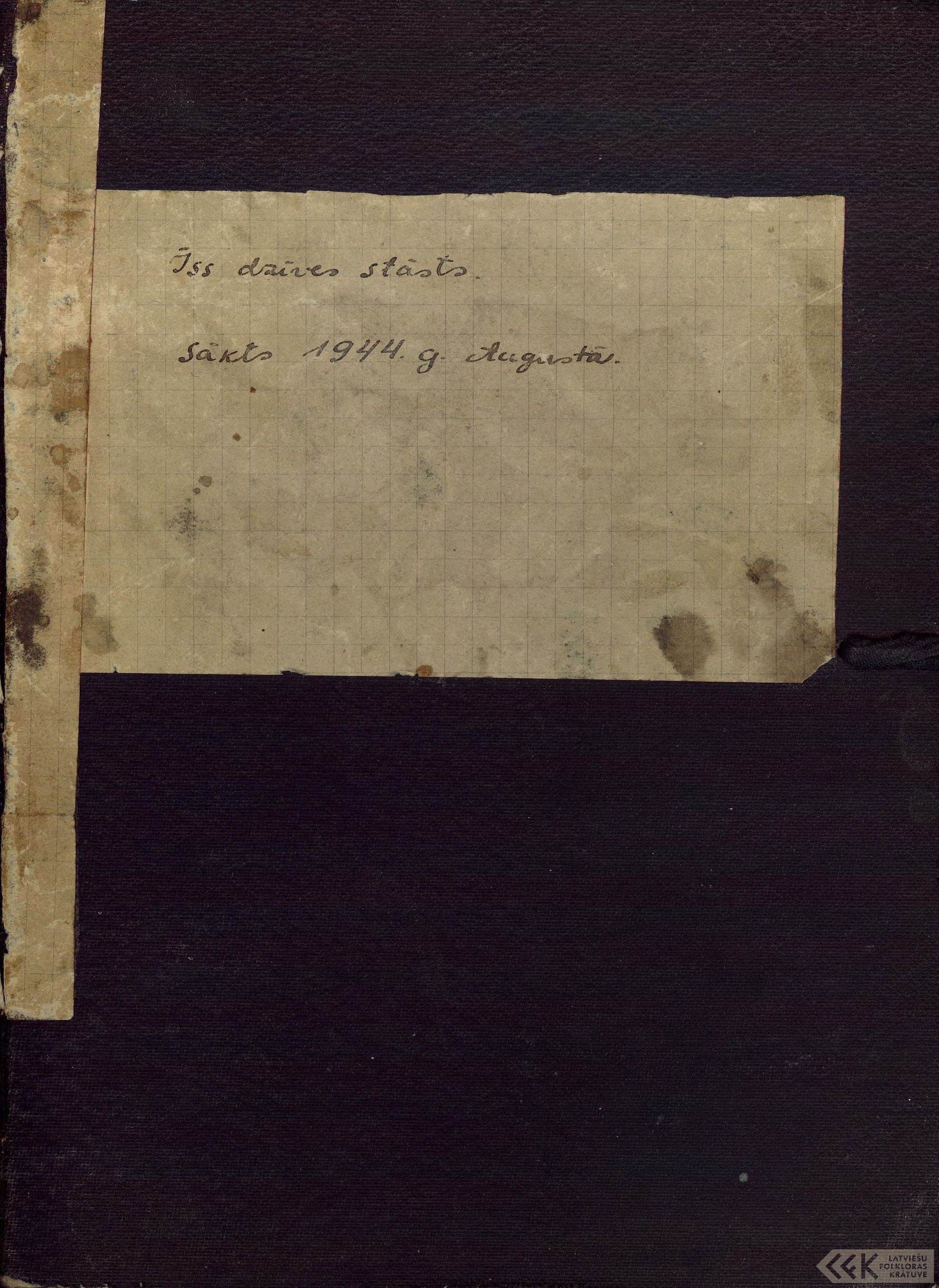
The autobiographical writing of an unknown man that covers events of author's life from the end of August 1944 to August 1947. The story describes this man’s imprisonment in the Central Prison, and his time spent in the concentration camps at Salaspils and in Zaksenhausen, Germany. Post-war time Latvia, especially Riga, is described vividly and in detail.

Submitted by: Jānis Streičs

Explore collectionClose details

The autobiographical writing of an unknown man that covers events of author's life from the end of August 1944 to August 1947. The story describes this man’s imprisonment in the Central Prison, and his time spent in the concentration camps at Salaspils and in Zaksenhausen, Germany. Post-war time Latvia, especially Riga, is described vividly and in detail.

Open on garamantas.lv (opens in a new tab)
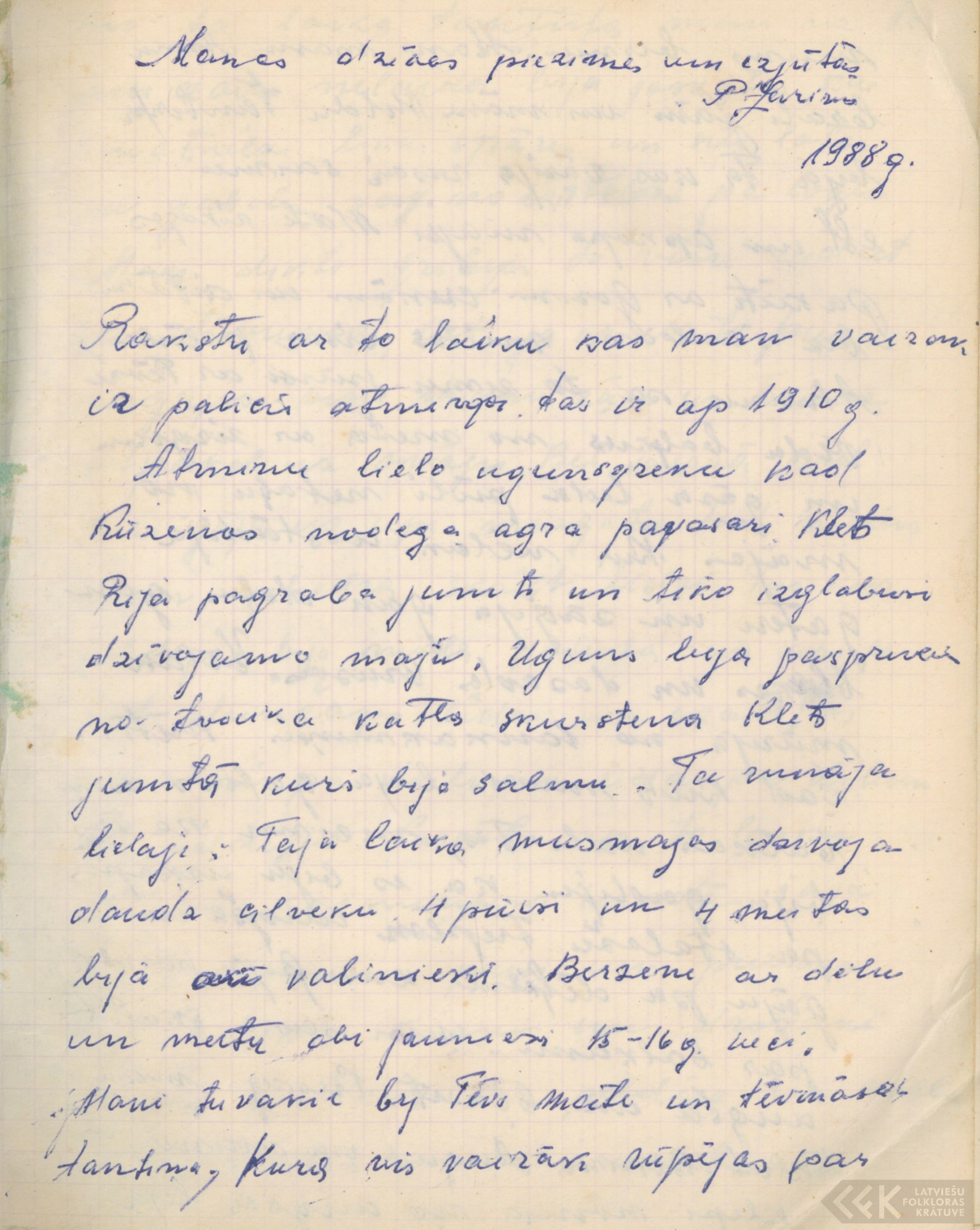
First manuscript page: Life story of Jānis Pavasaris
LFK Ak 41965–1989

Life story of Jānis Pavasaris

Jānis Pavasars (Zābaks) wrote his life story from 1965 to 1989. It covers the period from Jānis’ birth in 1912 in “Vecmārtiņi” in Kolbergi until 1985, allowing the reader to follow significant developments in Jānis’ family in the context of national and international political developments.

Author: Jānis Pavasars

Explore collectionClose details

Jānis Pavasars (Zābaks) wrote his life story from 1965 to 1989. It covers the period from Jānis’ birth in 1912 in “Vecmārtiņi” in Kolbergi until 1985, allowing the reader to follow significant developments in Jānis’ family in the context of national and international political developments.

Open on garamantas.lv (opens in a new tab)
First manuscript page: Diaries of Kārlis Valgums
LFK Ak 51987–1999

Diaries of Kārlis Valgums

Diaries of Kārlis Valgums (1921–2006) teacher at Beja, written from 1987 to 1999.

Explore collectionClose details

Diaries of Kārlis Valgums (1921–2006) teacher at Beja, written from 1987 to 1999.

Open on garamantas.lv (opens in a new tab)
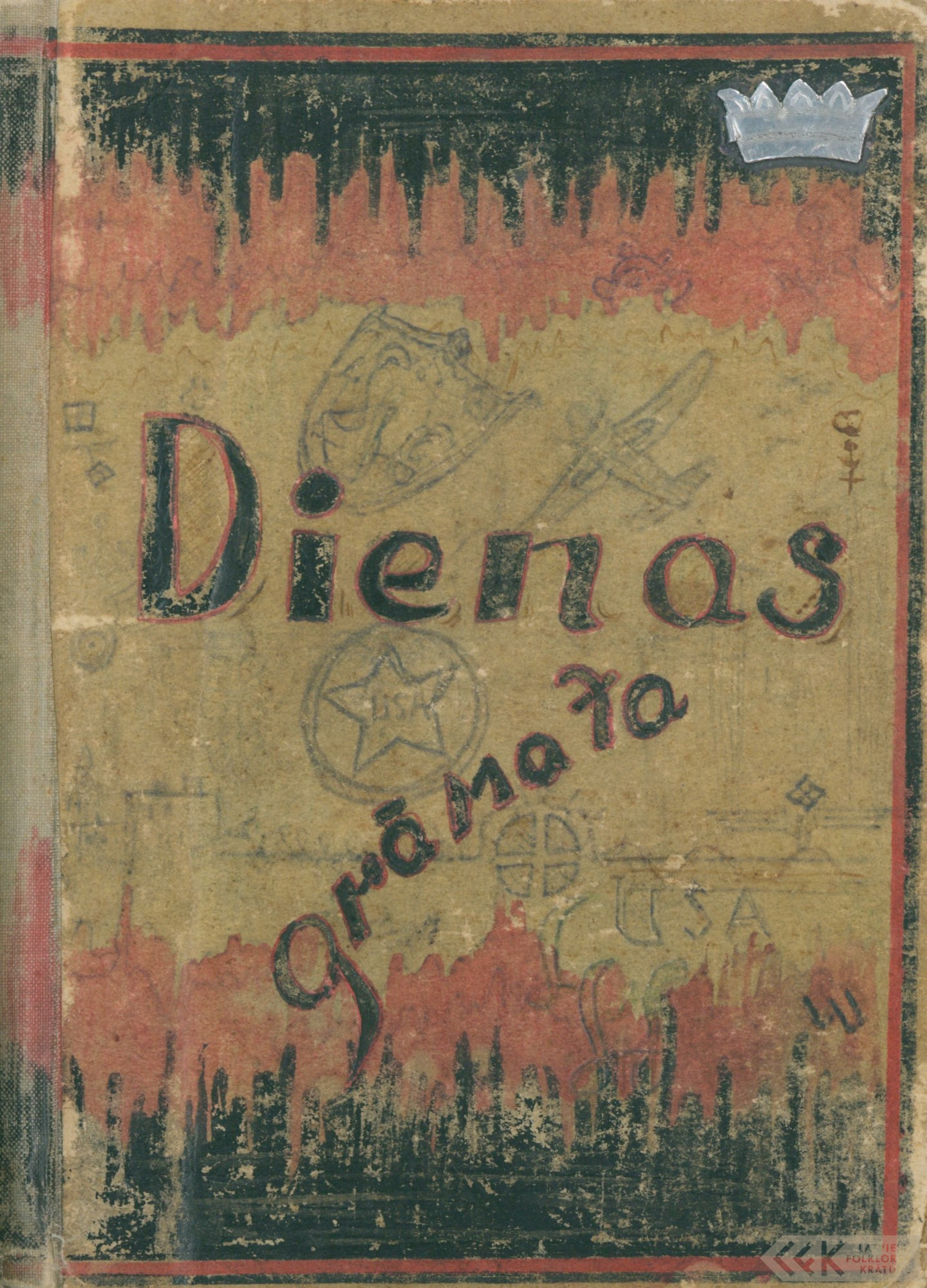
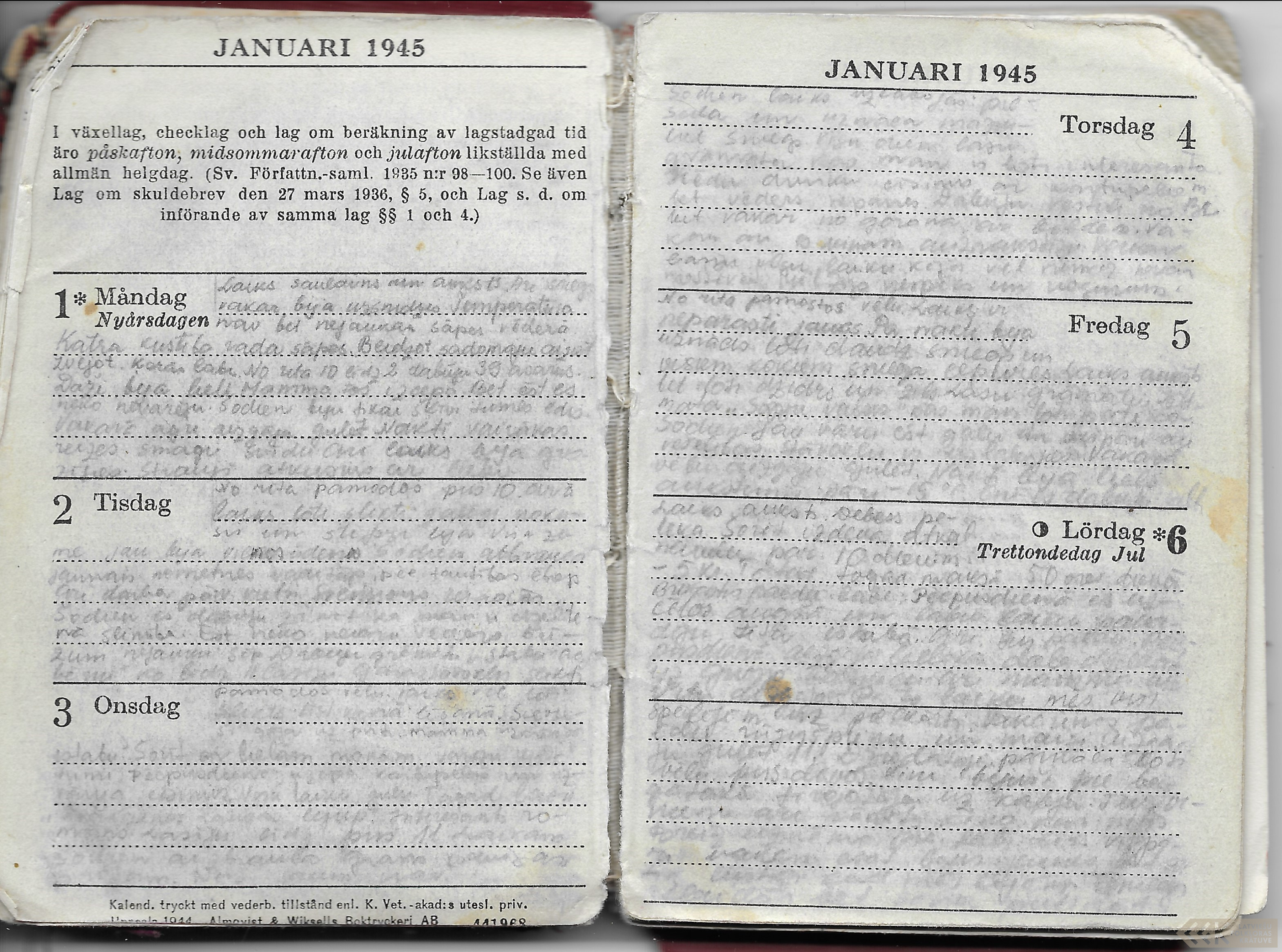
First manuscript page: School diaries of Ilze Sperga
LFK Ak 61993–2001

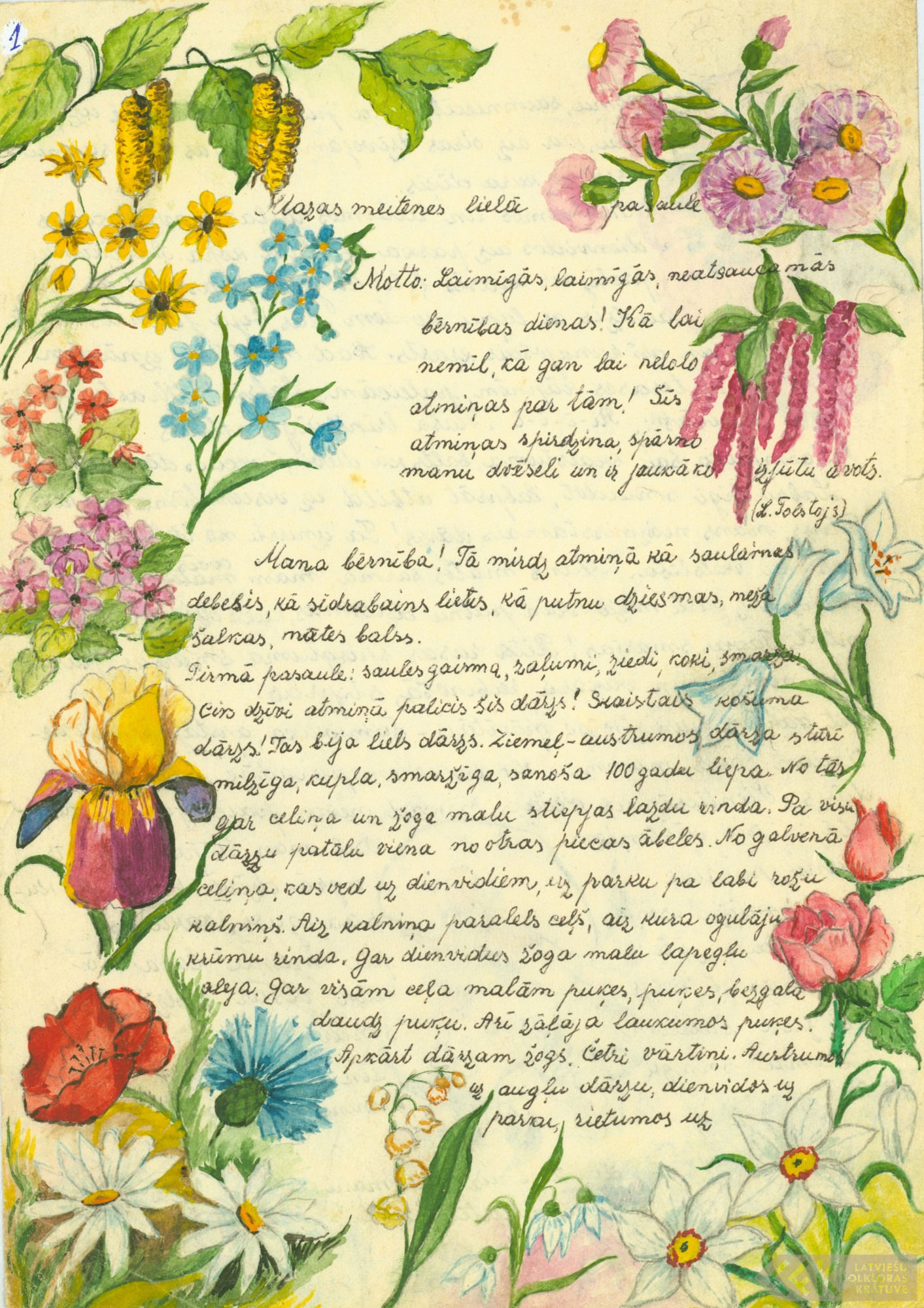
School diaries of Ilze Sperga

The school diaries of writer and scholar Ilze Sperga, begun in 1993. Everyday childhood experiences and school events in the 1990s are accompanied by colourful drawings, pasted images and collages created by the author.

Explore collectionClose details

The school diaries of writer and scholar Ilze Sperga, begun in 1993. Everyday childhood experiences and school events in the 1990s are accompanied by colourful drawings, pasted images and collages created by the author.

Open on garamantas.lv (opens in a new tab)
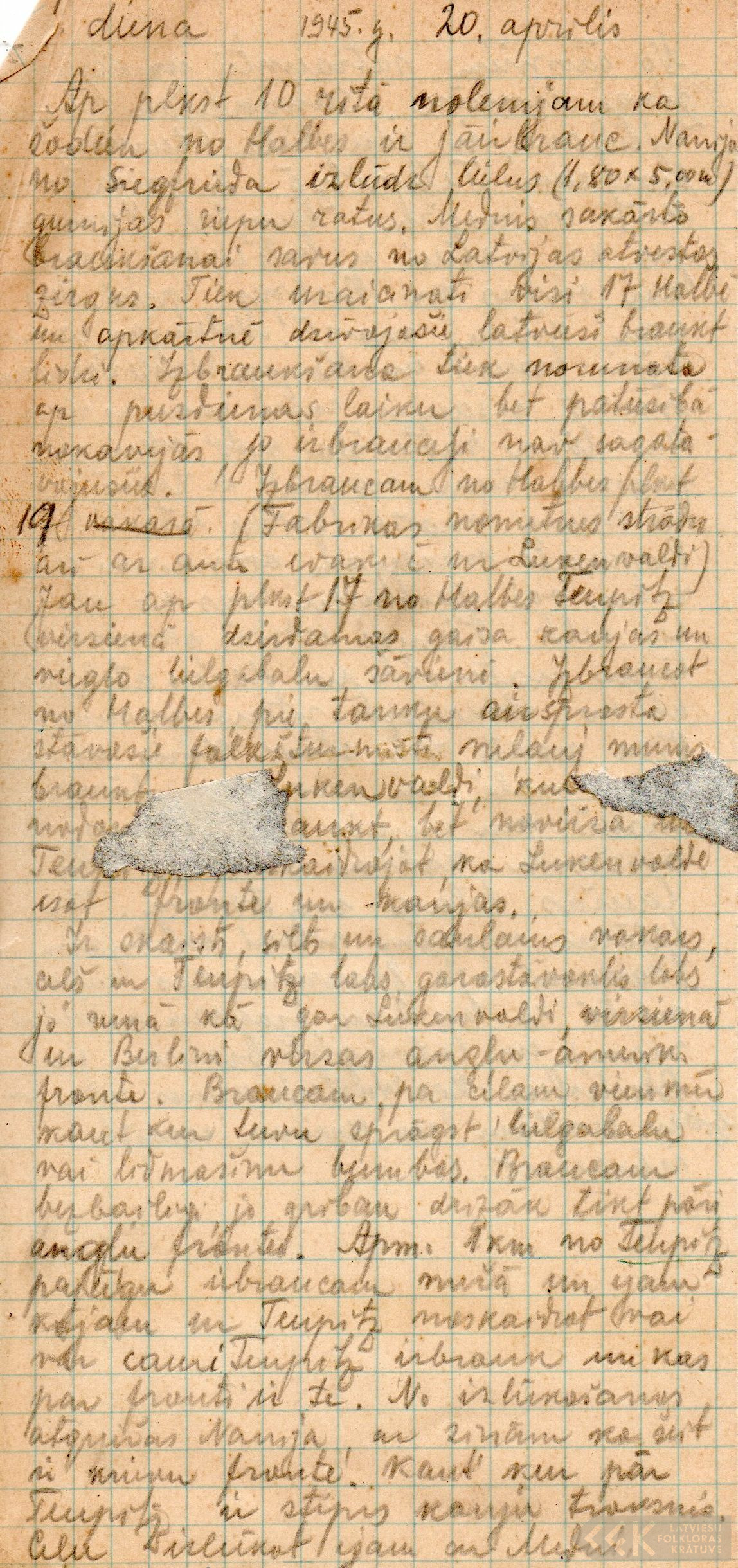
First manuscript page: Diary of Edgars Reinsons
LFK Ak 71944–1947

Diary of Edgars Reinsons

Diary of Edgars Reinsons from Bilskēni, born in 1927, written from 6 November 1944, when he began his training in Eger (now Heves) in Sudeti, until his arrival in Canada on 11 November 1947.

Author: Edgars Reinsons

Explore collectionClose details

Diary of Edgars Reinsons from Bilskēni, born in 1927, written from 6 November 1944, when he began his training in Eger (now Heves) in Sudeti, until his arrival in Canada on 11 November 1947.

Open on garamantas.lv (opens in a new tab)
LFK Ak 81979–1990

Diary of Alīda Āriņa

Daily events set down by Alïda Āriņa (1922-2003), postmistress from Madliena, recorded between 1979 and 1990.

Author: Alīda Āriņa

Explore collectionClose details

Daily events set down by Alïda Āriņa (1922-2003), postmistress from Madliena, recorded between 1979 and 1990.

Open on garamantas.lv (opens in a new tab)
First manuscript page: Diary of Kaspars Tobis
LFK Ak 91986–1991

Diary of Kaspars Tobis

The diary of the musician Kaspara Tobis was written from February 1986, when the author was 15 years old, until 23 March 1991. This is the work of a talented author, a vivid testimony of the thoughts and life of a young man living in Latvia in the 1980.

Submitted by: Kaspars Tobis

Explore collectionClose details

The diary of the musician Kaspara Tobis was written from February 1986, when the author was 15 years old, until 23 March 1991. This is the work of a talented author, a vivid testimony of the thoughts and life of a young man living in Latvia in the 1980.

Open on garamantas.lv (opens in a new tab)
First manuscript page: Diary of Irma Vīksniņa
LFK Ak 101941–1942

Diary of Irma Vīksniņa

The diary of Irma Vīksniņa, an author and cultural worker in exile (1922–1976), was penned during 1941 and 1942, a period when she was still a secondary school student. This poignant and emotionally charged narrative captures the experiences of a young girl during the 'Horrible Year,' spanning from the summer of 1940 to the summer of 1941, encompassing both the Soviet occupation of Latvia and the onset of German rule.

Author: Irma Vīksniņa

Explore collectionClose details

The diary of Irma Vīksniņa, an author and cultural worker in exile (1922–1976), was penned during 1941 and 1942, a period when she was still a secondary school student. This poignant and emotionally charged narrative captures the experiences of a young girl during the 'Horrible Year,' spanning from the summer of 1940 to the summer of 1941, encompassing both the Soviet occupation of Latvia and the onset of German rule.

Open on garamantas.lv (opens in a new tab)
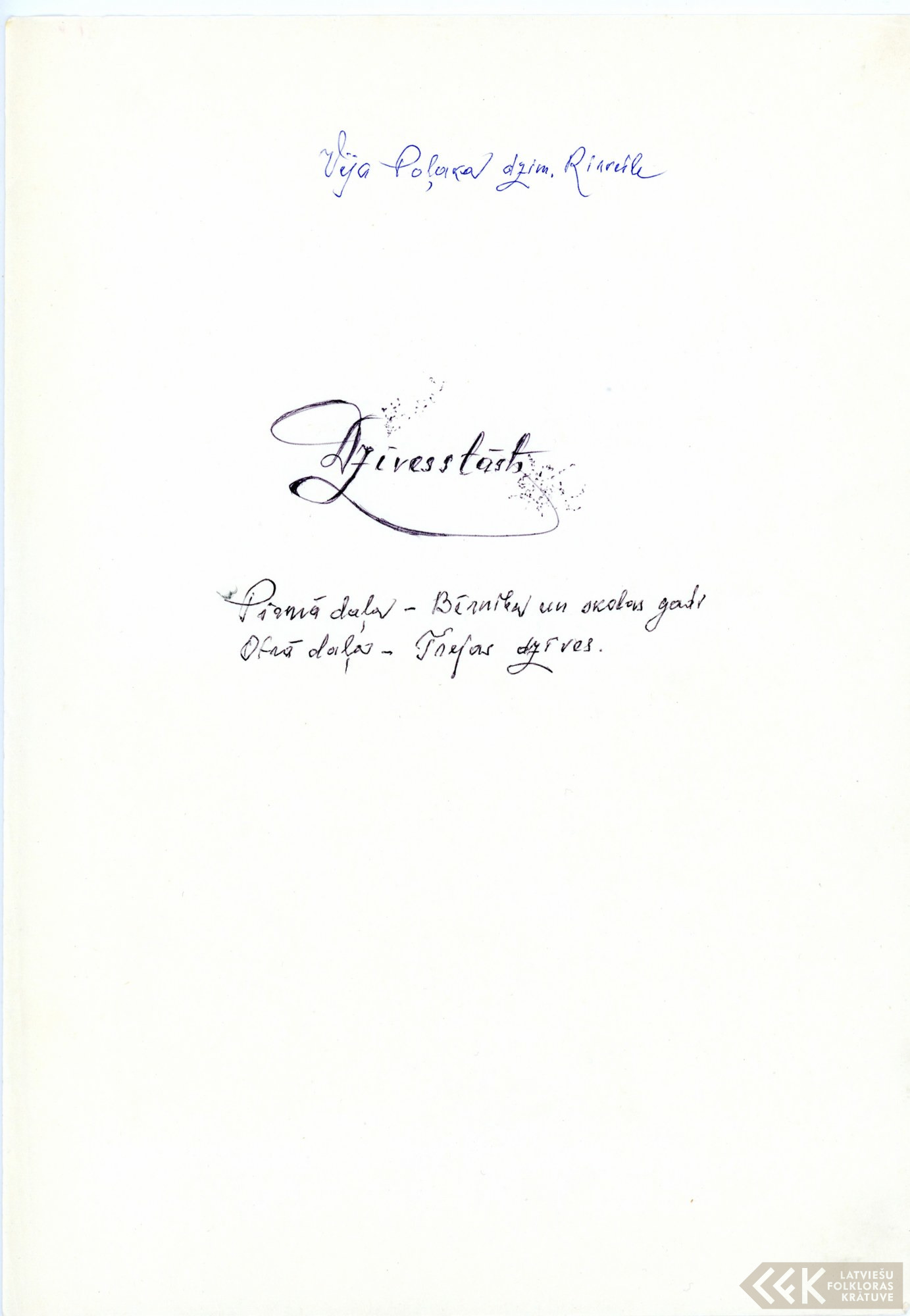
First manuscript page: Memories of Daina Rozenblate
LFK Ak 111995–1996

Memories of Daina Rozenblate

Responding to a public call heard on a radio programme, Daina has written down her memories of her childhood and youth in the 1930s-1940s, with some glimpses into the 1950s. They are dedicated to her granddaughter Lauma. Daina's memoir begins with a contemplation of her childhood spent in the Selkuļi home in Limbaži, which the author names after her favourite book at the time, Saulainais pagalms, then continues with the confusing changes of power in Latvia, the time spent in exile in Berezovka and other remote Russian villages, and ends abruptly with her return to Latvia, meeting Lauma's grandfather and reflecting on her life by interpreting a significant dream.

Author: Daina Rozenblate

Explore collectionClose details

Responding to a public call heard on a radio programme, Daina has written down her memories of her childhood and youth in the 1930s-1940s, with some glimpses into the 1950s. They are dedicated to her granddaughter Lauma. Daina's memoir begins with a contemplation of her childhood spent in the Selkuļi home in Limbaži, which the author names after her favourite book at the time, Saulainais pagalms, then continues with the confusing changes of power in Latvia, the time spent in exile in Berezovka and other remote Russian villages, and ends abruptly with her return to Latvia, meeting Lauma's grandfather and reflecting on her life by interpreting a significant dream.

Open on garamantas.lv (opens in a new tab)
LFK Ak 122000

Memories of Ruta Lūse

The memoirs of Ruta Lūse (1932–2012), former chair of the Mazsalaca Executive Committee.

Author: Ruta Lūse

Explore collectionClose details

The memoirs of Ruta Lūse (1932–2012), former chair of the Mazsalaca Executive Committee.

Open on garamantas.lv (opens in a new tab)
LFK Ak 132009

Memories of Māra Graustiņa

Māra Graustiņa’s (b. 1937) memoirs are dedicated to her children and grandchildren. They are written in 2009 and are a rich and colourful description of the day-to-day lives of Māra’s parents in the 1930s in Latvia, and the author’s own experiences during the Soviet era.

Author: Māra Graustiņa

Explore collectionClose details

Māra Graustiņa’s (b. 1937) memoirs are dedicated to her children and grandchildren. They are written in 2009 and are a rich and colourful description of the day-to-day lives of Māra’s parents in the 1930s in Latvia, and the author’s own experiences during the Soviet era.

Open on garamantas.lv (opens in a new tab)
First manuscript page: Life story of Augusts Heinrihsons
LFK Ak 141992–1996

Life story of Augusts Heinrihsons

Written in the late 1980s and early 1990s, Augusts Heinrihsons’s (1917–1996) autobiography, ‘My Unusual Life Story’, vividly portrays his childhood and youth in Latvia in the 1920s and 1930s, focusing on everyday life, experiences and joys in independent Latvia. The seemingly cheerful account in the first part of the memoir is disrupted by 1940, when the author becomes a witness to and participant in some of Latvia’s most tragic twentieth-century events. The memoir recounts the deportations of 1941 and the execution of officers, the Nazi German occupation, participation in the Second World War, the brutal Soviet filtration camps, the author’s activities as a Forest Brother, and life in the Latvian SSR in the 1940s and 1950s.

Author: Augusts Heinrihsons

Explore collectionClose details

Written in the late 1980s and early 1990s, Augusts Heinrihsons’s (1917–1996) autobiography, ‘My Unusual Life Story’, vividly portrays his childhood and youth in Latvia in the 1920s and 1930s, focusing on everyday life, experiences and joys in independent Latvia. The seemingly cheerful account in the first part of the memoir is disrupted by 1940, when the author becomes a witness to and participant in some of Latvia’s most tragic twentieth-century events. The memoir recounts the deportations of 1941 and the execution of officers, the Nazi German occupation, participation in the Second World War, the brutal Soviet filtration camps, the author’s activities as a Forest Brother, and life in the Latvian SSR in the 1940s and 1950s.

Open on garamantas.lv (opens in a new tab)
First manuscript page: Diary of Ērika Jurča
LFK Ak 151944

Diary of Ērika Jurča

Two pages from the diary of twelve-year-old Ērika Jurča (1932–1944). They describe Soviet air raids on Riga in September and October 1944.

Submitted by: Raitis Bukovskis

Explore collectionClose details

Two pages from the diary of twelve-year-old Ērika Jurča (1932–1944). They describe Soviet air raids on Riga in September and October 1944.

Open on garamantas.lv (opens in a new tab)
First manuscript page: Memories of Pēteris Treimanis
LFK Ak 161944–1950

Memories of Pēteris Treimanis

Pēteris Treimanis’s (1912–1997) memoir notebook describes his conscription into the Latvian Legion in 1944, combat and life in prisoner-of-war camps.

Author: Pēteris Treimanis

Explore collectionClose details

Pēteris Treimanis’s (1912–1997) memoir notebook describes his conscription into the Latvian Legion in 1944, combat and life in prisoner-of-war camps.

Open on garamantas.lv (opens in a new tab)
First manuscript page: Memories of Dzintars Lāzers
LFK Ak 171999–2010

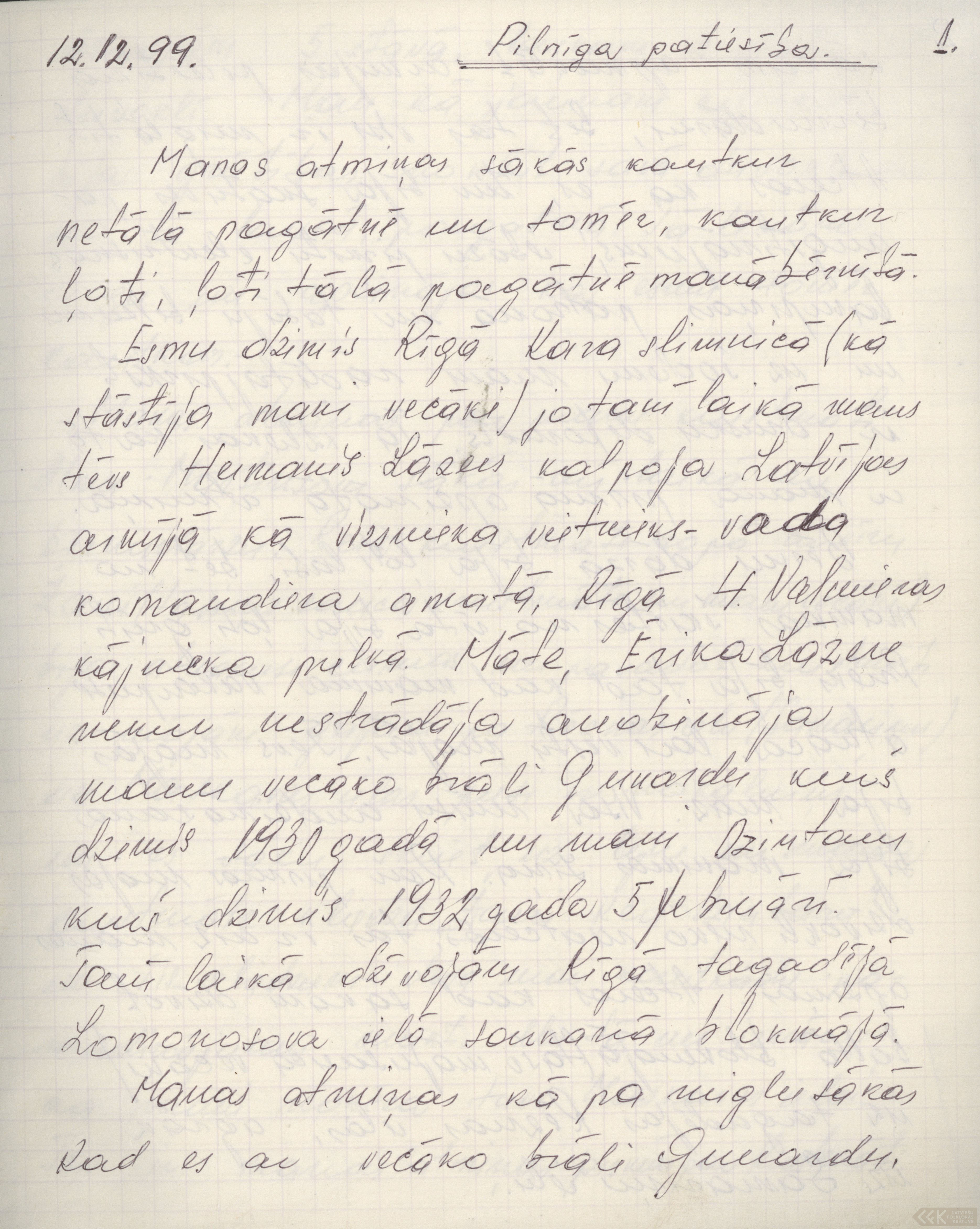
Memories of Dzintars Lāzers

The autobiography of Dzintars Lāzers, born in 1932, written between 1999 and 2010 and recounting his life experiences.

Author: Dzintars Lāzers

Explore collectionClose details

The autobiography of Dzintars Lāzers, born in 1932, written between 1999 and 2010 and recounting his life experiences.

Open on garamantas.lv (opens in a new tab)
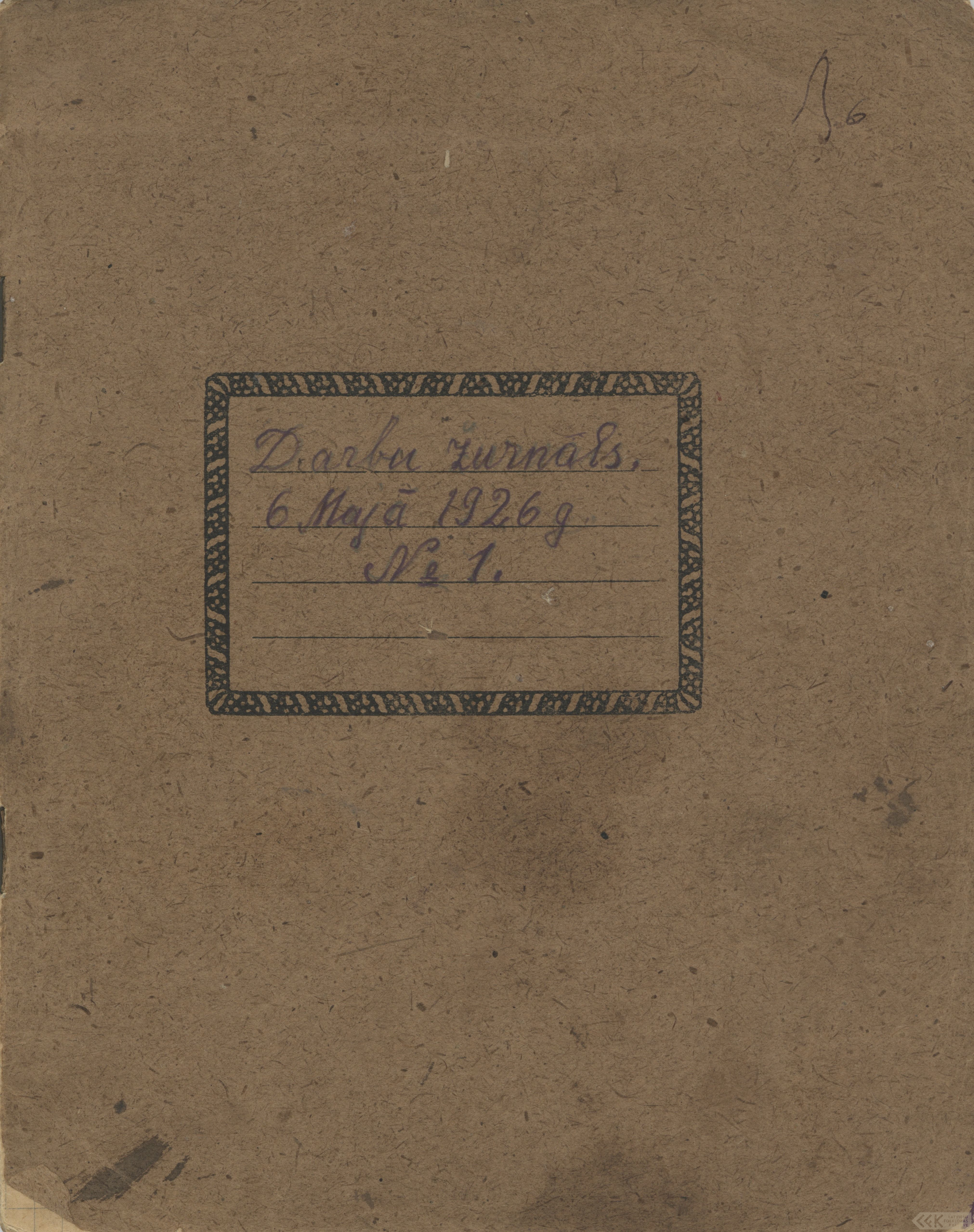
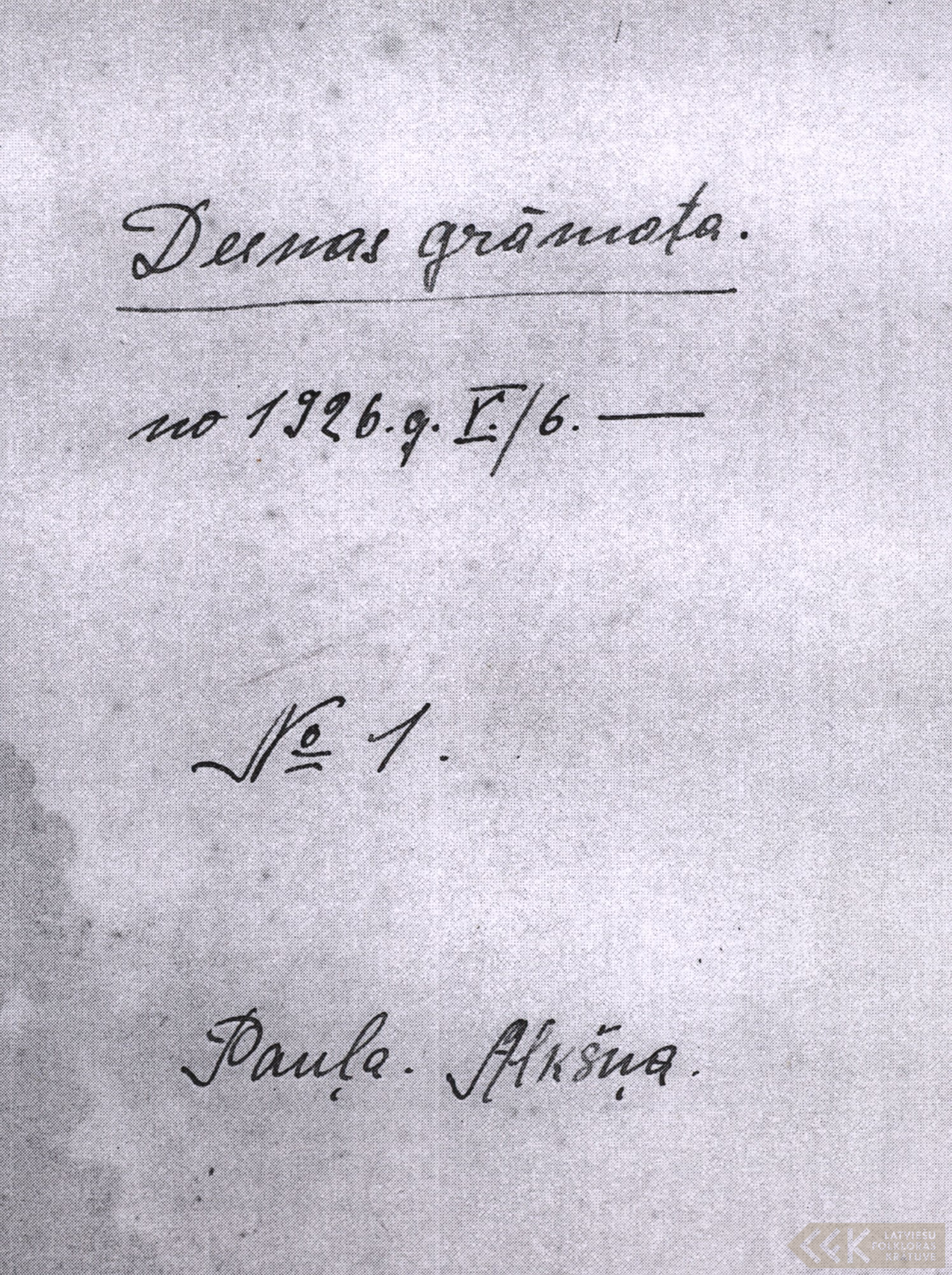
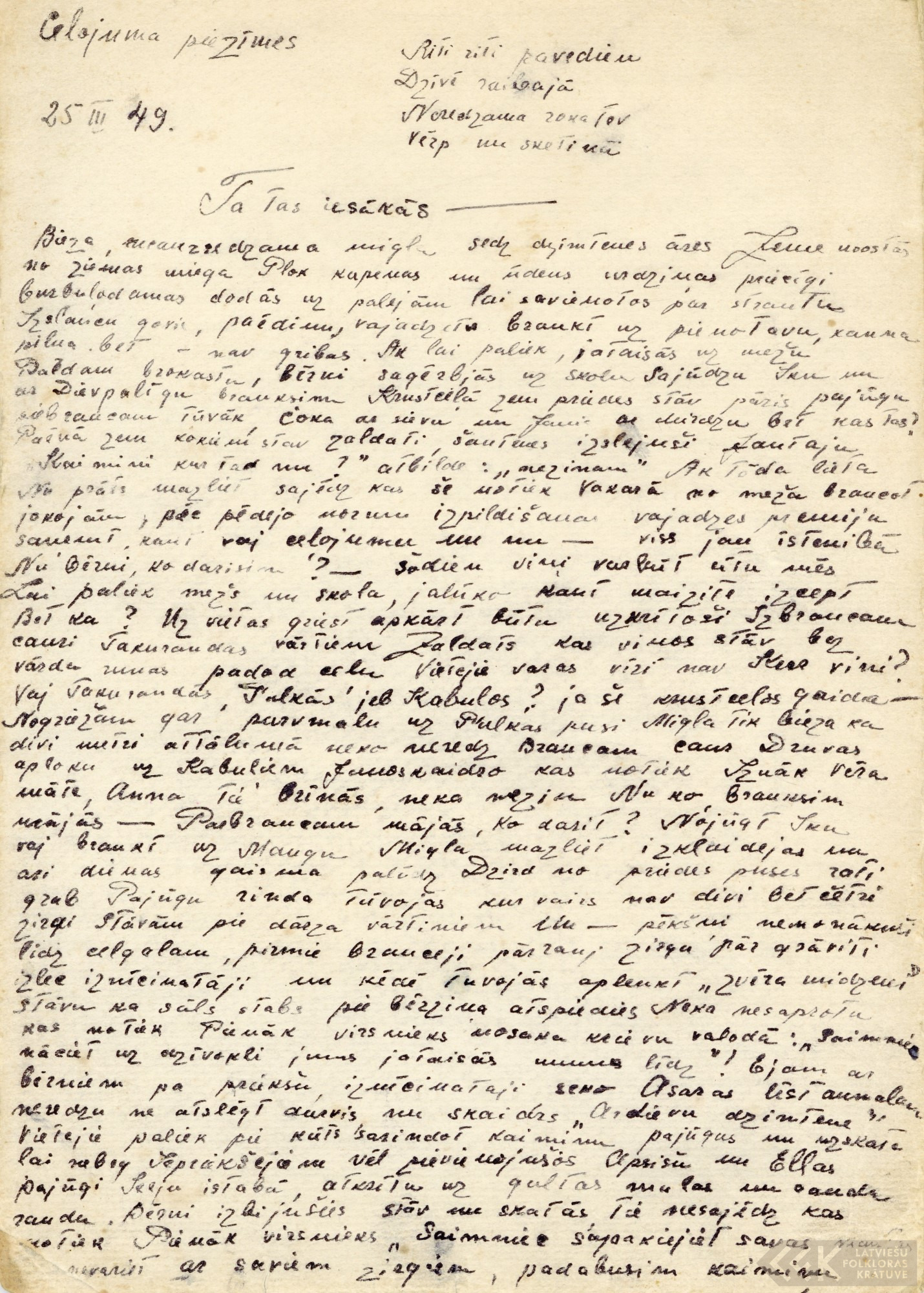
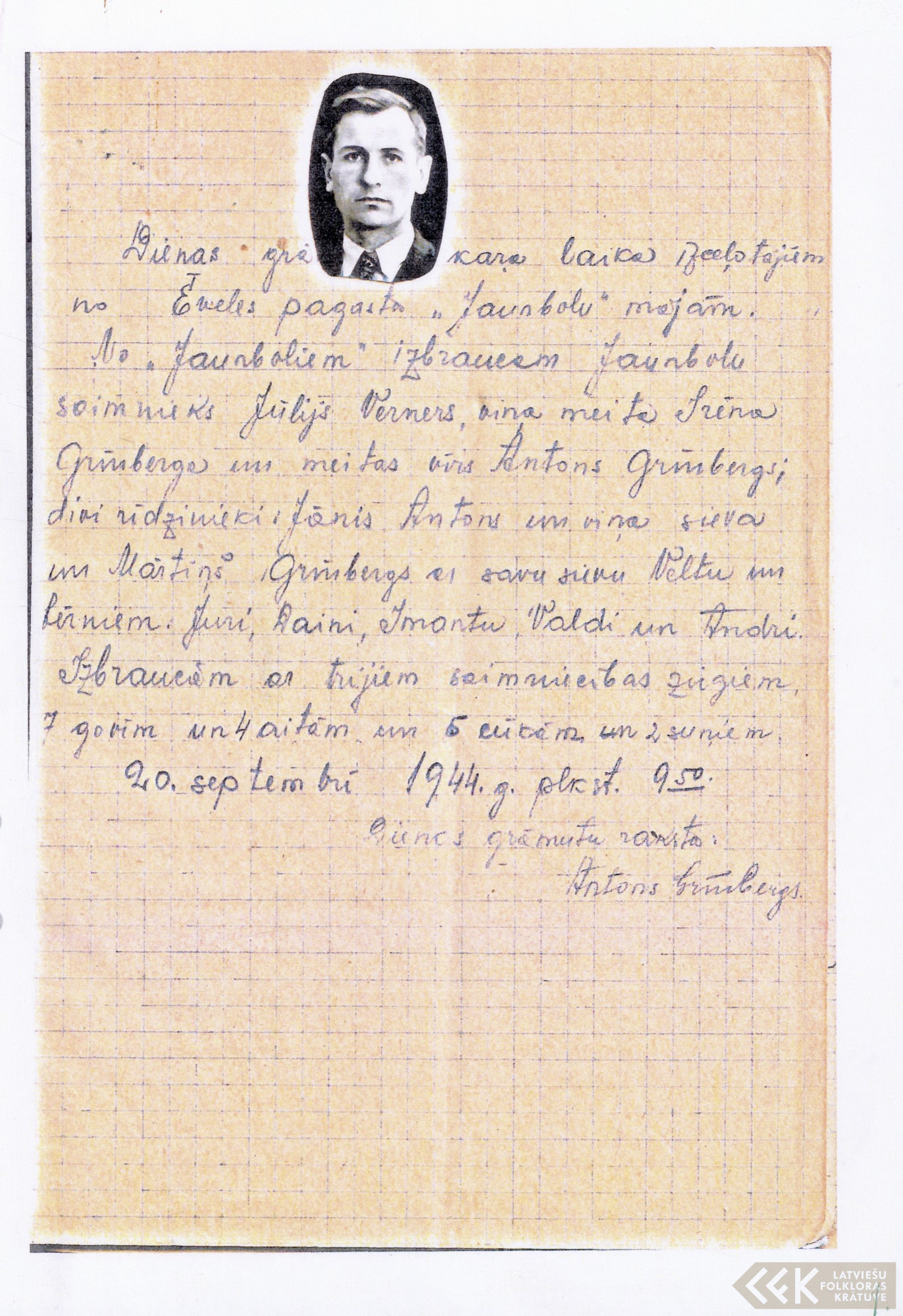
First manuscript page: Work diary and notes of Paulis Alksnis
LFK Ak 181926–1931

Work diary and notes of Paulis Alksnis

The ‘Work Journals’ of Paulis Alksnis, born in 1904 in Bauņi, Matīši parish. Written from 6 May 1926 to 1931, they document his life and farming at ‘Jaundruķi’ in Augstroze.

Author: Paulis Alksnis

Explore collectionClose details

The ‘Work Journals’ of Paulis Alksnis, born in 1904 in Bauņi, Matīši parish. Written from 6 May 1926 to 1931, they document his life and farming at ‘Jaundruķi’ in Augstroze.

Open on garamantas.lv (opens in a new tab)
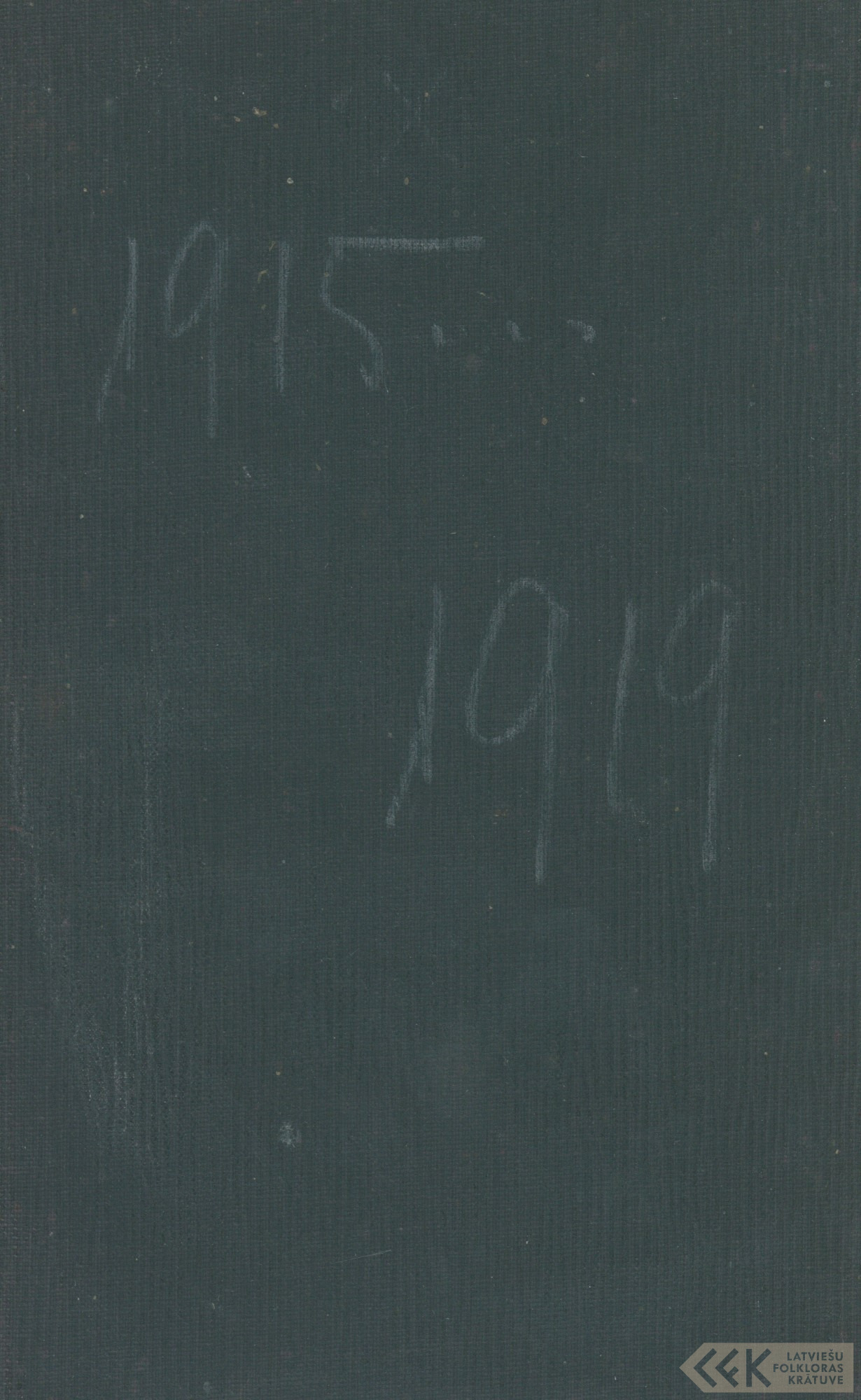
First manuscript page: Diary of an unknown man titled "Nature"
LFK Ak 191915–1919

Diary of an unknown man titled "Nature"

An unknown man’s diary entitled ‘Nature’, written in Russia between 1915 and 1919. It contains brief notes on observations of nature and outdoor activities.

Submitted by: Raimonds Briedis

Explore collectionClose details

An unknown man’s diary entitled ‘Nature’, written in Russia between 1915 and 1919. It contains brief notes on observations of nature and outdoor activities.

Open on garamantas.lv (opens in a new tab)
First manuscript page: Travel diaries of Astrīda Tobe
LFK Ak 201999–2009

Travel diaries of Astrīda Tobe

Astrīda Tobe’s diary, written from 1999 to 2009, recounts her family’s experiences while travelling around Latvia.

Author: Astrīda Tobe

Explore collectionClose details

Astrīda Tobe’s diary, written from 1999 to 2009, recounts her family’s experiences while travelling around Latvia.

Open on garamantas.lv (opens in a new tab)
First manuscript page: The country life of Uldis Ķirsis. Twitter diary
LFK Ak 212018

The country life of Uldis Ķirsis. Twitter diary

Since July 2018, Uldis Ķirsis has used his Twitter microblog to write about life after moving to the countryside. His concise, witty and perceptive observations describe a city dweller’s rural life in the twenty-first century.

Author: Uldis Ķirsis

Explore collectionClose details

Since July 2018, Uldis Ķirsis has used his Twitter microblog to write about life after moving to the countryside. His concise, witty and perceptive observations describe a city dweller’s rural life in the twenty-first century.

Open on garamantas.lv (opens in a new tab)
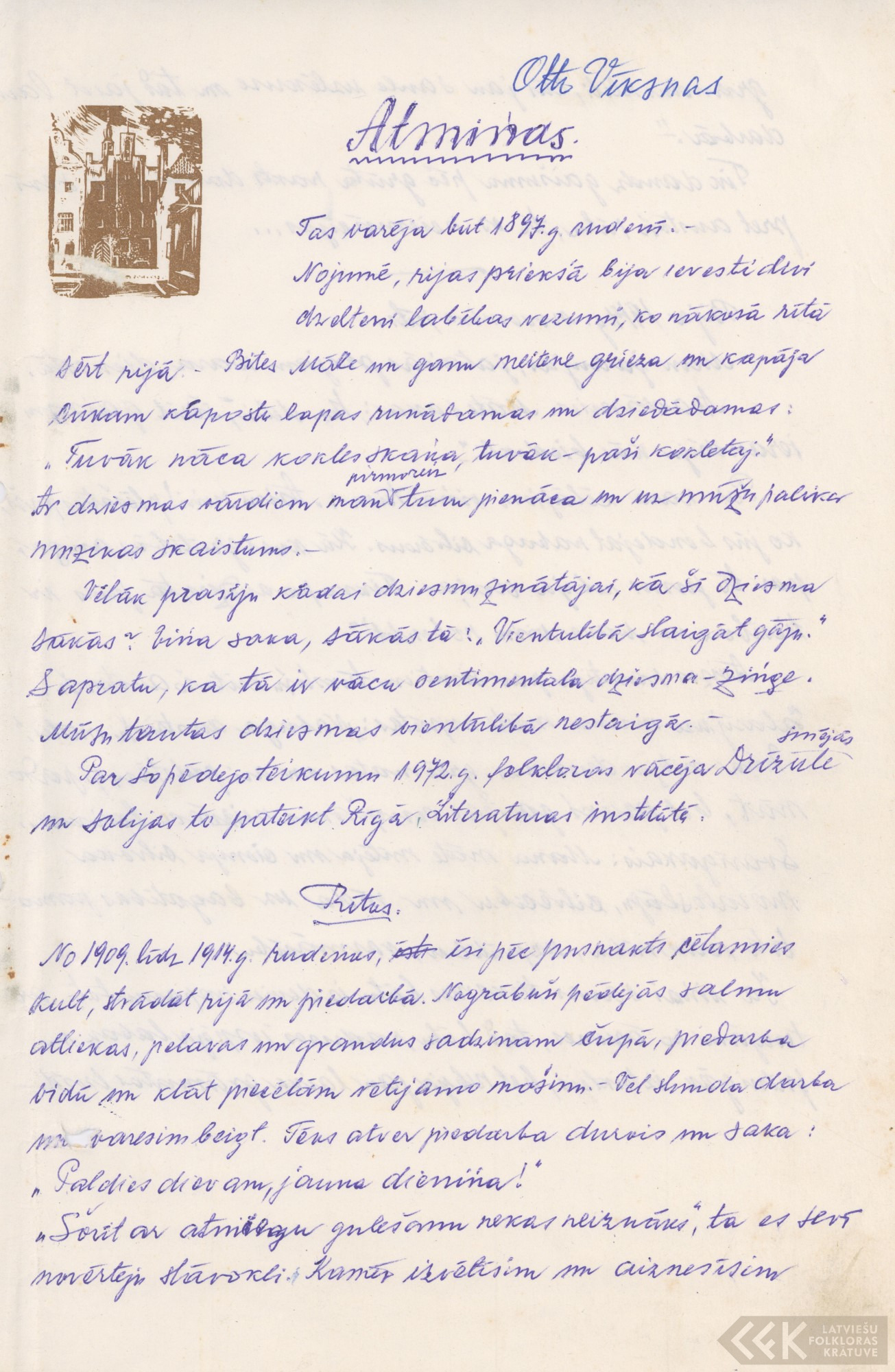
First manuscript page: Memories of Otto Vīksna
LFK Ak 221986

Memories of Otto Vīksna

In memoirs recorded in 1986, Otto Vīksna describes scenes from his childhood near Beja in detail. Structured as several stories, the account offers a broad portrayal of places, villages and their inhabitants, including Beja, Čistigi, Slišiņi and Igauņi. The stories extend well beyond Otto’s own lifetime and surroundings: alongside descriptions of his childhood home, portraits of relatives and vivid accounts of farm life, they outline the wider cultural, historical and economic circumstances of everyday farming life in northern Vidzeme in the nineteenth and twentieth centuries.

Author: Otto Vīksna

Explore collectionClose details

In memoirs recorded in 1986, Otto Vīksna describes scenes from his childhood near Beja in detail. Structured as several stories, the account offers a broad portrayal of places, villages and their inhabitants, including Beja, Čistigi, Slišiņi and Igauņi. The stories extend well beyond Otto’s own lifetime and surroundings: alongside descriptions of his childhood home, portraits of relatives and vivid accounts of farm life, they outline the wider cultural, historical and economic circumstances of everyday farming life in northern Vidzeme in the nineteenth and twentieth centuries.

Open on garamantas.lv (opens in a new tab)
LFK Ak 23From 2001

Secret diary of Elīza

Elīza, a Riga resident born in 1995, began keeping diaries in 2001, before starting school, and continues to write them. The first diary begins with colourful drawings and gradually develops, as she learns to write, into a record of everyday emotions and events.

Explore collectionClose details

Elīza, a Riga resident born in 1995, began keeping diaries in 2001, before starting school, and continues to write them. The first diary begins with colourful drawings and gradually develops, as she learns to write, into a record of everyday emotions and events.

Open on garamantas.lv (opens in a new tab)
LFK Ak 241967–1972

Diary of Viktors

Viktors was born in the 1940s, lived in Riga and described daily life in his diary from the second half of the 1960s to the early 1970s. The material was accidentally found in 2006 in "Ošiņi" in Inčukalns parish, when the new owners of the house started to look through the documents, photo albums and letters left by the previous inhabitants. Nothing more is known about the author of the diary – only that Viktor was related to the previous owners of the house.

Explore collectionClose details

Viktors was born in the 1940s, lived in Riga and described daily life in his diary from the second half of the 1960s to the early 1970s. The material was accidentally found in 2006 in "Ošiņi" in Inčukalns parish, when the new owners of the house started to look through the documents, photo albums and letters left by the previous inhabitants. Nothing more is known about the author of the diary – only that Viktor was related to the previous owners of the house.

Open on garamantas.lv (opens in a new tab)
LFK Ak 251971–1976

Diary of Astra Sleže

Astra Sleže, then Brīvmane, began her diary in 1971 as a fifteen-year-old girl in Liepāja and continued it during her studies in Jelgava. It records a young woman’s everyday concerns, relationships with peers and philosophical reflections, as well as questions about the purpose of keeping a diary.

Author: Astra Sleže

Explore collectionClose details

Astra Sleže, then Brīvmane, began her diary in 1971 as a fifteen-year-old girl in Liepāja and continued it during her studies in Jelgava. It records a young woman’s everyday concerns, relationships with peers and philosophical reflections, as well as questions about the purpose of keeping a diary.

Open on garamantas.lv (opens in a new tab)
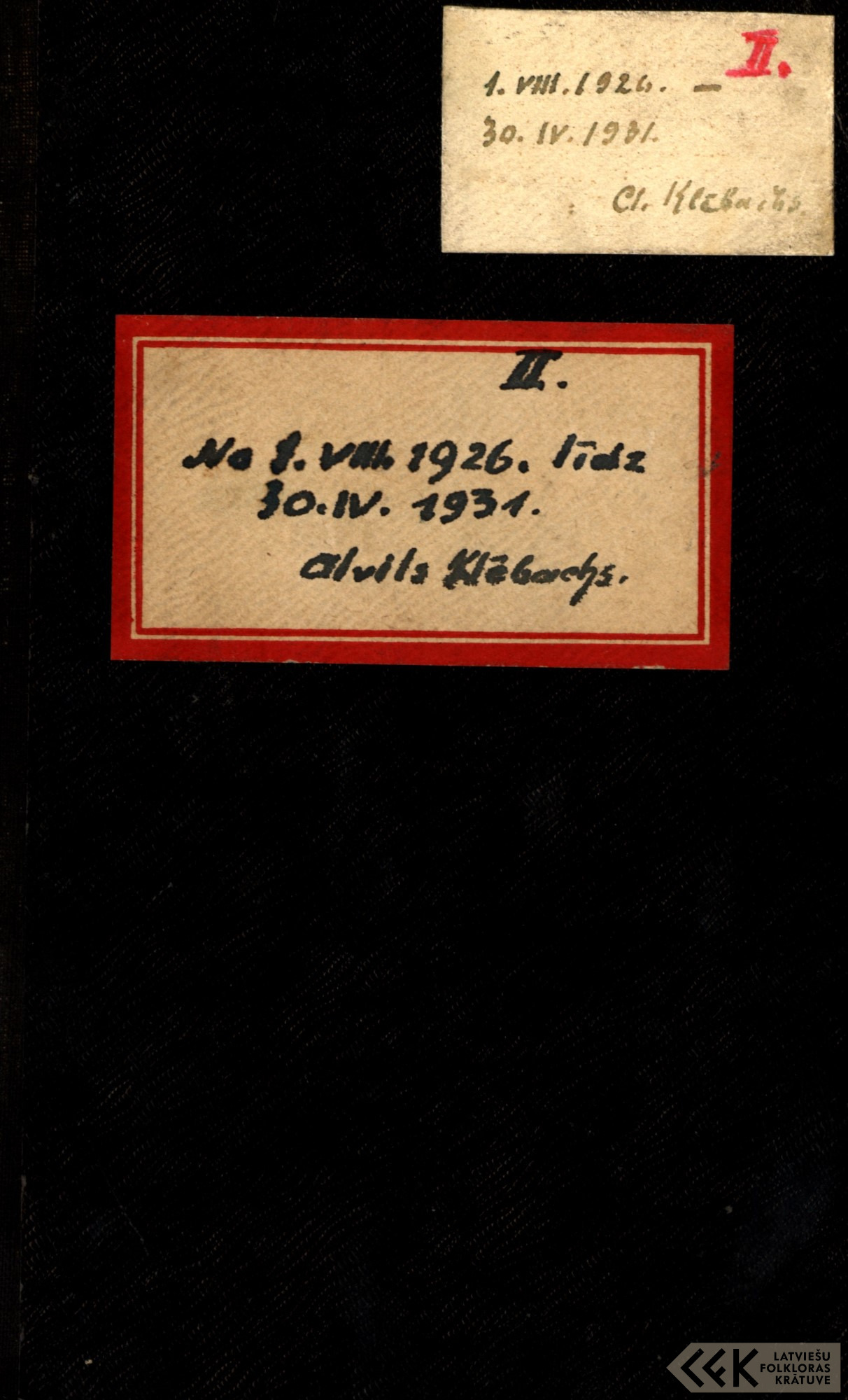
First manuscript page: Diaries of Alvils Kalnietis (Klēbahs)
LFK Ak 261926–1949

Diaries of Alvils Kalnietis (Klēbahs)

Alvils Kalnietis (Klēbahs, 1876–1958) was a teacher, an advocate for the Latvian language, a journalist and an intellectual in independent Latvia. His diaries from 1926 to 1956 record events and reflections day by day.

Author: Alvils Klēbahs

Explore collectionClose details

Alvils Kalnietis (Klēbahs, 1876–1958) was a teacher, an advocate for the Latvian language, a journalist and an intellectual in independent Latvia. His diaries from 1926 to 1956 record events and reflections day by day.

Open on garamantas.lv (opens in a new tab)
LFK Ak 272018

Diary of Rūta Šmite

Rūta documented one week of summer 2018 on her Facebook profile. The diary entries reveal the young woman's reflections on her husband's military career, social and political changes in Latvian society, her dynamic daily life in Pārdaugava with her son Miķelis, her efforts to balance her life between caring for a young child, her personal and professional interests.

Author: Rūta Šmite

Explore collectionClose details

Rūta documented one week of summer 2018 on her Facebook profile. The diary entries reveal the young woman's reflections on her husband's military career, social and political changes in Latvian society, her dynamic daily life in Pārdaugava with her son Miķelis, her efforts to balance her life between caring for a young child, her personal and professional interests.

Open on garamantas.lv (opens in a new tab)
LFK Ak 281927–1933

Diary of Lizete Strautniece

Lizete Strautniece’s diary, written between 1927 and 1933.

Author: Lizete Strautniece

Explore collectionClose details

Lizete Strautniece’s diary, written between 1927 and 1933.

Open on garamantas.lv (opens in a new tab)
First manuscript page: Diaries of Baiba Zīle
LFK Ak 291983–1992

Diaries of Baiba Zīle

Baiba Zīle’s diaries, written from 1983 to 1992, begin as written records of childhood surrounded by colourful drawings and develop into accounts of events and feelings during adolescence. Everyday life often takes literary form, with the narrative alternating between Baiba’s own creative writing and philosophical reflections.

Author: Baiba Zīle

Explore collectionClose details

Baiba Zīle’s diaries, written from 1983 to 1992, begin as written records of childhood surrounded by colourful drawings and develop into accounts of events and feelings during adolescence. Everyday life often takes literary form, with the narrative alternating between Baiba’s own creative writing and philosophical reflections.

Open on garamantas.lv (opens in a new tab)
First manuscript page: Diaries of Alfrēds Baltbārdis
LFK Ak 301948–1988

Diaries of Alfrēds Baltbārdis

Alfrēds Baltbārdis’s (1918–2003) diaries, written between 1948 and 1988.

Explore collectionClose details

Alfrēds Baltbārdis’s (1918–2003) diaries, written between 1948 and 1988.

Open on garamantas.lv (opens in a new tab)
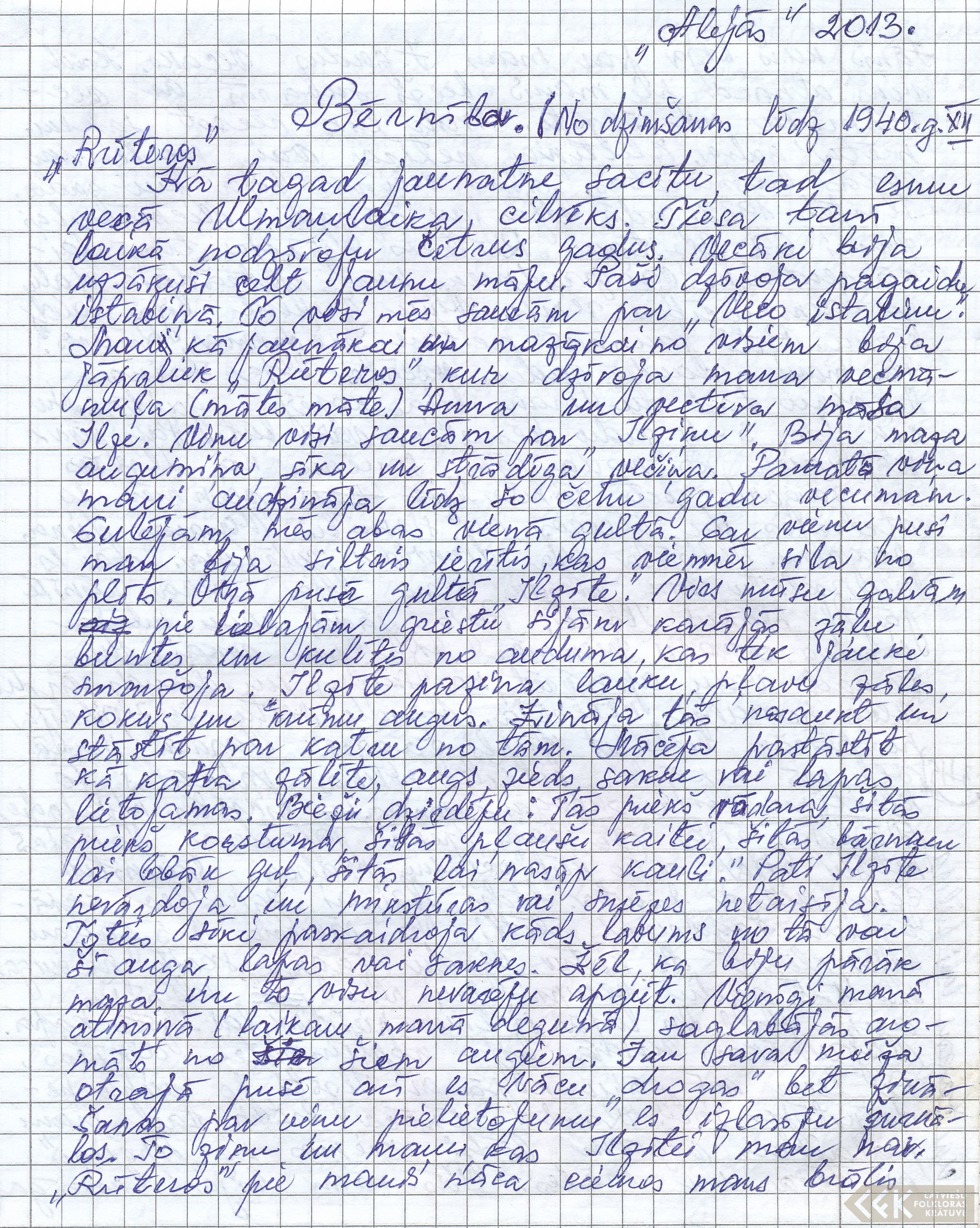
First manuscript page: Life story of Aina Rizga
LFK Ak 312013

Life story of Aina Rizga

Aina Rizga (1936–2015) of Sunākste wrote her life story in 2013. Initially intended as memories of her youth at open-air dances, it developed into a life story organised in chronological chapters.

Author: Aina Rizga

Explore collectionClose details

Aina Rizga (1936–2015) of Sunākste wrote her life story in 2013. Initially intended as memories of her youth at open-air dances, it developed into a life story organised in chronological chapters.

Open on garamantas.lv (opens in a new tab)
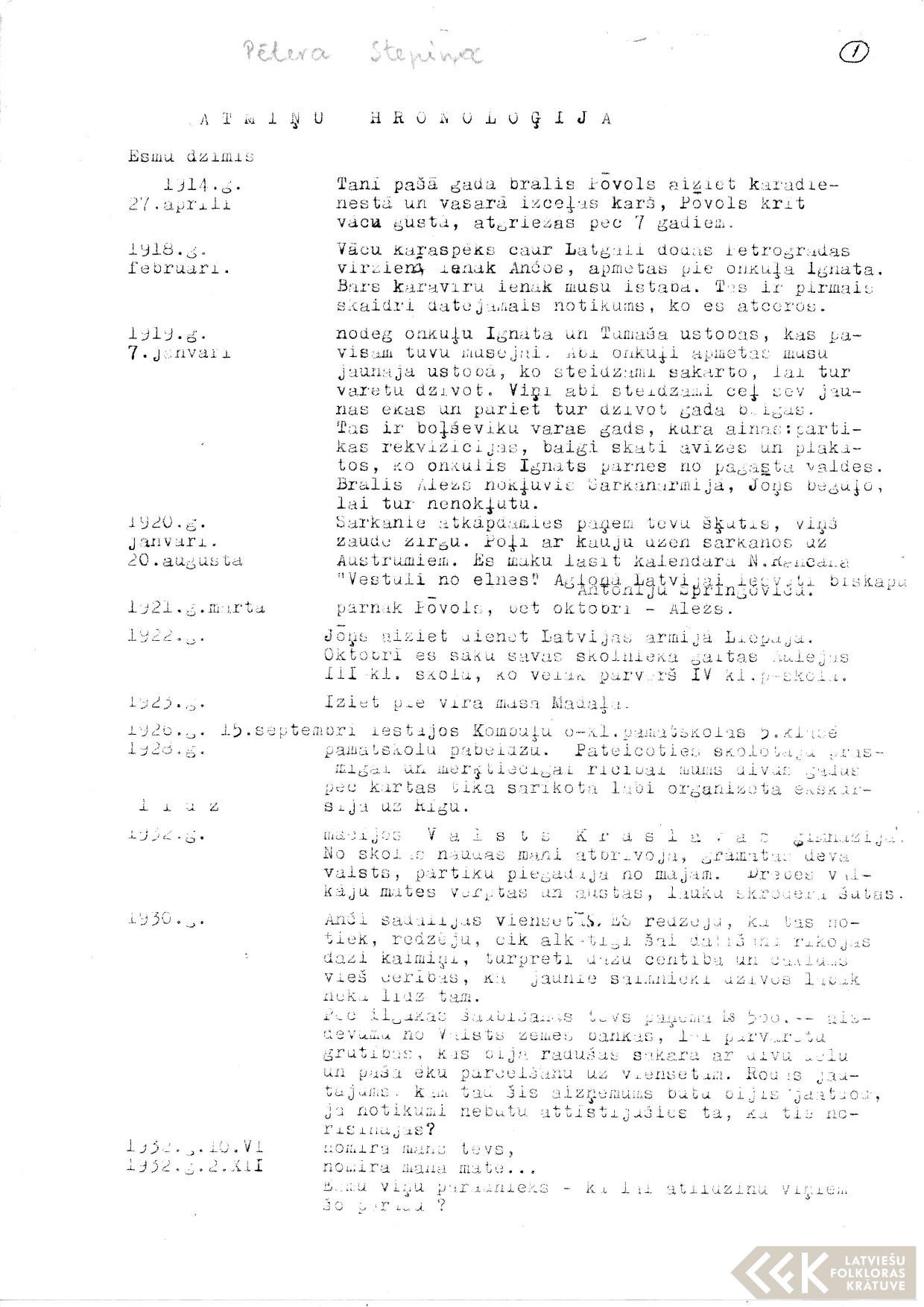
First manuscript page: Memories of Pēteris Lucāns
LFK Ak 321979–1990

Memories of Pēteris Lucāns

The memoirs of gardener Pēteris Lucāns (1900–1992), written from 1979 to 1990. They recount the history of the Lucāns family and the author’s eventful life, his years in exile and everyday life in a labour camp, his return to the Latvian SSR, his working life and his family.

Author: Pēteris Lucāns

Explore collectionClose details

The memoirs of gardener Pēteris Lucāns (1900–1992), written from 1979 to 1990. They recount the history of the Lucāns family and the author’s eventful life, his years in exile and everyday life in a labour camp, his return to the Latvian SSR, his working life and his family.

Open on garamantas.lv (opens in a new tab)
First manuscript page: Memories of Jānis Golvers
LFK Ak 331956

Memories of Jānis Golvers

Jānis Golvers’s autobiographical account, ‘Information about Our Family’, was written in 1956. The memoir relates the legend behind the Golvers family surname and describes an extensive network of relatives. It follows the author through the First World War and the Latvian War of Independence, and records a Vainiži farmer’s everyday observations, the changing seasons, the consequences of collectivisation and the family’s most tragic experiences, when some members were deported to Siberia.

Author: Jānis Golvers

Explore collectionClose details

Jānis Golvers’s autobiographical account, ‘Information about Our Family’, was written in 1956. The memoir relates the legend behind the Golvers family surname and describes an extensive network of relatives. It follows the author through the First World War and the Latvian War of Independence, and records a Vainiži farmer’s everyday observations, the changing seasons, the consequences of collectivisation and the family’s most tragic experiences, when some members were deported to Siberia.

Open on garamantas.lv (opens in a new tab)
LFK Ak 341966–1969

Diary and poetry of Gaida Mellupe

Gaida began her diaries in 1966, when she was in the seventh grade. Until 1969, she recorded her everyday life, including household and farm chores, school and events in Mazsalaca, alongside poetry she wrote herself.

Submitted by: Agita Lapsa

Explore collectionClose details

Gaida began her diaries in 1966, when she was in the seventh grade. Until 1969, she recorded her everyday life, including household and farm chores, school and events in Mazsalaca, alongside poetry she wrote herself.

Open on garamantas.lv (opens in a new tab)
LFK Ak 351981

Memories of Velta Zvanītāja

Explore collectionClose details
Open on garamantas.lv (opens in a new tab)
LFK Ak 361949–1950

Diary of Paulīne Ārgale

The diaries of Paulīne Ārgale, a home economics teacher at Jeri Primary School from 1948 to 1958, describing the everyday routines and challenges of school life.

Submitted by: Agita Lapsa

Explore collectionClose details

The diaries of Paulīne Ārgale, a home economics teacher at Jeri Primary School from 1948 to 1958, describing the everyday routines and challenges of school life.

Open on garamantas.lv (opens in a new tab)
LFK Ak 37

Diaries of Teenager Ēriks in 1970s

Born in 1965 in Riga, Eriks describes his daily life and reflections in the late 1970s and early 1980s. The diary traces the gradual transformation of Erik's personality from a fourth-grade student into a young man with a thirst for adventure. This change can be read in the vocabulary used by the young people of the time, in their current interests and in the dynamics of the relationships between the teenagers, their teachers and other adults. Erik kept his diary regularly, documenting events and experiences, not so much his inner world of feelings.

Explore collectionClose details

Born in 1965 in Riga, Eriks describes his daily life and reflections in the late 1970s and early 1980s. The diary traces the gradual transformation of Erik's personality from a fourth-grade student into a young man with a thirst for adventure. This change can be read in the vocabulary used by the young people of the time, in their current interests and in the dynamics of the relationships between the teenagers, their teachers and other adults. Erik kept his diary regularly, documenting events and experiences, not so much his inner world of feelings.

Open on garamantas.lv (opens in a new tab)
First manuscript page: Memories of Jānis Valters Čoks
LFK Ak 381992–1994

Memories of Jānis Valters Čoks

Jānis Valters Čoka’s (1927–1989) recollections of the summer of 1940 were written in the 1950s. He describes a summer spent at ‘Kangari’ near Mazsalaca, tending a garden for the Mazpulki youth organisation. The memoir offers a romantic account of his youth, carefree days and first love.

Author: Jānis Valters Čoka

Explore collectionClose details

Jānis Valters Čoka’s (1927–1989) recollections of the summer of 1940 were written in the 1950s. He describes a summer spent at ‘Kangari’ near Mazsalaca, tending a garden for the Mazpulki youth organisation. The memoir offers a romantic account of his youth, carefree days and first love.

Open on garamantas.lv (opens in a new tab)
LFK Ak 392016–2017

Granny's stories

In 2016 and 2017, Madara compiled the written memories of her grandmother Rasma, born in 1929, in the blog ‘Grandma’s Stories’.

Submitted by: Madara Strauta

Explore collectionClose details

In 2016 and 2017, Madara compiled the written memories of her grandmother Rasma, born in 1929, in the blog ‘Grandma’s Stories’.

Open on garamantas.lv (opens in a new tab)
LFK Ak 401940–1996

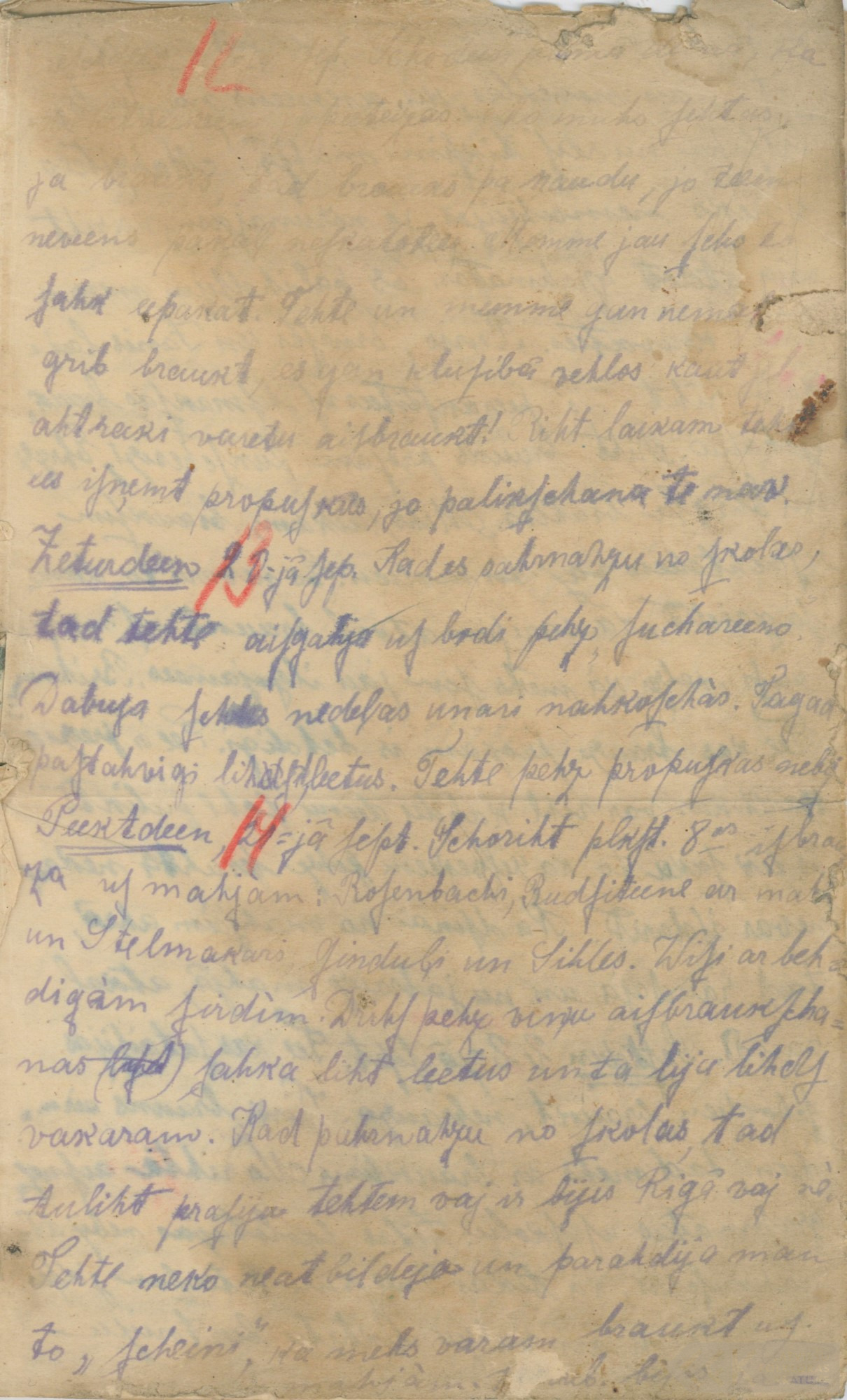
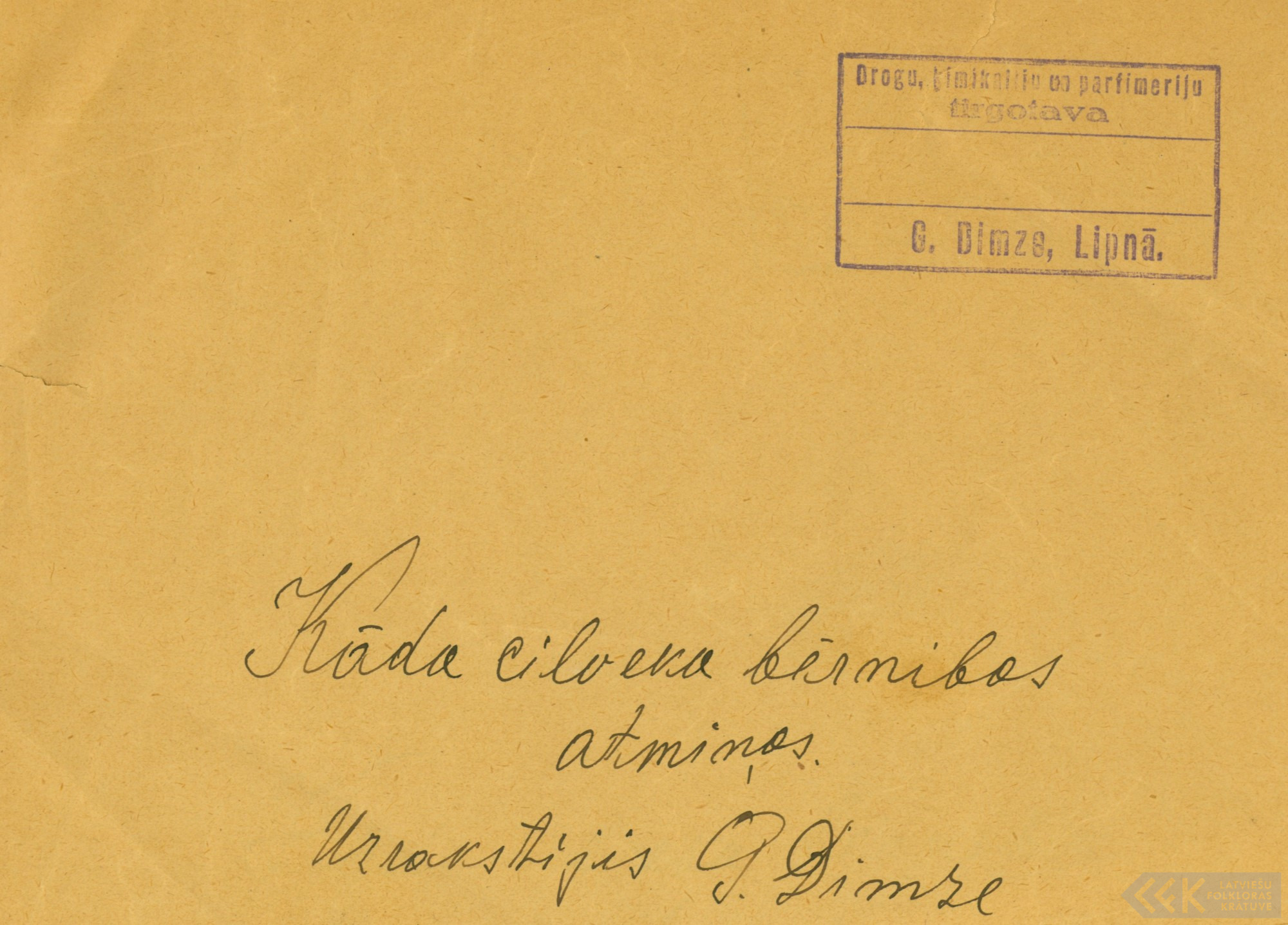
Diary and memories of Vilma Heinrihsone
The collection consists of two parts: Vilma Valentīne Heinrihsone’s (1918–2011) diary entries from 1940, and memoirs written in the 1980s and 1990s about the Second World War and its aftermath.

Author: Vilma Valentīne Heinrihsone
Explore collectionClose details

The collection consists of two parts: Vilma Valentīne Heinrihsone’s (1918–2011) diary entries from 1940, and memoirs written in the 1980s and 1990s about the Second World War and its aftermath.
Open on garamantas.lv (opens in a new tab)
LFK Ak 412001

Memories of Marianna Vecaine

Explore collectionClose details
Open on garamantas.lv (opens in a new tab)
LFK Ak 421954–1960

Memories and diary of Ņina Ozoliņa

Explore collectionClose details
Open on garamantas.lv (opens in a new tab)
First manuscript page: Diaries of Miķelis Tupesis
LFK Ak 431944–1968

Diaries of Miķelis Tupesis

The diary covers a broad span of time and a wide range of experiences. It is primarily rooted in the author’s personal journey during the Second World War and the post-war years as a refugee in Germany, yet a significant portion of the text consists of retrospective childhood and youth memories of life in Latvia before the war. The early part of the diary focuses on the refugee experience, life in various camps, adapting to unfamiliar environments, and longing for home. Later entries shift toward deeply personal recollections of childhood in the Nīca region and everyday life between the two world wars.

Author: Miķelis Tupesis

Explore collectionClose details

The diary covers a broad span of time and a wide range of experiences. It is primarily rooted in the author’s personal journey during the Second World War and the post-war years as a refugee in Germany, yet a significant portion of the text consists of retrospective childhood and youth memories of life in Latvia before the war. The early part of the diary focuses on the refugee experience, life in various camps, adapting to unfamiliar environments, and longing for home. Later entries shift toward deeply personal recollections of childhood in the Nīca region and everyday life between the two world wars.

Open on garamantas.lv (opens in a new tab)
LFK Ak 442007

Memories of Laimons Upmalis

Explore collectionClose details
Open on garamantas.lv (opens in a new tab)
LFK Ak 452001

Memories of Jānis Pirtnieks

Explore collectionClose details
Open on garamantas.lv (opens in a new tab)
LFK Ak 461997

Memories of Antoņina Brasla

The memoir begins in 1940, when little Antoņina lives in a small village of Latgale region, and witnesses the changes brought about by the USSR in Latvia and the repression of the local population. The writing also goes back to the 1940s, 1950s and 1960s, when Antoņina experiences the confusing changes of repressive political regimes in Latvia, followed by exile, life in Omsk, her return to Latvia and attempts to restart her life.

Explore collectionClose details

The memoir begins in 1940, when little Antoņina lives in a small village of Latgale region, and witnesses the changes brought about by the USSR in Latvia and the repression of the local population. The writing also goes back to the 1940s, 1950s and 1960s, when Antoņina experiences the confusing changes of repressive political regimes in Latvia, followed by exile, life in Omsk, her return to Latvia and attempts to restart her life.

Open on garamantas.lv (opens in a new tab)
LFK Ak 471927–1996

Diaries of Kaspars Irbe

Explore collectionClose details
Open on garamantas.lv (opens in a new tab)
LFK Ak 481968

Memories of Cēzars Aleksis

Cēzars Aleksis’s (1895–1976) memoirs recount his childhood and schooling, studies at the Pskov surveying school and work as a military topographer. They also describe his involvement in the Troitsk Battalion and life as a forester in newly independent Latvia up to 1925. A separate chapter is devoted to his family and the fates of his relatives.

Submitted by: Māra Zirnīte

Explore collectionClose details

Cēzars Aleksis’s (1895–1976) memoirs recount his childhood and schooling, studies at the Pskov surveying school and work as a military topographer. They also describe his involvement in the Troitsk Battalion and life as a forester in newly independent Latvia up to 1925. A separate chapter is devoted to his family and the fates of his relatives.

Open on garamantas.lv (opens in a new tab)
LFK Ak 491948

Memories of Jānis Auzenbahs

Written in 1948, Jānis Auzenbahs’s (1896–1948) memoirs bring together a family chronicle and his own life story: childhood, fighting in the First World War, an injury, life as a teacher and a new smallholder in independent Latvia, and the events of the Second World War.

Submitted by: Filips Bobinskis

Explore collectionClose details

Written in 1948, Jānis Auzenbahs’s (1896–1948) memoirs bring together a family chronicle and his own life story: childhood, fighting in the First World War, an injury, life as a teacher and a new smallholder in independent Latvia, and the events of the Second World War.

Open on garamantas.lv (opens in a new tab)
First manuscript page: Diary of Lija Blūma
LFK Ak 501965–1971

Diary of Lija Blūma

The diaries of poet and journalist Lija Blūma (born 1953).

Submitted by: Lija Blūma

Explore collectionClose details

The diaries of poet and journalist Lija Blūma (born 1953).

Open on garamantas.lv (opens in a new tab)
First manuscript page: Diaries of Arvīds Fēlikss Latsons
LFK Ak 511944–1945

Diaries of Arvīds Fēlikss Latsons

Arvīds Fēlikss Latsons’s (1897–1945) diaries, written in 1944 and 1945, record his experiences as a refugee and trace his journey from Omuļi parish to the Fischbach refugee camp.

Submitted by: Maija Razumovska

Explore collectionClose details

Arvīds Fēlikss Latsons’s (1897–1945) diaries, written in 1944 and 1945, record his experiences as a refugee and trace his journey from Omuļi parish to the Fischbach refugee camp.

Open on garamantas.lv (opens in a new tab)
LFK Ak 521993–1997

Life story of Aleksandra Eihe

Aleksandra Eihe’s (1905–2002) life story was written in the 1990s. She looks back on her childhood in Siberia, her youth in Latvia and her adult life, which she spent in exile in Sweden.

Submitted by: Māra Zirnīte

Explore collectionClose details

Aleksandra Eihe’s (1905–2002) life story was written in the 1990s. She looks back on her childhood in Siberia, her youth in Latvia and her adult life, which she spent in exile in Sweden.

Open on garamantas.lv (opens in a new tab)
LFK Ak 532011–2012

Elina's Adventures in Samara

Elīna Vilmane-Meženiece’s blog about volunteering in Samara, Russia, in 2011–2012.

Submitted by: Elīna Vilmane-Meženiece

Explore collectionClose details

Elīna Vilmane-Meženiece’s blog about volunteering in Samara, Russia, in 2011–2012.

Open on garamantas.lv (opens in a new tab)
First manuscript page: Diary of Mirga Iveta Kuļikovska
LFK Ak 541941–1944

Diary of Mirga Iveta Kuļikovska

Mirga Iveta Kuļikovska’s (1927–1997) diary was written from 1941 to 1944. A schoolgirl at the time, she describes life under Nazi occupation, including the war, classmates, studies and growing up.

Submitted by: Ēriks Kuļikovskis

Explore collectionClose details

Mirga Iveta Kuļikovska’s (1927–1997) diary was written from 1941 to 1944. A schoolgirl at the time, she describes life under Nazi occupation, including the war, classmates, studies and growing up.

Open on garamantas.lv (opens in a new tab)
First manuscript page: Memories of Velta Vītola
LFK Ak 551970–1990

Memories of Velta Vītola

Velta Vītola’s (1903–2002) memoirs, written between the 1970s and 1990s, recount her childhood in Moscow, her youth in Latvia, her studies at the Moscow Academy of Arts and her work as a teacher in various Latvian schools. The account symbolically concludes in 1937, when she marries.

Submitted by: Irēna Zaščerinska

Explore collectionClose details

Velta Vītola’s (1903–2002) memoirs, written between the 1970s and 1990s, recount her childhood in Moscow, her youth in Latvia, her studies at the Moscow Academy of Arts and her work as a teacher in various Latvian schools. The account symbolically concludes in 1937, when she marries.

Open on garamantas.lv (opens in a new tab)
First manuscript page: Memories of Jēkabs Millers
LFK Ak 561923–1937

Memories of Jēkabs Millers

Jēkabs was born in 1878 and wrote down his memoirs "Avotu" home chronicle" in 1951 in Braslava parish. It begins with the death of the first owner of the house, Kārlis Millers, the time when the will was drawn up in 1906 and the conditions for the redistribution of the inheritance to family members, as well as the value of the house at that time. Jēkabs then records in detail the changes that affected the family home from year to year after his father's death: The chronicle ends with the 1930s and a brief mention of the 1940s.

Explore collectionClose details

Jēkabs was born in 1878 and wrote down his memoirs "Avotu" home chronicle" in 1951 in Braslava parish. It begins with the death of the first owner of the house, Kārlis Millers, the time when the will was drawn up in 1906 and the conditions for the redistribution of the inheritance to family members, as well as the value of the house at that time. Jēkabs then records in detail the changes that affected the family home from year to year after his father's death: The chronicle ends with the 1930s and a brief mention of the 1940s.

Open on garamantas.lv (opens in a new tab)
LFK Ak 572000–2004

Memories of Uldis Pudelis

Uldis Pudelis’s (1929–2016) recollections of childhood in Mazsalaca parish in the 1930s and of everyday life and work as an agronomist in the Soviet Union.

Submitted by: Juris Pudelis

Explore collectionClose details

Uldis Pudelis’s (1929–2016) recollections of childhood in Mazsalaca parish in the 1930s and of everyday life and work as an agronomist in the Soviet Union.

Open on garamantas.lv (opens in a new tab)
First manuscript page: Memories of Kārlis Kreicmanis
LFK Ak 581980–1983

Memories of Kārlis Kreicmanis

Kārlis Kreicmanis’s (1903–1984) recollections of the ‘Bēkas’ homestead, Ķoņi and the Rūjiena area during the First and Second World Wars.

Submitted by: Agita Lapsa

Explore collectionClose details

Kārlis Kreicmanis’s (1903–1984) recollections of the ‘Bēkas’ homestead, Ķoņi and the Rūjiena area during the First and Second World Wars.

Open on garamantas.lv (opens in a new tab)
First manuscript page: Memories of Aleksandrs Kudiņš
LFK Ak 591996

Memories of Aleksandrs Kudiņš

Aleksandrs Kudiņš’s (1919–2004) memoirs cover his entire life. They recount his childhood in a Latgalian village in Siberia, his education, everyday life in the USSR in the 1920s and 1930s, the Second World War and his work as a teacher in the Latvian SSR after the war.

Submitted by: Skaidrīte Kudiņa

Explore collectionClose details

Aleksandrs Kudiņš’s (1919–2004) memoirs cover his entire life. They recount his childhood in a Latgalian village in Siberia, his education, everyday life in the USSR in the 1920s and 1930s, the Second World War and his work as a teacher in the Latvian SSR after the war.

Open on garamantas.lv (opens in a new tab)
LFK Ak 601965–2000

Diaries of Juris Zariņš

Submitted by: Juris Zariņš

Explore collectionClose details
Open on garamantas.lv (opens in a new tab)
LFK Ak 611995–1996

Miniatures of Ziedones Sērmūkšas Memories

Ziedone Sērmūkša’s memoir miniatures form a literary life story about her childhood in independent Latvia, a young musician’s dreams and hopes, Latvian musical and theatrical circles after the Second World War, and the Soviet literary world and the particular challenges of translation.

Submitted by: Ziedone Sērmūkša

Explore collectionClose details

Ziedone Sērmūkša’s memoir miniatures form a literary life story about her childhood in independent Latvia, a young musician’s dreams and hopes, Latvian musical and theatrical circles after the Second World War, and the Soviet literary world and the particular challenges of translation.

Open on garamantas.lv (opens in a new tab)
LFK Ak 622007–2008

Extracts from text messaging between Viesturs and Inna

Explore collectionClose details
Open on garamantas.lv (opens in a new tab)
LFK Ak 631998

Memories of Anna Millere

Explore collectionClose details
Open on garamantas.lv (opens in a new tab)
First manuscript page: Voyage diary
LFK Ak 641959

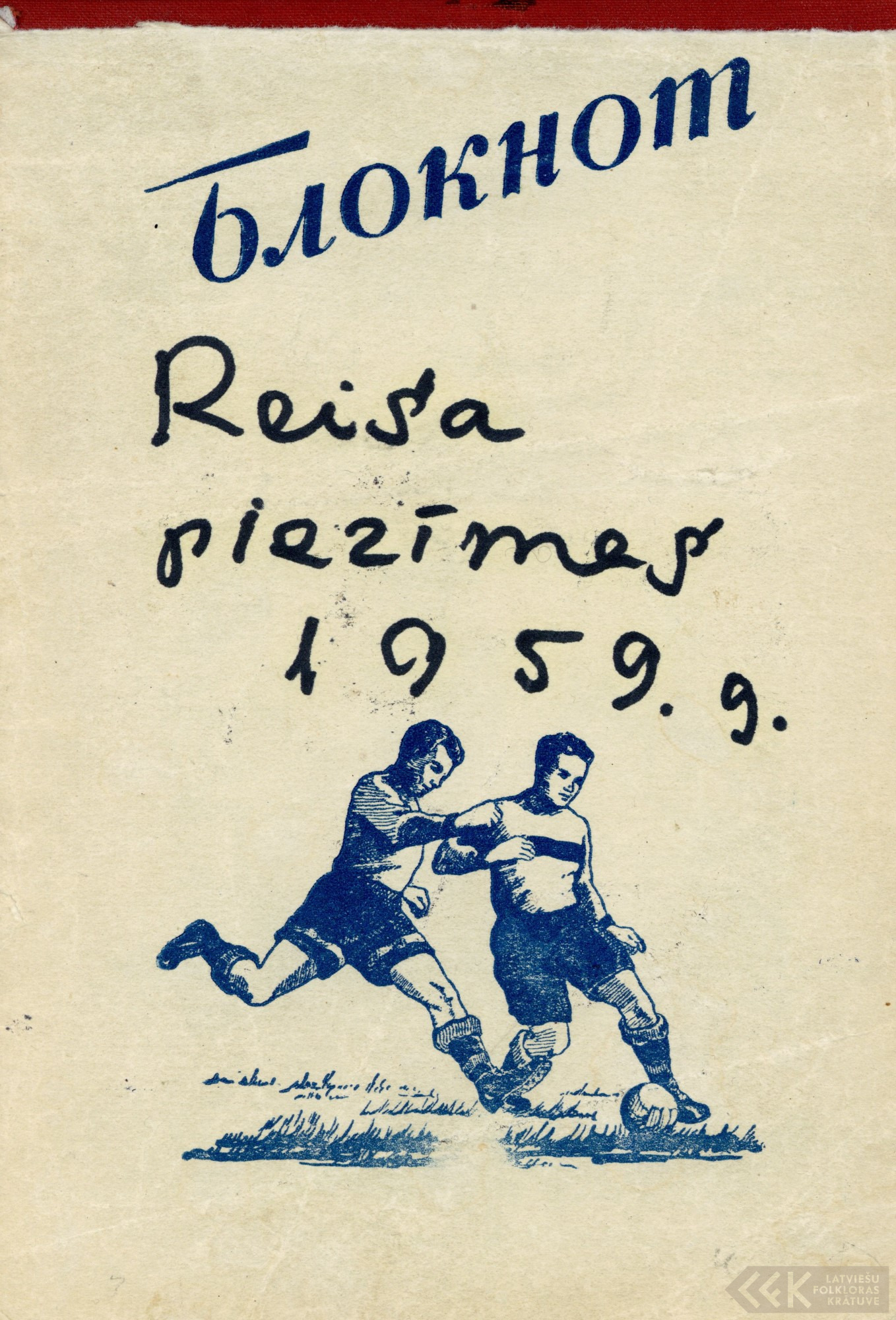
Voyage diary

The authors of ‘Voyage Notes’ are three researchers, Kārlis, Sašs and Andis, graduates of the University of Latvia Faculty of Biology who were recruited from different laboratories for a research voyage in the Baltic Sea in December 1959. From the outset, they expected long passages with little research work, while winter conditions would prevent them from enjoying the sea views. They would have to spend long periods in cramped cabins, struggling with seasickness. To make daily life on board more interesting, Sašs suggested keeping a collective diary.

Submitted by: Andis Mitāns

Explore collectionClose details

The authors of ‘Voyage Notes’ are three researchers, Kārlis, Sašs and Andis, graduates of the University of Latvia Faculty of Biology who were recruited from different laboratories for a research voyage in the Baltic Sea in December 1959. From the outset, they expected long passages with little research work, while winter conditions would prevent them from enjoying the sea views. They would have to spend long periods in cramped cabins, struggling with seasickness. To make daily life on board more interesting, Sašs suggested keeping a collective diary.

Open on garamantas.lv (opens in a new tab)
First manuscript page: Diary of Žanis Tālbergs from time in Kolyma
LFK Ak 661946–1947

Diary of Žanis Tālbergs from time in Kolyma

Žanis Tālbergs’s diary, written in a labour camp in Kolyma, records events from May to November 1946. It documents harsh everyday life, working conditions, meals and daily routines. These stark accounts alternate with romantic dreams of his homeland and returning home.

Explore collectionClose details

Žanis Tālbergs’s diary, written in a labour camp in Kolyma, records events from May to November 1946. It documents harsh everyday life, working conditions, meals and daily routines. These stark accounts alternate with romantic dreams of his homeland and returning home.

Open on garamantas.lv (opens in a new tab)
First manuscript page: Diaries of Betija Grava
LFK Ak 671917–1965

Diaries of Betija Grava

Betija Grava’s (1902–1995) diaries were written at different times: the earliest dates from 1917 and the latest from the late 1960s.

Submitted by: Inese Tuka

Explore collectionClose details

Betija Grava’s (1902–1995) diaries were written at different times: the earliest dates from 1917 and the latest from the late 1960s.

Open on garamantas.lv (opens in a new tab)
First manuscript page: A diary of unknown man from 1941 to 1942
LFK Ak 681941–1942

A diary of unknown man from 1941 to 1942

Explore collectionClose details
Open on garamantas.lv (opens in a new tab)
First manuscript page: Memories of Georgs Dimze
LFK Ak 691920–1921

Memories of Georgs Dimze

Explore collectionClose details
Open on garamantas.lv (opens in a new tab)
LFK Ak 701917–1921

Memories of Lilija Auzenbaha

Lilija Auzenbaha’s (1898–1973) memoir recounts her family’s flight from their home in Lestene parish to Riga in 1915, and from Riga to Vidzeme in 1917. The young woman’s notes were written in Valka in 1917 and 1921. They offer detailed accounts of refugees’ everyday lives and feelings during their journeys.

Submitted by: Filips Bobinskis

Explore collectionClose details

Lilija Auzenbaha’s (1898–1973) memoir recounts her family’s flight from their home in Lestene parish to Riga in 1915, and from Riga to Vidzeme in 1917. The young woman’s notes were written in Valka in 1917 and 1921. They offer detailed accounts of refugees’ everyday lives and feelings during their journeys.

Open on garamantas.lv (opens in a new tab)
LFK Ak 712005–2006

Memories of Vineta Beltiņa

Vineta Beltiņa’s memoirs were written in the early twenty-first century, looking back on her life. She reflects on her childhood and her parents’ work on the Pārgauja collective farm, her schooling and working life, and her various relationships and experiences of love.

Explore collectionClose details

Vineta Beltiņa’s memoirs were written in the early twenty-first century, looking back on her life. She reflects on her childhood and her parents’ work on the Pārgauja collective farm, her schooling and working life, and her various relationships and experiences of love.

Open on garamantas.lv (opens in a new tab)
First manuscript page: Notes by Kārlis Svensons
LFK Ak 721910–1931

Notes by Kārlis Svensons

Part of the material recorded by Kārlis Svensons (1884–1964) throughout his life: quotations, poems, copied passages of literature and translation exercises. This extensive material was compiled by his grandson Andris after Svensons’s death. There are more than one hundred notebooks; in three of them, the author recounts his own life, from his parents’ marriage in Sweden in the late nineteenth century to his final years in Latvia in the 1950s and 1960s.

Submitted by: Agita Lapsa

Explore collectionClose details

Part of the material recorded by Kārlis Svensons (1884–1964) throughout his life: quotations, poems, copied passages of literature and translation exercises. This extensive material was compiled by his grandson Andris after Svensons’s death. There are more than one hundred notebooks; in three of them, the author recounts his own life, from his parents’ marriage in Sweden in the late nineteenth century to his final years in Latvia in the 1950s and 1960s.

Open on garamantas.lv (opens in a new tab)
First manuscript page: Diary of Valmiera Business School students
LFK Ak 731937–1939

Diary of Valmiera Business School students

The diary was written in 1937–1938 in Valmiera by schoolgirls of the Valmiera Commercial School, who called themselves "Savējās" ("The Ours"). The idea to start the diary emerged collectively during a German language class, as a way to record the "romantic adventures" of school life and to document both real and imagined events. Writing the diary soon became a unifying project that strengthened their sense of belonging and served as a means of self-expression.

Explore collectionClose details

The diary was written in 1937–1938 in Valmiera by schoolgirls of the Valmiera Commercial School, who called themselves "Savējās" ("The Ours"). The idea to start the diary emerged collectively during a German language class, as a way to record the "romantic adventures" of school life and to document both real and imagined events. Writing the diary soon became a unifying project that strengthened their sense of belonging and served as a means of self-expression.

Open on garamantas.lv (opens in a new tab)
LFK Ak 741996–2014

Memoirs of Silvija Grēniņa-Priedniece

The collection contains autobiographical writings by Silvija Priedniece, née Grēniņa, begun in the 1990s: an autobiographical account covering her entire life, alongside diary entries recording everyday events from 1995 onwards.

Explore collectionClose details

The collection contains autobiographical writings by Silvija Priedniece, née Grēniņa, begun in the 1990s: an autobiographical account covering her entire life, alongside diary entries recording everyday events from 1995 onwards.

Open on garamantas.lv (opens in a new tab)
LFK Ak 751919–1926

Diary of Margarēta Grosvalde

Explore collectionClose details
Open on garamantas.lv (opens in a new tab)
First manuscript page: Diary of Emīlija Vecvagare
LFK Ak 761917–1922

Diary of Emīlija Vecvagare

Emīlija Vecvagare worked as a secretary in the Provisional Government’s office and kept her diary from 21 July 1917 to 31 December 1921. It is rich in the young woman’s personal feelings and observations of events in Liepāja. Particularly noteworthy are the entries describing the coup in Liepāja on 16 April 1919, during the Latvian War of Independence.

Explore collectionClose details

Emīlija Vecvagare worked as a secretary in the Provisional Government’s office and kept her diary from 21 July 1917 to 31 December 1921. It is rich in the young woman’s personal feelings and observations of events in Liepāja. Particularly noteworthy are the entries describing the coup in Liepāja on 16 April 1919, during the Latvian War of Independence.

Open on garamantas.lv (opens in a new tab)
LFK Ak 771965–1968

Diaries and letters of Mārtiņš Engīzers

Explore collectionClose details
Open on garamantas.lv (opens in a new tab)
First manuscript page: Diary of Gunārs Viļums
LFK Ak 781971–1977

Diary of Gunārs Viļums

The diary of woodworking engineer and educator Gunārs Viļums (1945–1989), entitled ‘With a Shotgun and a Fishing Rod’. Written from 1971 to 1977, it records hunting and fishing adventures.

Submitted by: Ieva Pauloviča

Explore collectionClose details

The diary of woodworking engineer and educator Gunārs Viļums (1945–1989), entitled ‘With a Shotgun and a Fishing Rod’. Written from 1971 to 1977, it records hunting and fishing adventures.

Open on garamantas.lv (opens in a new tab)
First manuscript page: Diary of Baložu family
LFK Ak 791951–1977

Diary of Baložu family

Diary entries written in Līgatne in 1951 describe the birth and childhood of Egita Balode-Logina’s father. Notes written there in 1975 document Egita’s own arrival in the family, portraying her parents’ feelings as they raise their first child.

Explore collectionClose details

Diary entries written in Līgatne in 1951 describe the birth and childhood of Egita Balode-Logina’s father. Notes written there in 1975 document Egita’s own arrival in the family, portraying her parents’ feelings as they raise their first child.

Open on garamantas.lv (opens in a new tab)
First manuscript page: Journey through 6 Republics. The Diary
LFK Ak 801964

Journey through 6 Republics. The Diary

From 16 July to 9 August 1964, a group of tourists from Latvia travelled through six Soviet republics: Russia, Ukraine, Moldova, Belarus, Lithuania and Latvia. They recorded their experiences and observations in a shared diary.

Submitted by: Ojārs Lāms

Explore collectionClose details

From 16 July to 9 August 1964, a group of tourists from Latvia travelled through six Soviet republics: Russia, Ukraine, Moldova, Belarus, Lithuania and Latvia. They recorded their experiences and observations in a shared diary.

Open on garamantas.lv (opens in a new tab)
First manuscript page: Diaries of Andrejs Pablo Mierkalns
LFK Ak 811954–1959

Diaries of Andrejs Pablo Mierkalns

The diaries and notes of poet Andrejs Pablo Mierkalns, written in 1954 and 1959.

Submitted by: Rolands Lappuķe

Explore collectionClose details

The diaries and notes of poet Andrejs Pablo Mierkalns, written in 1954 and 1959.

Open on garamantas.lv (opens in a new tab)
First manuscript page: Diary of Natālija Draudziņa Gymnasium schoolgirls
LFK Ak 821949–1951

Diary of Natālija Draudziņa Gymnasium schoolgirls

Submitted by: Zane Lāce

Explore collectionClose details
Open on garamantas.lv (opens in a new tab)
First manuscript page: Shadows of the Past by Artūrs Krūms
LFK Ak 831954

Shadows of the Past by Artūrs Krūms

Artūrs Krūms’s recollections of eleven women in his life, written in 1954 under the title ‘Shadows of the Past’.

Submitted by: Ainārs Radovics

Explore collectionClose details

Artūrs Krūms’s recollections of eleven women in his life, written in 1954 under the title ‘Shadows of the Past’.

Open on garamantas.lv (opens in a new tab)
First manuscript page: Life story of Jānis Dāvis
LFK Ak 841950–1953

Life story of Jānis Dāvis

Jānis Dāvis was born in 1891 in Vestiena situated in the Vidzeme Central Upland of Latvia. The author has titled his life story "The life of one Latvian farmer’s son (Sort of an autobiography)". The first part of it begins with a compilation about his ancestors who had lived in the regions of Vestiena and nearby Piebalga for decades and ends with the year 1944, when Dāvis family had to become refugees. Material has been written from 1950 to 1953.

Explore collectionClose details

Jānis Dāvis was born in 1891 in Vestiena situated in the Vidzeme Central Upland of Latvia. The author has titled his life story "The life of one Latvian farmer’s son (Sort of an autobiography)". The first part of it begins with a compilation about his ancestors who had lived in the regions of Vestiena and nearby Piebalga for decades and ends with the year 1944, when Dāvis family had to become refugees. Material has been written from 1950 to 1953.

Open on garamantas.lv (opens in a new tab)
First manuscript page: Diary of Velta Sproģe
LFK Ak 851922–1963

Diary of Velta Sproģe

The diary of ceramic artist and long-serving Liepāja Theatre employee Velta Sproģe (1902–1997), written in the 1920s and 1930s and resumed after a break in 1955. It records everyday events and experiences until 1963.

Explore collectionClose details

The diary of ceramic artist and long-serving Liepāja Theatre employee Velta Sproģe (1902–1997), written in the 1920s and 1930s and resumed after a break in 1955. It records everyday events and experiences until 1963.

Open on garamantas.lv (opens in a new tab)
First manuscript page: Memories of Nikolajs Brīvlauks
LFK Ak 861999

Memories of Nikolajs Brīvlauks

Photographer Nikolajs Brīvlauks’s (1928–2003) recollections of the end of the Second World War, when, aged just sixteen, he was conscripted into air defence service and became involved in the war.

Explore collectionClose details

Photographer Nikolajs Brīvlauks’s (1928–2003) recollections of the end of the Second World War, when, aged just sixteen, he was conscripted into air defence service and became involved in the war.

Open on garamantas.lv (opens in a new tab)
LFK Ak 871910–1926

Diary of Kārlis Zemdega

Explore collectionClose details
Open on garamantas.lv (opens in a new tab)
LFK Ak 881826–1837

Diary of Anna Koch

The German-language diary of Baltic German Anna Koch, covering the periods 1826–1837 and 1863–1864.

Explore collectionClose details

The German-language diary of Baltic German Anna Koch, covering the periods 1826–1837 and 1863–1864.

Open on garamantas.lv (opens in a new tab)
First manuscript page: Diaries of Jānis Sudmalis
LFK Ak 891939–1981

Diaries of Jānis Sudmalis

The diaries of artist Jānis Sudmalis (1887–1984), founder and long-serving director of Liepāja Museum. The first diary was written in 1939–1940; the next available diary dates from 1973 and is followed by regular daily entries until 1981.

Explore collectionClose details

The diaries of artist Jānis Sudmalis (1887–1984), founder and long-serving director of Liepāja Museum. The first diary was written in 1939–1940; the next available diary dates from 1973 and is followed by regular daily entries until 1981.

Open on garamantas.lv (opens in a new tab)
First manuscript page: Diary in the cash book of "Vecsētas"
LFK Ak 90

Diary in the cash book of "Vecsētas"

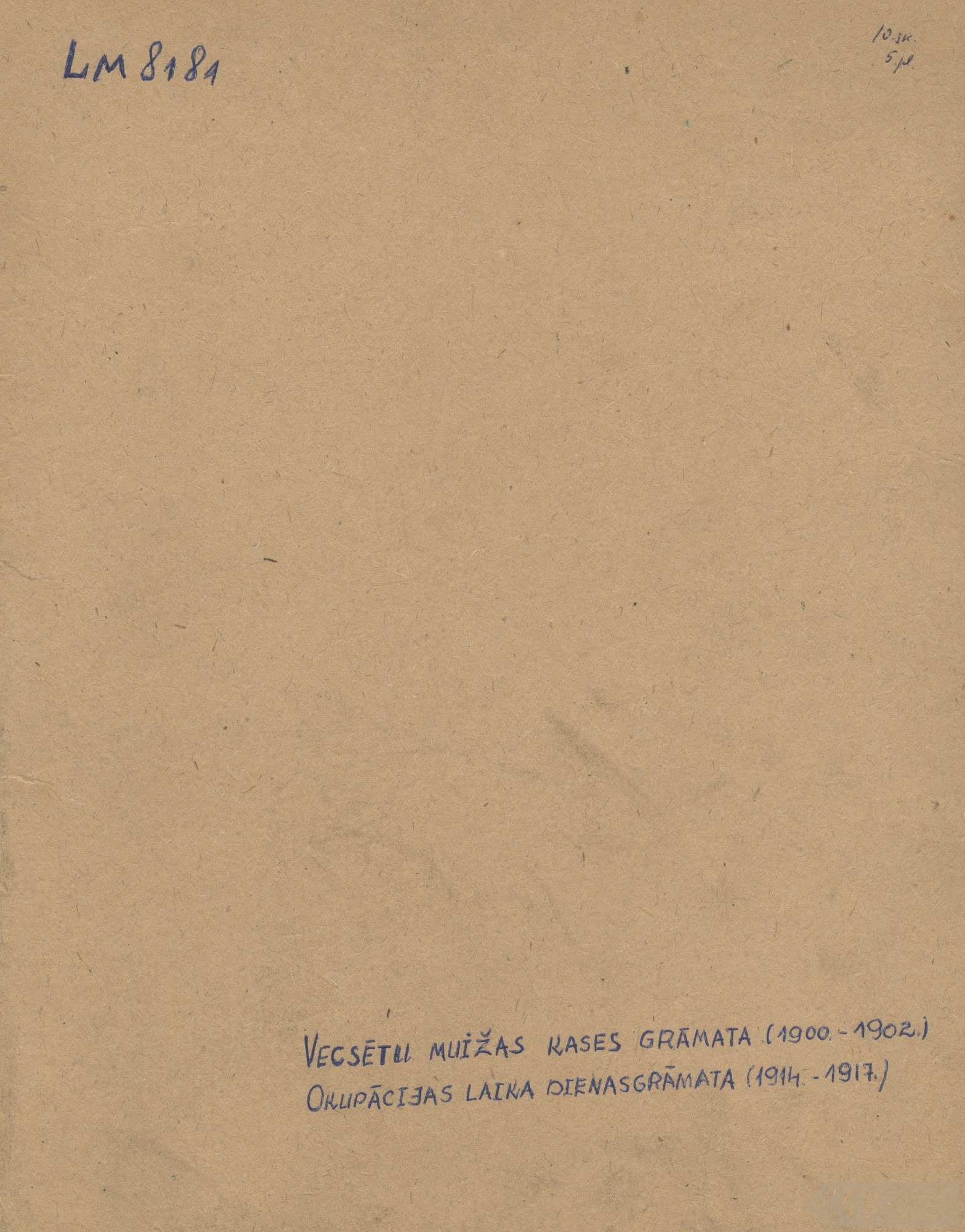
The Vecsētas manor cash book (1900–1902) contains not only records of various expenses, but also unrelated everyday notes written by an unidentified person in Russian and Latvian between 1914 and 1917.

Explore collectionClose details

The Vecsētas manor cash book (1900–1902) contains not only records of various expenses, but also unrelated everyday notes written by an unidentified person in Russian and Latvian between 1914 and 1917.

Open on garamantas.lv (opens in a new tab)
LFK Ak 912016–2019

Memories of Andis Mitāns

Andis Mitāns divides his autobiographical reflections into nine thematic parts, each representing a significant aspect of his personal development, family history, or broader historical context: 1) Museums and Personal Memory; 2) A Symbolic Map from “National Geographic”; 3) Young Naturalists’ Club; 4) The Arrival of Ballpoint Pens in Soviet Schools; 5) Remembering a Modest Classmate; 6) Message to Grandchildren About Latvia’s Path to Independence; 7) The Baltic Sea and Diplomatic Tactics; 8) Life on Tērbatas Street (1940–1980).

Submitted by: Andis Mitāns

Explore collectionClose details

Andis Mitāns divides his autobiographical reflections into nine thematic parts, each representing a significant aspect of his personal development, family history, or broader historical context: 1) Museums and Personal Memory; 2) A Symbolic Map from “National Geographic”; 3) Young Naturalists’ Club; 4) The Arrival of Ballpoint Pens in Soviet Schools; 5) Remembering a Modest Classmate; 6) Message to Grandchildren About Latvia’s Path to Independence; 7) The Baltic Sea and Diplomatic Tactics; 8) Life on Tērbatas Street (1940–1980).

Open on garamantas.lv (opens in a new tab)
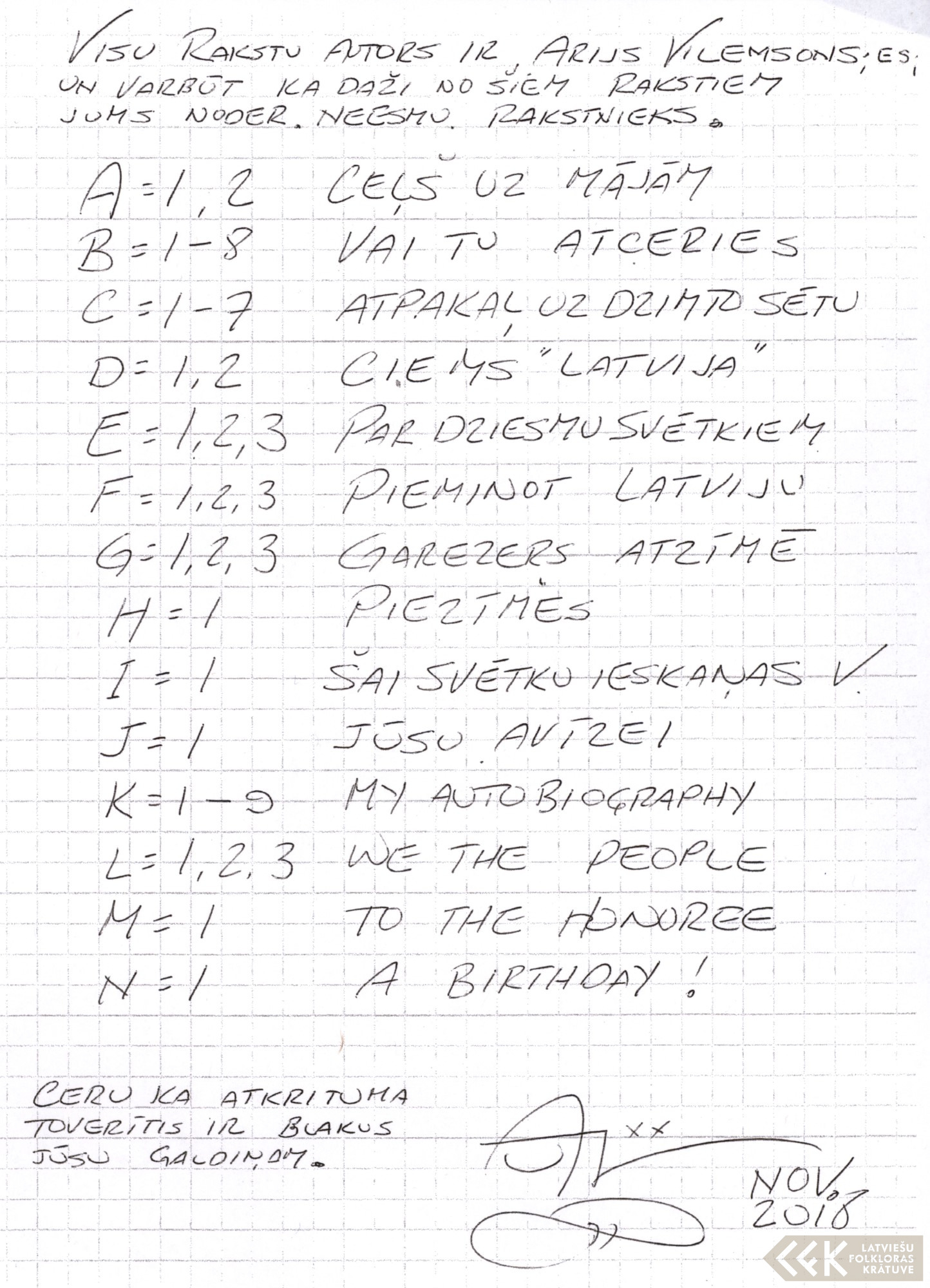
First manuscript page: Writings of Arijs Vilsemsons
LFK Ak 921995–2018

Writings of Arijs Vilsemsons

Explore collectionClose details
Open on garamantas.lv (opens in a new tab)
First manuscript page: Diary of R. Āboliņš
LFK Ak 931941

Diary of R. Āboliņš

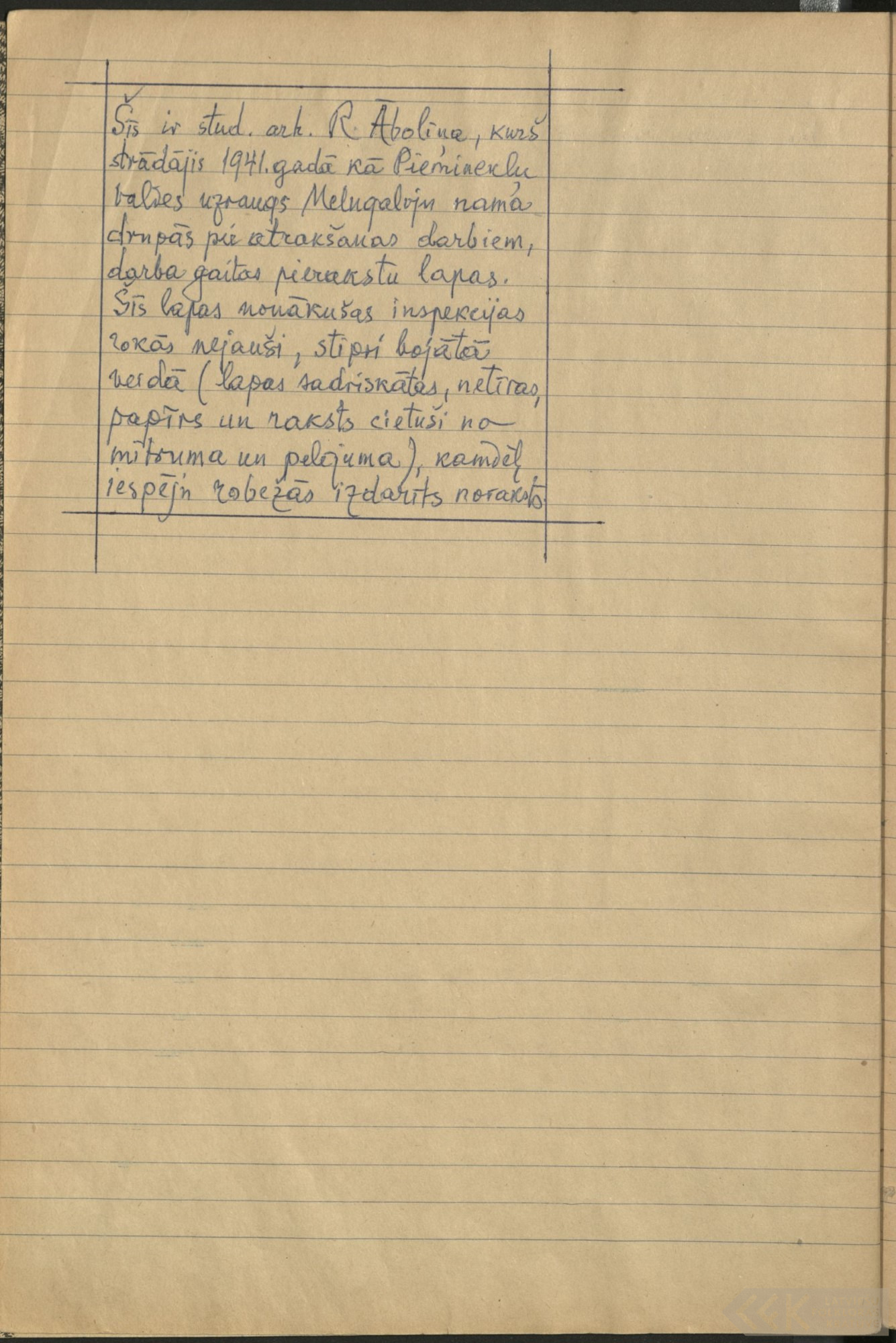
Architecture student R. Āboliņš’s notes on the excavation of the ruins of the war-damaged House of the Black Heads in 1941.

Explore collectionClose details

Architecture student R. Āboliņš’s notes on the excavation of the ruins of the war-damaged House of the Black Heads in 1941.

Open on garamantas.lv (opens in a new tab)
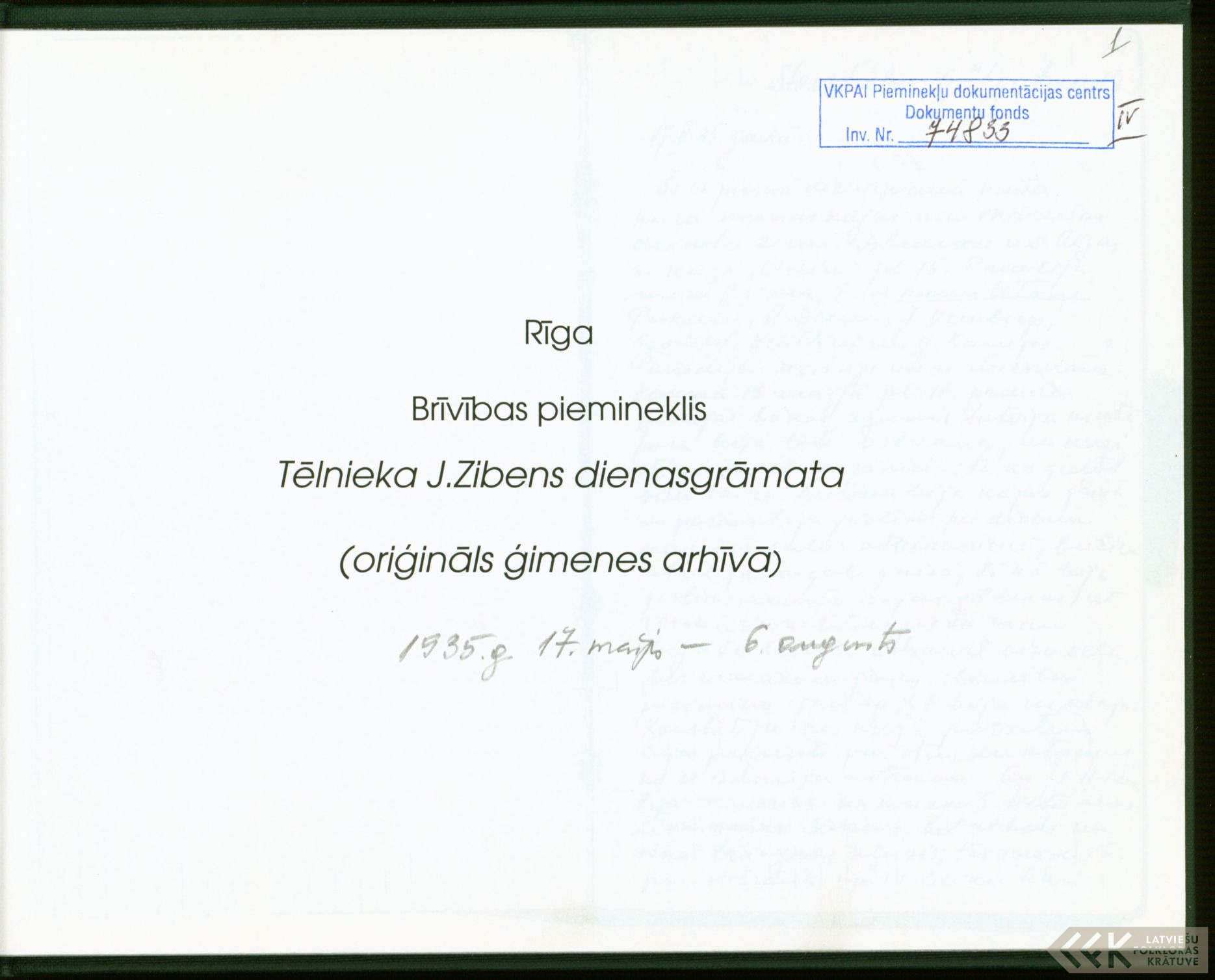
First manuscript page: Diary of sculptor Jānis Zibens
LFK Ak 941935

Diary of sculptor Jānis Zibens

Sculptor Jānis Zibens’s professional diary records his work and various events while carving an element of the Freedom Monument in 1935.

Explore collectionClose details

Sculptor Jānis Zibens’s professional diary records his work and various events while carving an element of the Freedom Monument in 1935.

Open on garamantas.lv (opens in a new tab)
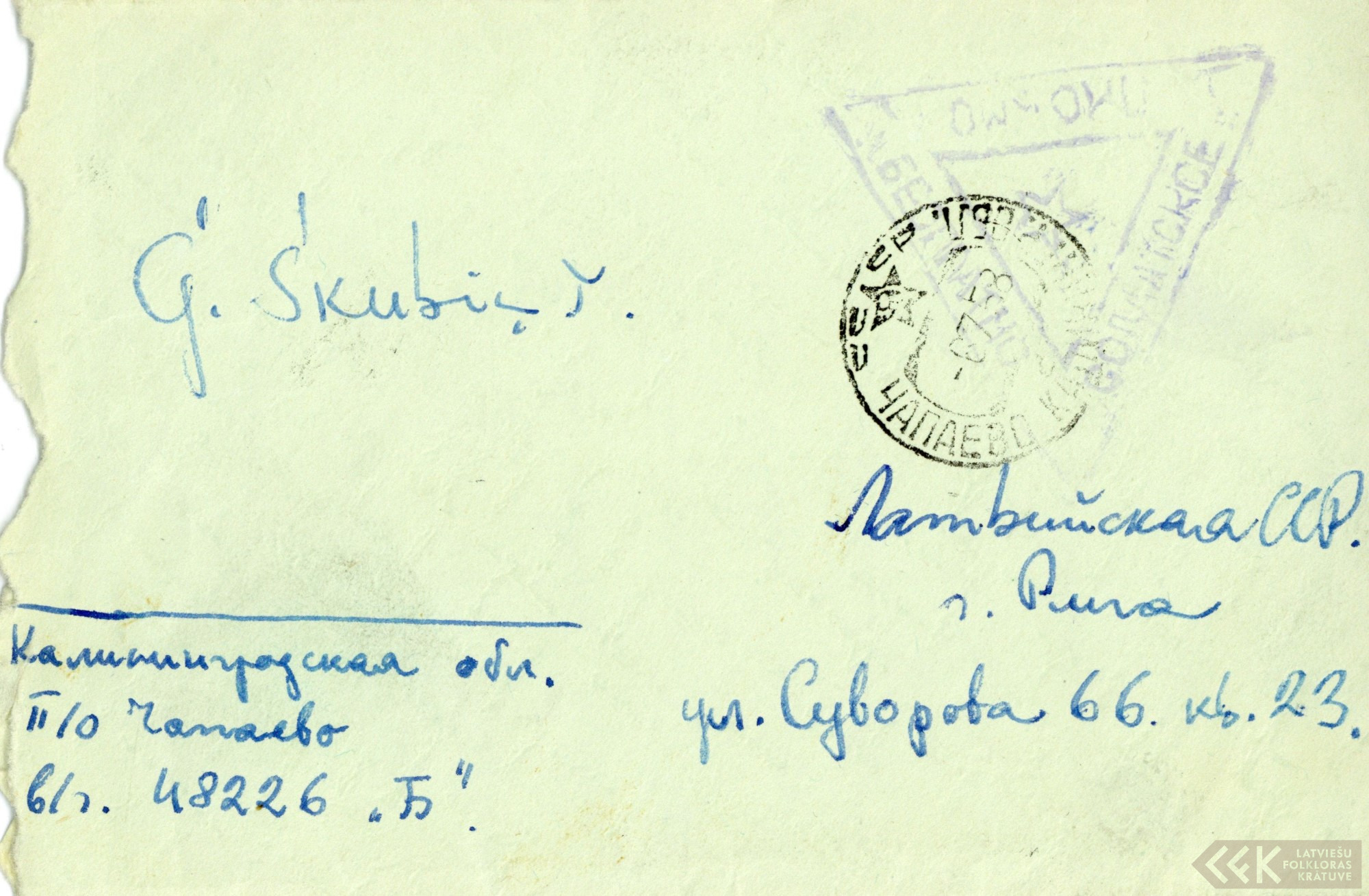
First manuscript page: Letters of Andis Mitāns and Gunārs Skubiņš
LFK Ak 95

Letters of Andis Mitāns and Gunārs Skubiņš

The correspondence between Andis Mitāns (born 1935) and Gunārs Skubiņš (born 1934) covers 1958–1960. The two childhood friends began exchanging letters regularly after graduation, when Andis started working in Riga and Gunārs’s work took him to Jaungulbene.

Explore collectionClose details

The correspondence between Andis Mitāns (born 1935) and Gunārs Skubiņš (born 1934) covers 1958–1960. The two childhood friends began exchanging letters regularly after graduation, when Andis started working in Riga and Gunārs’s work took him to Jaungulbene.

Open on garamantas.lv (opens in a new tab)
First manuscript page: Diaries of Alfrēds Krūmiņš
LFK Ak 961944–1996

Diaries of Alfrēds Krūmiņš

Explore collectionClose details
Open on garamantas.lv (opens in a new tab)
First manuscript page: Memories of Mečislavs Vertinskis
LFK Ak 97

Memories of Mečislavs Vertinskis

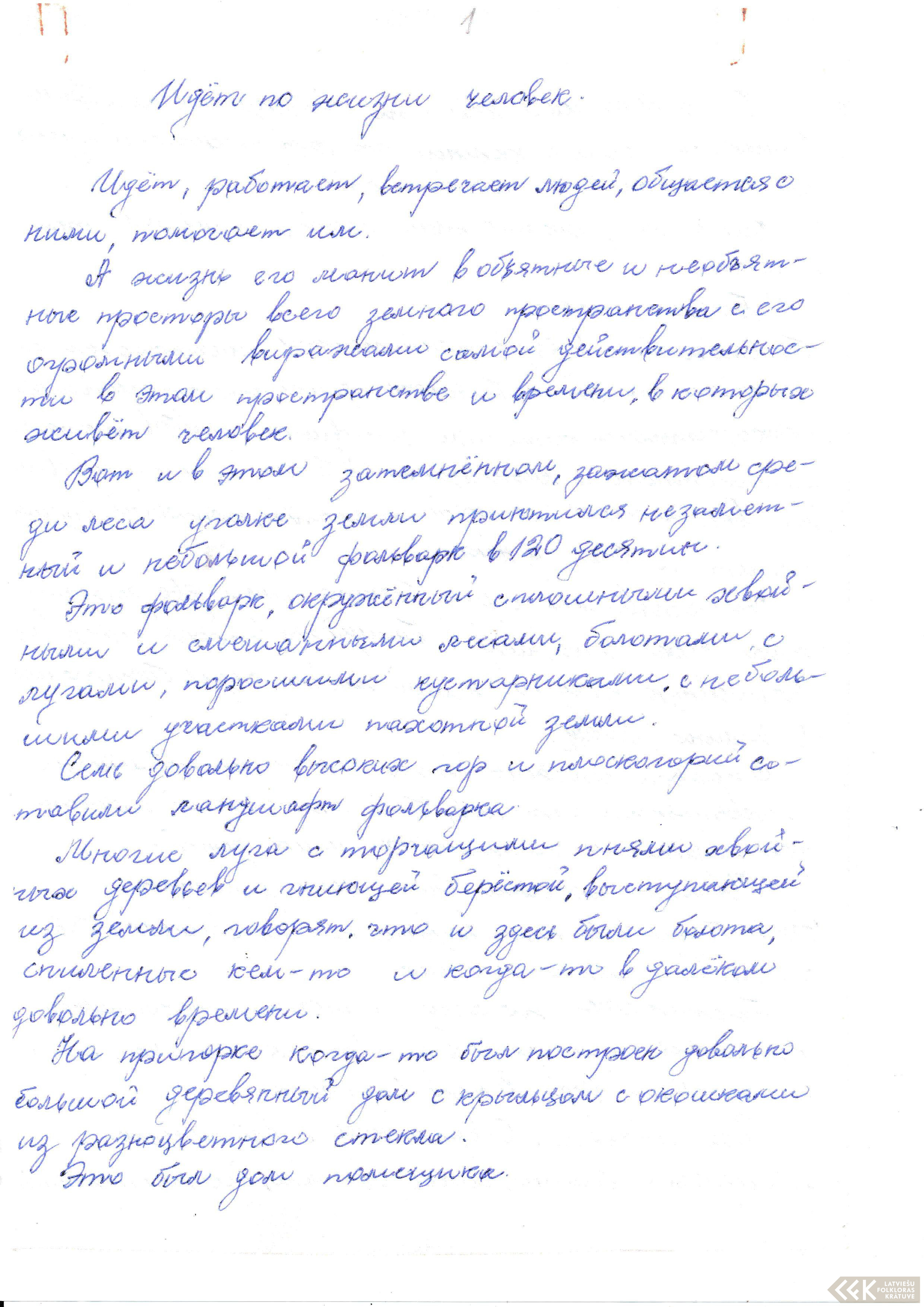
Former history teacher and local historian Mečislavs Vertinskis’s (born 1932) recollections of childhood and everyday life around Dagda. Written in Russian in 2011.

Explore collectionClose details

Former history teacher and local historian Mečislavs Vertinskis’s (born 1932) recollections of childhood and everyday life around Dagda. Written in Russian in 2011.

Open on garamantas.lv (opens in a new tab)
First manuscript page: Memories of Anna Vagale
LFK Ak 981988–1990

Memories of Anna Vagale

The memoirs of Anna Vagale (born 1918), a former Latvian language and literature teacher and enthusiastic local historian, about her native village of Mateļi. She incorporates folklore materials, including folk songs, beliefs and various customs. Written in the late 1980s, the memoir looks back on the village from Anna’s childhood to the Second World War.

Explore collectionClose details

The memoirs of Anna Vagale (born 1918), a former Latvian language and literature teacher and enthusiastic local historian, about her native village of Mateļi. She incorporates folklore materials, including folk songs, beliefs and various customs. Written in the late 1980s, the memoir looks back on the village from Anna’s childhood to the Second World War.

Open on garamantas.lv (opens in a new tab)
First manuscript page: Diaries of Imants Freimanis
LFK Ak 991935–1996

Diaries of Imants Freimanis

Submitted by: Linda Freimane

Explore collectionClose details
Open on garamantas.lv (opens in a new tab)
LFK Ak 1011945–1947

Diaries of Jānis Spriņģis

Jānis was born in 1926 at ‘Lejaskliņģeri’ in Vecate parish, where he lived throughout his life. After his death in 2005, his daughter Gaida Pevko found old papers while cleaning the attic. They turned out to be his diaries from 1945–1947. Everyday concerns and duties on the farm, changing temperatures and observations of nature alternate with uncertainty about his own fate and that of his loved ones in Latvia under Nazi German and Soviet occupation.

Submitted by: Agita Lapsa

Explore collectionClose details

Jānis was born in 1926 at ‘Lejaskliņģeri’ in Vecate parish, where he lived throughout his life. After his death in 2005, his daughter Gaida Pevko found old papers while cleaning the attic. They turned out to be his diaries from 1945–1947. Everyday concerns and duties on the farm, changing temperatures and observations of nature alternate with uncertainty about his own fate and that of his loved ones in Latvia under Nazi German and Soviet occupation.

Open on garamantas.lv (opens in a new tab)
LFK Ak 1021950–1980

Diary of Spodra Ozoliņa

Explore collectionClose details
Open on garamantas.lv (opens in a new tab)
First manuscript page: Diary of Miķelis Pankoks
LFK Ak 1031916–1922

Diary of Miķelis Pankoks

Explore collectionClose details
Open on garamantas.lv (opens in a new tab)
First manuscript page: Autobiographical materials of Silvija Grunte
LFK Ak 1042008–2010

Autobiographical materials of Silvija Grunte

Explore collectionClose details
Open on garamantas.lv (opens in a new tab)
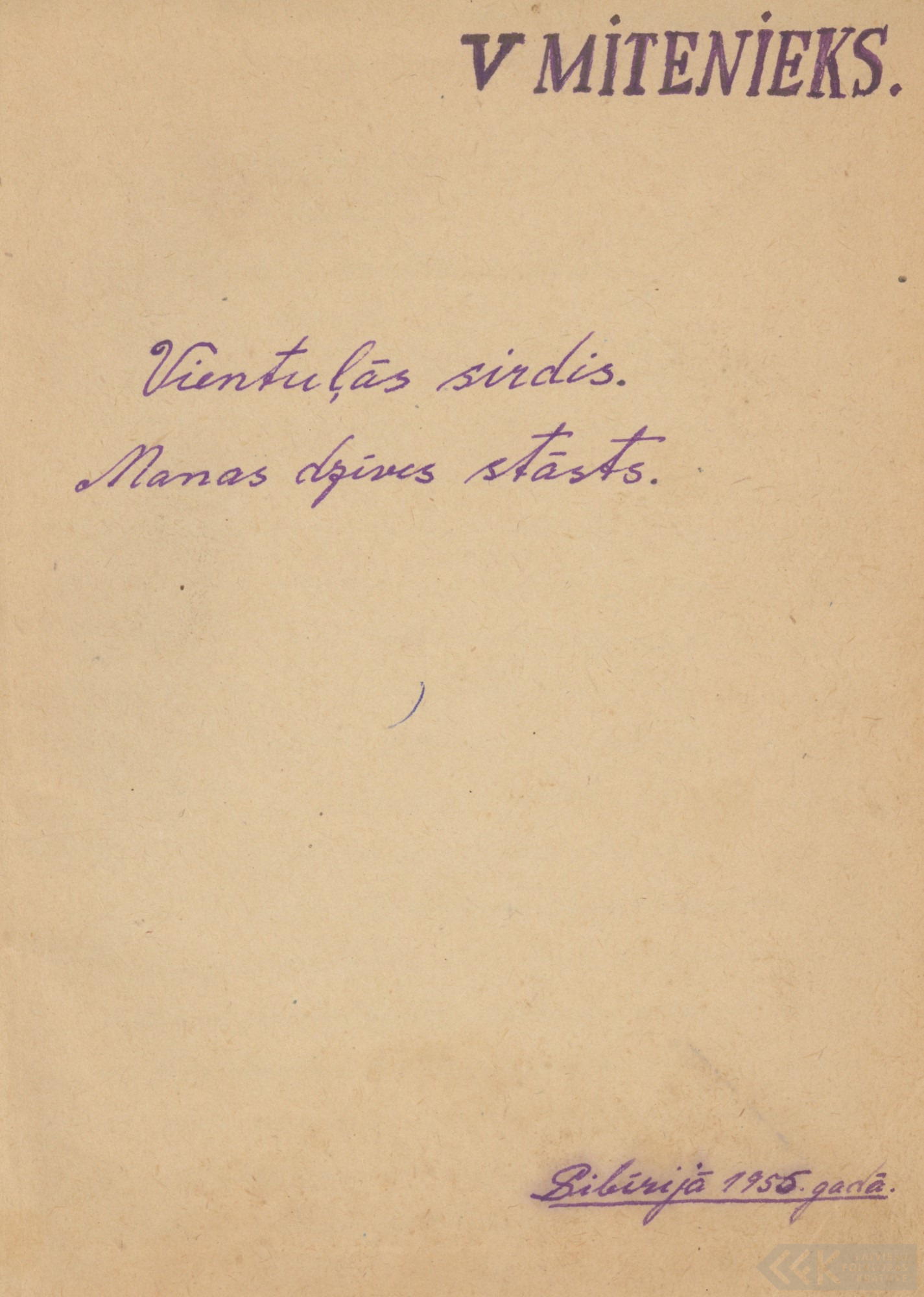
First manuscript page: Life story of Voldemārs Mitenieks
LFK Ak 1051955

Life story of Voldemārs Mitenieks

In 1955, while in exile in Siberia, blacksmith Voldemārs Mitenieks (1908–1960) began writing his life story, entitled ‘Lonely Hearts’. He completed the first part, describing his childhood near Dobele in a somewhat romantic and poetic, yet candid manner.

Explore collectionClose details

In 1955, while in exile in Siberia, blacksmith Voldemārs Mitenieks (1908–1960) began writing his life story, entitled ‘Lonely Hearts’. He completed the first part, describing his childhood near Dobele in a somewhat romantic and poetic, yet candid manner.

Open on garamantas.lv (opens in a new tab)
First manuscript page: Autobiography of Pēteris Šmits
LFK Ak 1061935

Autobiography of Pēteris Šmits

Explore collectionClose details
Open on garamantas.lv (opens in a new tab)
First manuscript page: Diaries of Paulis Alksnis
LFK Ak 1071926–1936

Diaries of Paulis Alksnis

Explore collectionClose details
Open on garamantas.lv (opens in a new tab)
First manuscript page: Diary of Imants Jansons
LFK Ak 1081944–1947

Diary of Imants Jansons

Latvian Legion soldier Imants Jansons’s diary, accompanied by photographs, recounts the experiences and feelings of a nineteen-year-old during the Second World War. The author called it ‘The Book of My Days’, documenting daily life in turbulent circumstances through poetic language and vocabulary characteristic of his native Kuldīga area.

Explore collectionClose details

Latvian Legion soldier Imants Jansons’s diary, accompanied by photographs, recounts the experiences and feelings of a nineteen-year-old during the Second World War. The author called it ‘The Book of My Days’, documenting daily life in turbulent circumstances through poetic language and vocabulary characteristic of his native Kuldīga area.

Open on garamantas.lv (opens in a new tab)
LFK Ak 1091997

Memory stories of Marta Vītuma

Marta Vītuma began writing her recollections in 1997, aged eighty-eight. Her daughter Zaiga later typed them up and gave each story a thematic title. Zaiga recalls that writing gave her mother ‘an opportunity to fill lonely hours and to tell us, her loved ones, about important events in her life that would otherwise remain unknown’.

Explore collectionClose details

Marta Vītuma began writing her recollections in 1997, aged eighty-eight. Her daughter Zaiga later typed them up and gave each story a thematic title. Zaiga recalls that writing gave her mother ‘an opportunity to fill lonely hours and to tell us, her loved ones, about important events in her life that would otherwise remain unknown’.

Open on garamantas.lv (opens in a new tab)
LFK Ak 1102010–2018

Memory stories of Zaiga Zandmane

Explore collectionClose details
Open on garamantas.lv (opens in a new tab)
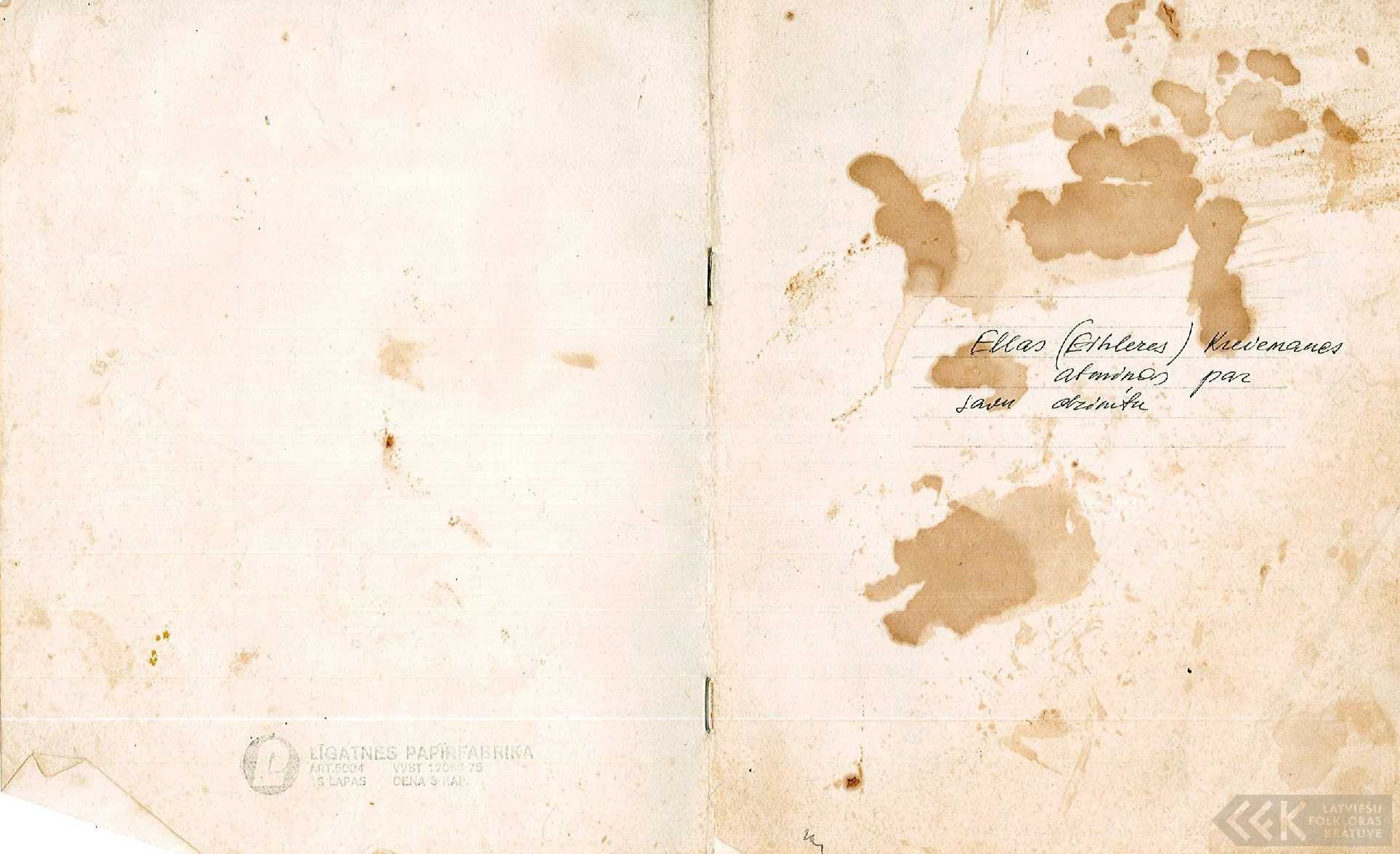
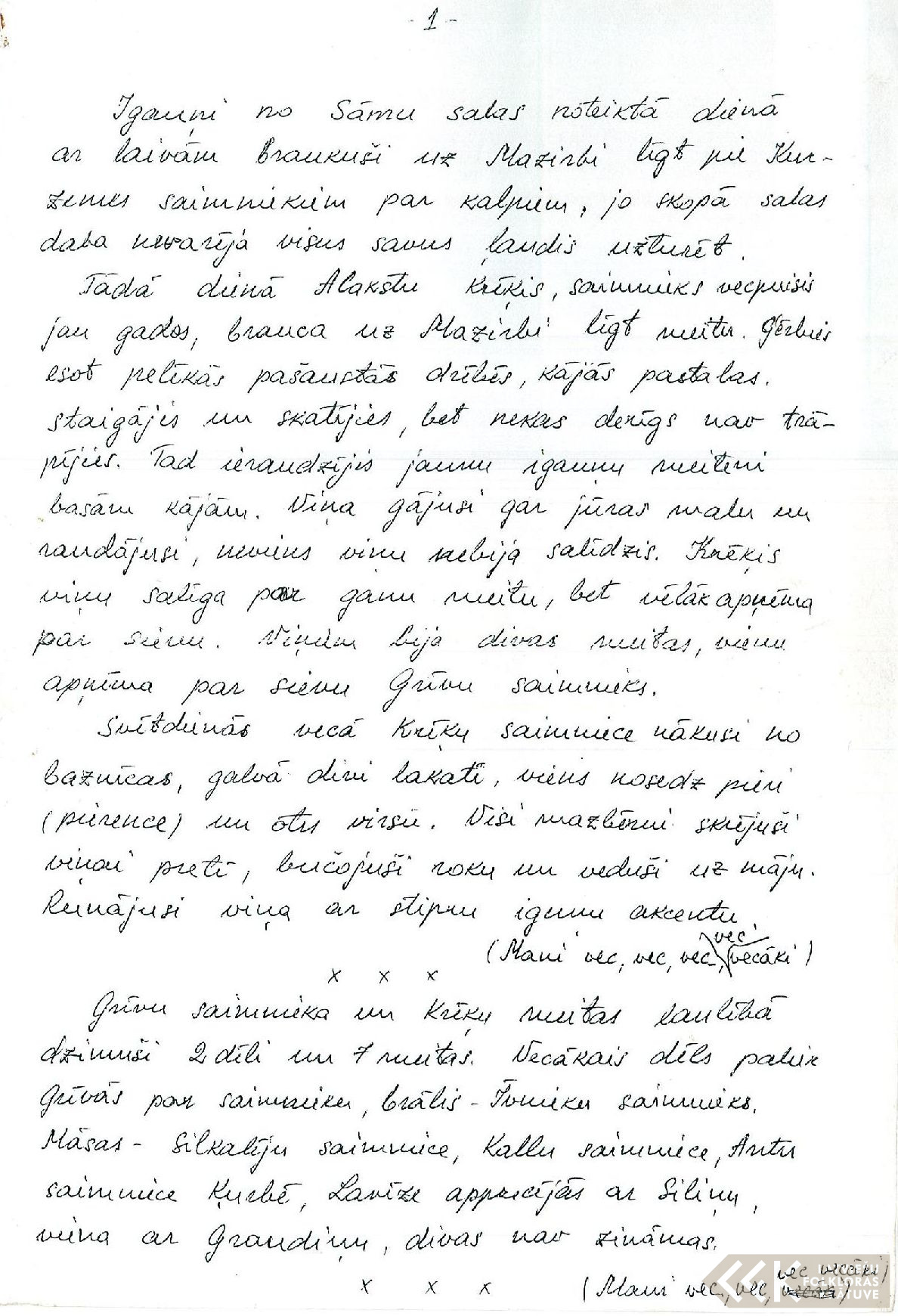
First manuscript page: Memories of Ella Kreicmane about her family
LFK Ak 1111937

Memories of Ella Kreicmane about her family

Submitted by: Agita Lapsa

Explore collectionClose details
Open on garamantas.lv (opens in a new tab)
First manuscript page: Memories of Nadīna Pavlova
LFK Ak 1122010

Memories of Nadīna Pavlova

Submitted by: Agita Lapsa

Explore collectionClose details
Open on garamantas.lv (opens in a new tab)
LFK Ak 1131996–2018

Diaries of Egons Tālivaldis Ziediņš

Explore collectionClose details
Open on garamantas.lv (opens in a new tab)
LFK Ak 1142017

Memories of Jēkabs Ziedars

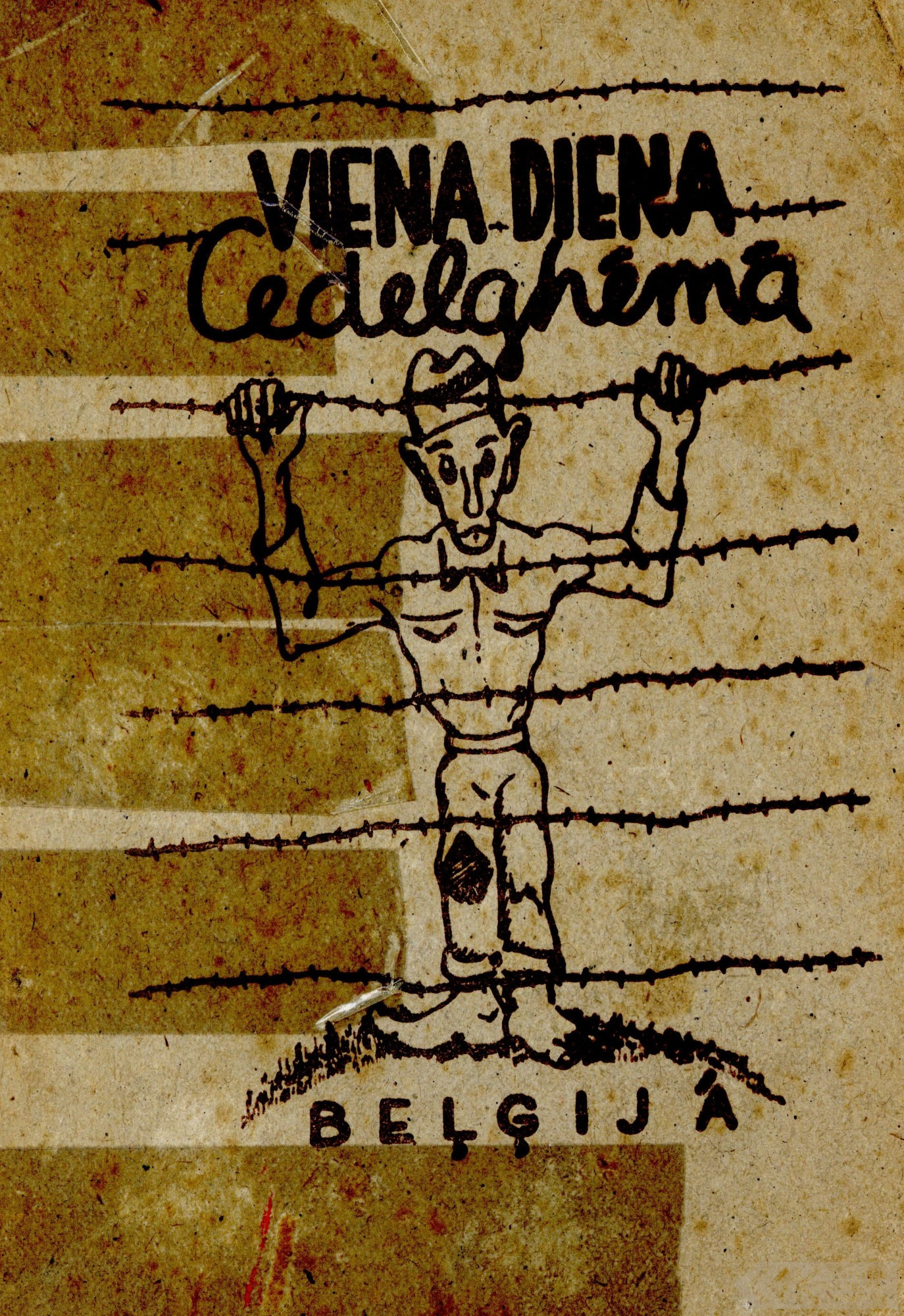
Jēkabs Ziedars’s (born 1924) memoir, entitled ‘Puišķins, Anūts, Džeks’. Written in the third person, it recounts his childhood in Silene, Latgale, studies at Liepāja Technical School, involvement in the Second World War and time in the prisoner-of-war camp at Zedelgem. His studies at the Baltic University are particularly important in the account. The final part describes his journey to Australia and his first years there.

Submitted by: Jēkabs Ziedars

Explore collectionClose details

Jēkabs Ziedars’s (born 1924) memoir, entitled ‘Puišķins, Anūts, Džeks’. Written in the third person, it recounts his childhood in Silene, Latgale, studies at Liepāja Technical School, involvement in the Second World War and time in the prisoner-of-war camp at Zedelgem. His studies at the Baltic University are particularly important in the account. The final part describes his journey to Australia and his first years there.

Open on garamantas.lv (opens in a new tab)
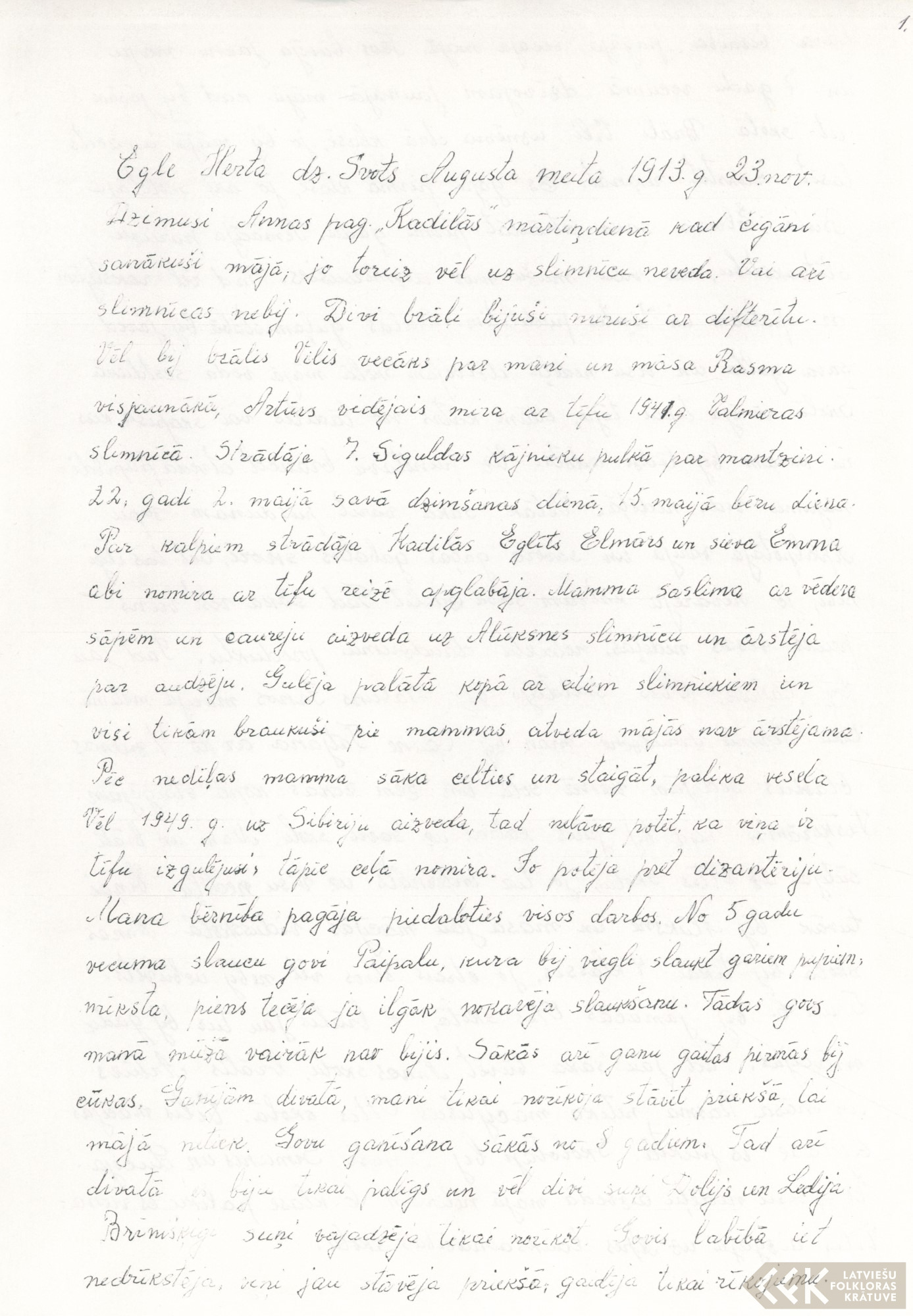
First manuscript page: Life story of Herta Egle
LFK Ak 1152000

Life story of Herta Egle

Herta Egle’s (1913–2004) life story focuses on major milestones: childhood in Anna parish, studies at the Ranka Home Economics School, marriage, the upheavals of the Second World War, years in exile in Siberia, and everyday life in the Latvian SSR after returning home.

Submitted by: Ina Balaņuka

Explore collectionClose details

Herta Egle’s (1913–2004) life story focuses on major milestones: childhood in Anna parish, studies at the Ranka Home Economics School, marriage, the upheavals of the Second World War, years in exile in Siberia, and everyday life in the Latvian SSR after returning home.

Open on garamantas.lv (opens in a new tab)
First manuscript page: Life story of Adolfs Čerbikovs
LFK Ak 1162006

Life story of Adolfs Čerbikovs

The life story of Adolfs Čerbikovs (1921–2013), a resident of Anna parish in the Alūksne region, recorded in 2006 by his granddaughter Līva Čerbikova. It recounts his experiences in the Latvian Legion during the Second World War and in Soviet penal camps, followed by life after returning to his father’s homestead. He remained actively involved in the cultural life of Anna parish until the end of his life.

Submitted by: Ina Balaņuka

Explore collectionClose details

The life story of Adolfs Čerbikovs (1921–2013), a resident of Anna parish in the Alūksne region, recorded in 2006 by his granddaughter Līva Čerbikova. It recounts his experiences in the Latvian Legion during the Second World War and in Soviet penal camps, followed by life after returning to his father’s homestead. He remained actively involved in the cultural life of Anna parish until the end of his life.

Open on garamantas.lv (opens in a new tab)
LFK Ak 1172013–2014

Memories of Aivars Puzulis

Aivars Puzulis of Alūksne recorded his recollections of his native village of Mazuļi between April 2013 and May 2014. His mother had been the village’s last resident. Accounts of villagers, including Aivars’s parents and grandparents, houses and events are accompanied by an extensive collection of place names from Mazuļi and its surroundings.

Explore collectionClose details

Aivars Puzulis of Alūksne recorded his recollections of his native village of Mazuļi between April 2013 and May 2014. His mother had been the village’s last resident. Accounts of villagers, including Aivars’s parents and grandparents, houses and events are accompanied by an extensive collection of place names from Mazuļi and its surroundings.

Open on garamantas.lv (opens in a new tab)
First manuscript page: Memories of Romāns Dūnis
LFK Ak 1182003

Memories of Romāns Dūnis

Romāns Dūnis’s (1925–2019) memoirs, written in 2003, recount his childhood in Valmiera. They offer a vivid portrayal of the town in the 1930s, describing family members and relatives, his father Jānis Dūnis’s publishing business, its employees and the processes involved in producing books.

Submitted by: Nellija Dūne

Explore collectionClose details

Romāns Dūnis’s (1925–2019) memoirs, written in 2003, recount his childhood in Valmiera. They offer a vivid portrayal of the town in the 1930s, describing family members and relatives, his father Jānis Dūnis’s publishing business, its employees and the processes involved in producing books.

Open on garamantas.lv (opens in a new tab)
LFK Ak 1191947–1950

Diaries of Roberts Ligers and Riga pantomime ensemble

Explore collectionClose details
Open on garamantas.lv (opens in a new tab)
First manuscript page: Diaries of Alberts Baltturs
LFK Ak 1201975–1979

Diaries of Alberts Baltturs

Alberts Baltturs’s (1899–1980) diaries, written from 1975 to 1979. Alongside weather observations and a work journal, they contain his poems, quotations, newspaper clippings and drawings, conveying his inner life. The diary entries are in Russian; the poems are in both Russian and Latvian.

Submitted by: Ārija Murāne

Explore collectionClose details

Alberts Baltturs’s (1899–1980) diaries, written from 1975 to 1979. Alongside weather observations and a work journal, they contain his poems, quotations, newspaper clippings and drawings, conveying his inner life. The diary entries are in Russian; the poems are in both Russian and Latvian.

Open on garamantas.lv (opens in a new tab)
First manuscript page: Memories and poetry of Elizabete Buša
LFK Ak 1211905–1974

Memories and poetry of Elizabete Buša

The collection includes Elizabete Buša’s (1891–1981) memoirs, written in 1916, of her family’s flight from Sloka to Russia, poems written in the early twentieth century, and a separate notebook of poems from the 1970s.

Submitted by: Ināra Rūce

Explore collectionClose details

The collection includes Elizabete Buša’s (1891–1981) memoirs, written in 1916, of her family’s flight from Sloka to Russia, poems written in the early twentieth century, and a separate notebook of poems from the 1970s.

Open on garamantas.lv (opens in a new tab)
LFK Ak 1222006–2008

Memories of Juris Emsiņš

Juris Emsiņš’s (born 1936) recollections of his childhood and youth in Lielvārde. Particular attention is paid to Lielvārde Secondary School and his studies, the ‘Lāčplēsis’ collective farm’s folk dance group, initially led by Harijs Sūna and later by Uldis Šteins, and sporting events.

Submitted by: Juris Emsiņš

Explore collectionClose details

Juris Emsiņš’s (born 1936) recollections of his childhood and youth in Lielvārde. Particular attention is paid to Lielvārde Secondary School and his studies, the ‘Lāčplēsis’ collective farm’s folk dance group, initially led by Harijs Sūna and later by Uldis Šteins, and sporting events.

Open on garamantas.lv (opens in a new tab)
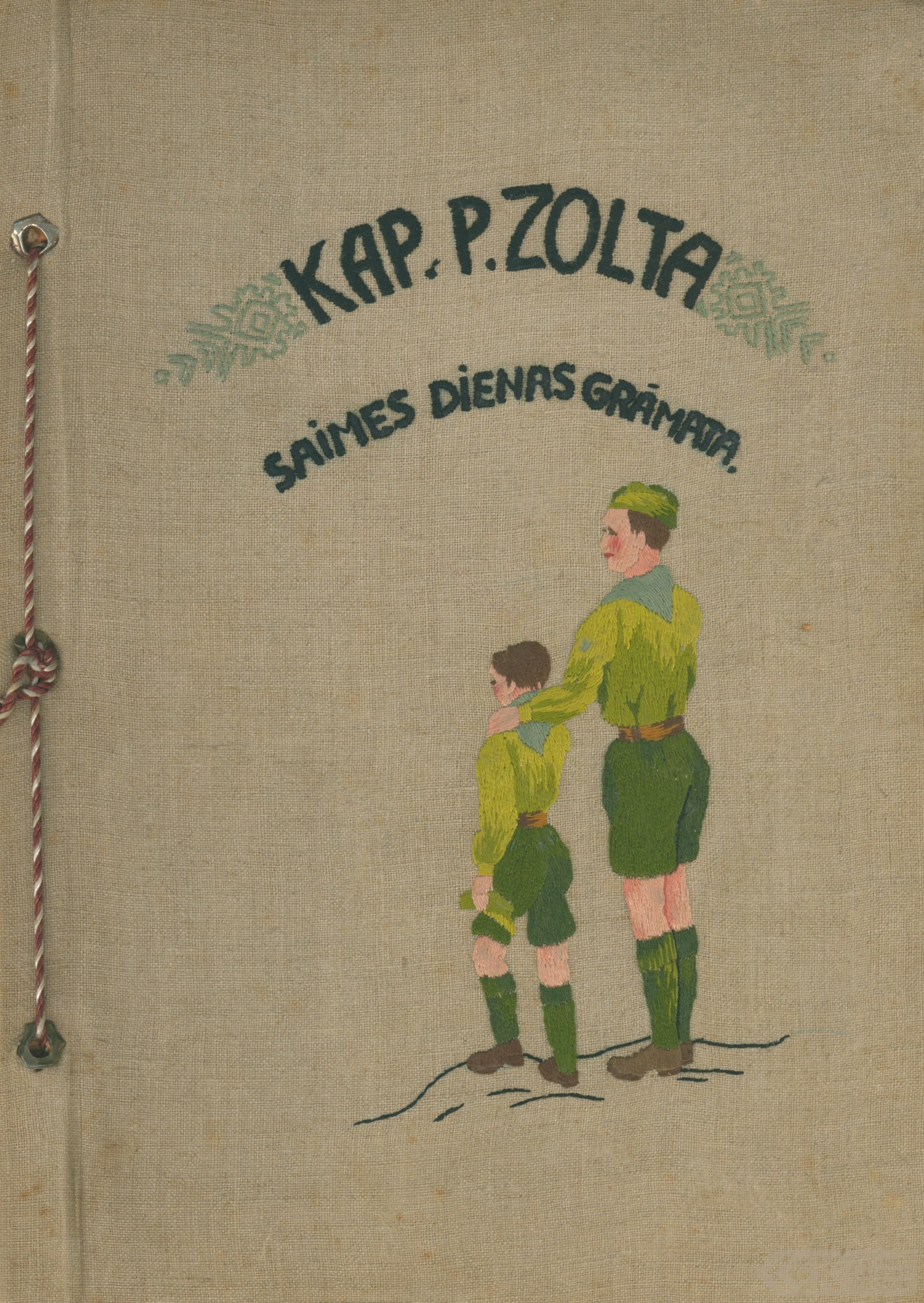
First manuscript page: Diary of Scouts Unit Named by Captain P. Zolts
LFK Ak 1231938–1939

Diary of Scouts Unit Named by Captain P. Zolts

The diary documents scouting activities in 1938–1939. The boys informally describe discussions and activities at scout meetings. Combining criticism with friendly teasing, they record knowledge gained from lectures, skills acquired in practical sessions and shared experiences on several trips. The text is accompanied by drawings, newspaper clippings and photographs.

Explore collectionClose details

The diary documents scouting activities in 1938–1939. The boys informally describe discussions and activities at scout meetings. Combining criticism with friendly teasing, they record knowledge gained from lectures, skills acquired in practical sessions and shared experiences on several trips. The text is accompanied by drawings, newspaper clippings and photographs.

Open on garamantas.lv (opens in a new tab)
First manuscript page: Memories of Aija Vīksna
LFK Ak 1242009

Memories of Aija Vīksna

Aija Vīksna’s (born 1929) recollections of Vecdzērve, a village in Sauka parish where she was born and spent her early years. The memoir describes all the village’s houses in the 1930s, its most memorable inhabitants and notable events.

Submitted by: Aija Vīksna

Explore collectionClose details

Aija Vīksna’s (born 1929) recollections of Vecdzērve, a village in Sauka parish where she was born and spent her early years. The memoir describes all the village’s houses in the 1930s, its most memorable inhabitants and notable events.

Open on garamantas.lv (opens in a new tab)
LFK Ak 1252009–2010

Memories of Olga Rasa

Explore collectionClose details
Open on garamantas.lv (opens in a new tab)
LFK Ak 1261993–2003

Life story of Edmunds Ozoliņš

Explore collectionClose details
Open on garamantas.lv (opens in a new tab)
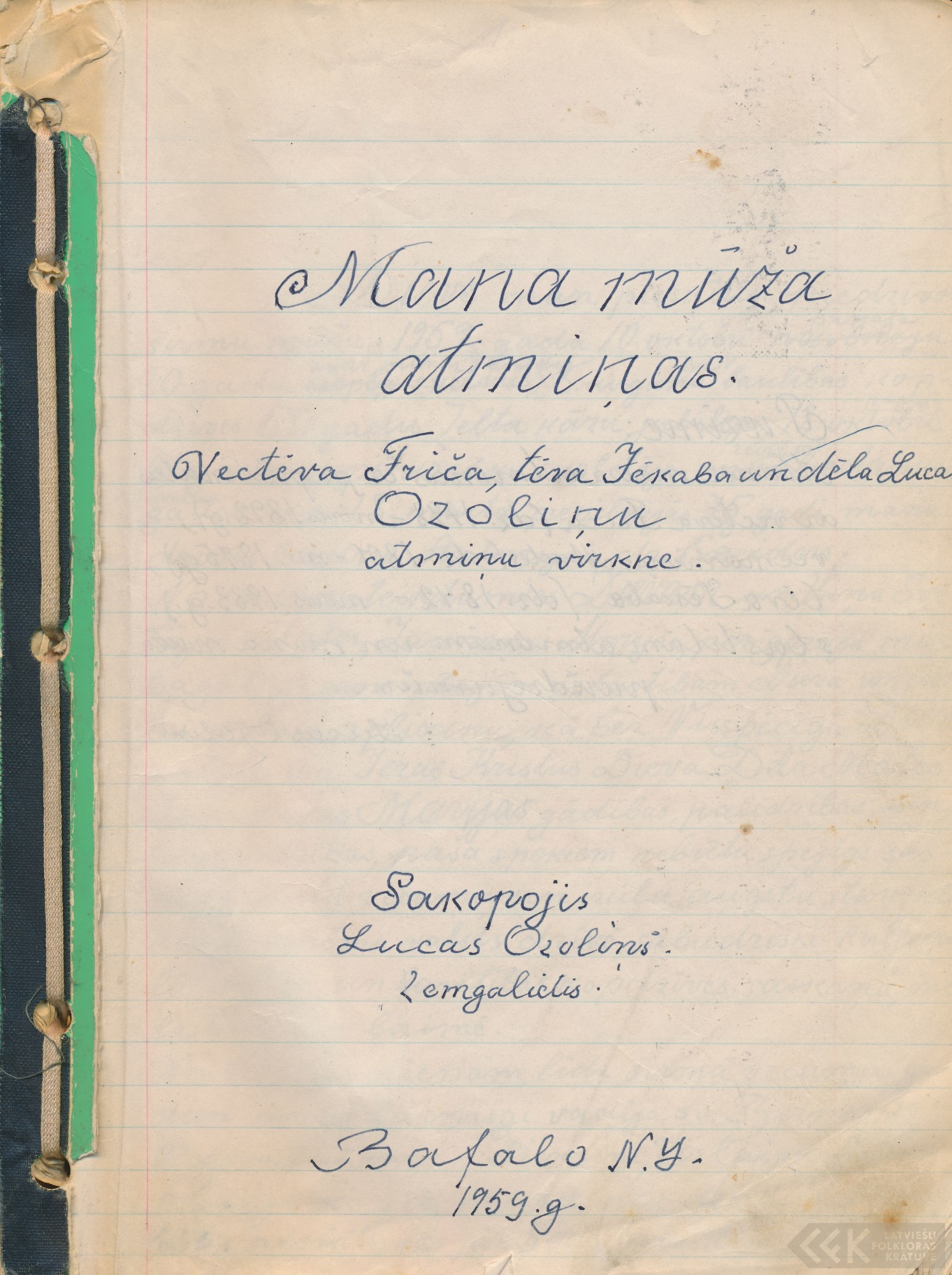
First manuscript page: Memories of Lūkass Ozoliņš
LFK Ak 1271959

Memories of Lūkass Ozoliņš

Lūkass Ozoliņš’s (1879–1962) memoirs, written in Buffalo, USA, in 1959. The first part brings together information about his family, including his grandparents Fricis and Made Ozoliņš and his father Jēkabs Ozoliņš. The concluding part recounts his own life: the 1905 Revolution and the flight that followed, the First World War, service as a member of Latvia’s parliament, teaching in various Latvian schools, emigration to displaced persons camps in Germany and his final years in Buffalo.

Submitted by: Agita Lapsa

Explore collectionClose details

Lūkass Ozoliņš’s (1879–1962) memoirs, written in Buffalo, USA, in 1959. The first part brings together information about his family, including his grandparents Fricis and Made Ozoliņš and his father Jēkabs Ozoliņš. The concluding part recounts his own life: the 1905 Revolution and the flight that followed, the First World War, service as a member of Latvia’s parliament, teaching in various Latvian schools, emigration to displaced persons camps in Germany and his final years in Buffalo.

Open on garamantas.lv (opens in a new tab)
First manuscript page: Memories of Vladimirs Vigdorčiks
LFK Ak 1281985–1992

Memories of Vladimirs Vigdorčiks

Explore collectionClose details
Open on garamantas.lv (opens in a new tab)
First manuscript page: Memories of Marfa Mivrenika
LFK Ak 130

Memories of Marfa Mivrenika

Marfa Mivrenika’s (born 1937) recollections of a carefree and happy childhood in Viļāni, disrupted in 1944 when partisans killed her father. The subsequent account chronologically describes life on a collective farm and the realities of the early Soviet period.

Explore collectionClose details

Marfa Mivrenika’s (born 1937) recollections of a carefree and happy childhood in Viļāni, disrupted in 1944 when partisans killed her father. The subsequent account chronologically describes life on a collective farm and the realities of the early Soviet period.

Open on garamantas.lv (opens in a new tab)
First manuscript page: Memories of Edgars Ezerlīcītis
LFK Ak 1312005–2010

Memories of Edgars Ezerlīcītis

Forester Edgars Ezerlīcītis’s (1927–2015) memoirs, written in the early twenty-first century, look back on his life and examine forest management around Jūrmala. He describes flora and fauna, soil characteristics, lakes and rivers in detail, alongside various hunting experiences. The account contains extensive factual and scientific information, yet the narrative is fluent and at times poetic.

Explore collectionClose details

Forester Edgars Ezerlīcītis’s (1927–2015) memoirs, written in the early twenty-first century, look back on his life and examine forest management around Jūrmala. He describes flora and fauna, soil characteristics, lakes and rivers in detail, alongside various hunting experiences. The account contains extensive factual and scientific information, yet the narrative is fluent and at times poetic.

Open on garamantas.lv (opens in a new tab)
First manuscript page: Memories of Zigfrīds Kārlis Brakmanis
LFK Ak 1321996–1997

Memories of Zigfrīds Kārlis Brakmanis

Explore collectionClose details
Open on garamantas.lv (opens in a new tab)
LFK Ak 1331979

Life Story of Emīls Kriškāns

Emīls Kriškāns (1908–2000), a Latvian living in Lithuania, wrote these memoirs in 1979 about his childhood and his family home, ‘Kalneļi’. He reconstructs his family history in detail and records everyday events and personal experiences.

Submitted by: Lilija Kudirkiene

Explore collectionClose details

Emīls Kriškāns (1908–2000), a Latvian living in Lithuania, wrote these memoirs in 1979 about his childhood and his family home, ‘Kalneļi’. He reconstructs his family history in detail and records everyday events and personal experiences.

Open on garamantas.lv (opens in a new tab)
First manuscript page: Memories of Pēteris Stepiņš
LFK Ak 1341995

Memories of Pēteris Stepiņš

Historian Pēteris Stepiņš’s (1914–1999) memoirs, written in 1995, about his native village of Anči in Auleja parish. Written in a distinctive mixture of Latvian and Latgalian, they recount personal memories of everyday village life in the 1920s.

Submitted by: Alberts Stepiņš

Explore collectionClose details

Historian Pēteris Stepiņš’s (1914–1999) memoirs, written in 1995, about his native village of Anči in Auleja parish. Written in a distinctive mixture of Latvian and Latgalian, they recount personal memories of everyday village life in the 1920s.

Open on garamantas.lv (opens in a new tab)
LFK Ak 1351984–2017

Diaries of Jevgēnijs Siksnāns

Explore collectionClose details
Open on garamantas.lv (opens in a new tab)
LFK Ak 1361959–2018

Diaries of Genofeva Upeniece

Genovefa Upeniece’s (born 1945) diaries record everyday events and personal experiences from 1959 to 2018.

Submitted by: Genovefa Upeniece

Explore collectionClose details

Genovefa Upeniece’s (born 1945) diaries record everyday events and personal experiences from 1959 to 2018.

Open on garamantas.lv (opens in a new tab)
LFK Ak 1371946–1976

Diaries of Broņislava

Explore collectionClose details
Open on garamantas.lv (opens in a new tab)
LFK Ak 1381922–1960

Memories of Nikolajs Ulmanis

Submitted by: Māra Zirnīte

Explore collectionClose details
Open on garamantas.lv (opens in a new tab)
First manuscript page: Diaries of Zigrīda Paegle
LFK Ak 1391961–2018

Diaries of Zigrīda Paegle

The collection contains the diaries of Zigrīda Paegle (born 1945) of Jūrkalne. The earliest dates from 1961; the more recent diaries were written from 1999 onwards. Initially, they record practical information such as weather, farm figures including milk yields and hatched eggs, debts incurred or repaid, and dates of deaths. Over time, the entries become more personal and detailed. Zigrīda describes what she has done on particular days and reflects on her emotions. Read together, the diaries show how a notebook develops into a deeply felt means of self-therapy.

Submitted by: Zigrīda Paegle

Explore collectionClose details

The collection contains the diaries of Zigrīda Paegle (born 1945) of Jūrkalne. The earliest dates from 1961; the more recent diaries were written from 1999 onwards. Initially, they record practical information such as weather, farm figures including milk yields and hatched eggs, debts incurred or repaid, and dates of deaths. Over time, the entries become more personal and detailed. Zigrīda describes what she has done on particular days and reflects on her emotions. Read together, the diaries show how a notebook develops into a deeply felt means of self-therapy.

Open on garamantas.lv (opens in a new tab)
LFK Ak 1401992–1997

Diaries of Dace Skeranska

A young woman’s thoughts and emotions recorded in diary form in the 1990s.

Submitted by: Dace Skeranska

Explore collectionClose details

A young woman’s thoughts and emotions recorded in diary form in the 1990s.

Open on garamantas.lv (opens in a new tab)
LFK Ak 1421975–1976

Pioneer Diary of Ozolaines School

Explore collectionClose details
Open on garamantas.lv (opens in a new tab)
First manuscript page: Diary of Jāzeps Puksts
LFK Ak 1441951–1952

Diary of Jāzeps Puksts

Jāzeps Puksts wrote his only diary in 1951 while serving in the Soviet Army in the Ukrainian city of Berdychiv.

Submitted by: Anda Pukste

Explore collectionClose details

Jāzeps Puksts wrote his only diary in 1951 while serving in the Soviet Army in the Ukrainian city of Berdychiv.

Open on garamantas.lv (opens in a new tab)
First manuscript page: Diary of Dāvis Dauvarts
LFK Ak 1451931–1944

Diary of Dāvis Dauvarts

Dāvis Dauvarts, owner of the ‘Vecdaudži’ farm in Brenguļi parish, began his fourth diary on 31 December 1931. The final entry was written shortly before his death on 17 September 1944. Entries were made irregularly and often include quotations from literary sources. His wife Olga Dauvarte, née Lappekins, contributes entries in two places. In describing her grandfather’s diary, Ilze Dauvarte highlights the influence of the Moravian Brethren movement.

Explore collectionClose details

Dāvis Dauvarts, owner of the ‘Vecdaudži’ farm in Brenguļi parish, began his fourth diary on 31 December 1931. The final entry was written shortly before his death on 17 September 1944. Entries were made irregularly and often include quotations from literary sources. His wife Olga Dauvarte, née Lappekins, contributes entries in two places. In describing her grandfather’s diary, Ilze Dauvarte highlights the influence of the Moravian Brethren movement.

Open on garamantas.lv (opens in a new tab)
First manuscript page: Life story by Vija Poļaka
LFK Ak 1472018

Life story by Vija Poļaka

The life story of Vija Poļaka (born 1928), a poet from the Gulbene region, written in 2009. The account consists of short miniature pieces recalling the most vivid and significant moments of her life.

Submitted by: Inga Caunīte

Explore collectionClose details

The life story of Vija Poļaka (born 1928), a poet from the Gulbene region, written in 2009. The account consists of short miniature pieces recalling the most vivid and significant moments of her life.

Open on garamantas.lv (opens in a new tab)
First manuscript page: Notes by Zigrīda Paegle and Marija Liepniece
LFK Ak 1491979–1988

Notes by Zigrīda Paegle and Marija Liepniece

Marija Liepniece’s weather observations and notes recording deaths among her acquaintances and in the surrounding area. Written in the late 1970s and the 1980s, these notes began a tradition continued by her daughter Zigrīda Paegle in her own records. The collection contains writings by both women, illustrating a family tradition of autobiographical record-keeping.

Submitted by: Zigrīda Paegle

Explore collectionClose details

Marija Liepniece’s weather observations and notes recording deaths among her acquaintances and in the surrounding area. Written in the late 1970s and the 1980s, these notes began a tradition continued by her daughter Zigrīda Paegle in her own records. The collection contains writings by both women, illustrating a family tradition of autobiographical record-keeping.

Open on garamantas.lv (opens in a new tab)
LFK Ak 1502001–2019

Calendars of Vita Neimane

Vita Neimane’s calendar notes record personal information, such as family and friends’ celebrations, financial matters, illnesses, planned meetings and events, alongside events in the wider world, including politics and the birthdays of well-known people. The collection contains calendars from 2001 to 2019.

Submitted by: Vita Neimane

Explore collectionClose details

Vita Neimane’s calendar notes record personal information, such as family and friends’ celebrations, financial matters, illnesses, planned meetings and events, alongside events in the wider world, including politics and the birthdays of well-known people. The collection contains calendars from 2001 to 2019.

Open on garamantas.lv (opens in a new tab)
First manuscript page: Memories by Eduards Smurģis
LFK Ak 1511925–1926

Memories by Eduards Smurģis

Explore collectionClose details
Open on garamantas.lv (opens in a new tab)
LFK Ak 1521967–1973

Letters to Valllija and Vēra

Explore collectionClose details
Open on garamantas.lv (opens in a new tab)
LFK Ak 1531980–1995

Diaries of Benita Neimane

Explore collectionClose details
Open on garamantas.lv (opens in a new tab)
First manuscript page: Diary of Kārlis Lapiņš
LFK Ak 1541936–1937

Diary of Kārlis Lapiņš

Sailor Kārlis Lapiņš’s (1920–1937) diary, written in 1936–1937 during his first sea voyage aboard the steamship ‘Rasma’. Brief entries record locations, weather, unfamiliar plants and animals, everyday events on board, meals and other observations. The notebook also contains sailors’ songs.

Submitted by: Vita Neimane

Explore collectionClose details

Sailor Kārlis Lapiņš’s (1920–1937) diary, written in 1936–1937 during his first sea voyage aboard the steamship ‘Rasma’. Brief entries record locations, weather, unfamiliar plants and animals, everyday events on board, meals and other observations. The notebook also contains sailors’ songs.

Open on garamantas.lv (opens in a new tab)
First manuscript page: Scout's Diary by L. Zālītis and B. Strads
LFK Ak 1551938

Scout's Diary by L. Zālītis and B. Strads

Scouts L. Zālītis and B. Strads’s account of a cycling trip undertaken on 21–23 October 1938 along the route Riga–Ķekava–Rembate–Jaunjelgava–Koknese–Pļaviņas–Madona–Gaiziņš Hill–Ērgļi–Riga.

Explore collectionClose details

Scouts L. Zālītis and B. Strads’s account of a cycling trip undertaken on 21–23 October 1938 along the route Riga–Ķekava–Rembate–Jaunjelgava–Koknese–Pļaviņas–Madona–Gaiziņš Hill–Ērgļi–Riga.

Open on garamantas.lv (opens in a new tab)
First manuscript page: Diary of an unidentified rifleman
LFK Ak 1561914

Diary of an unidentified rifleman

A rifleman’s diary, begun on 23 December 1914.

Explore collectionClose details

A rifleman’s diary, begun on 23 December 1914.

Open on garamantas.lv (opens in a new tab)
First manuscript page: Letters by Eduards Tančers
LFK Ak 1581935–1936

Letters by Eduards Tančers

Eduards Tančers’s (1909–1994) letters to his future wife Velta, written in 1936–1937. The collection includes a draft of a poetic love letter and several original letters expressing his longing and affection.

Submitted by: Jānis Tančers

Explore collectionClose details

Eduards Tančers’s (1909–1994) letters to his future wife Velta, written in 1936–1937. The collection includes a draft of a poetic love letter and several original letters expressing his longing and affection.

Open on garamantas.lv (opens in a new tab)
First manuscript page: Letters of Jānis Tančers and memories
LFK Ak 1591961–1968

Letters of Jānis Tančers and memories

The collection contains letters sent by Jānis Tančers to his family in Valmiera. The first group dates from his service in the Soviet Army in 1961–1964; the second consists of letters written while working for the ‘Brīvais vilnis’ fishing collective in Salacgrīva in 1966–1968, when he frequently undertook deep-sea voyages. The collection also includes Jānis’s recollections and a photograph from the time of the barricades in the 1990s.

Submitted by: Jānis Tančers

Explore collectionClose details

The collection contains letters sent by Jānis Tančers to his family in Valmiera. The first group dates from his service in the Soviet Army in 1961–1964; the second consists of letters written while working for the ‘Brīvais vilnis’ fishing collective in Salacgrīva in 1966–1968, when he frequently undertook deep-sea voyages.

The collection also includes Jānis’s recollections and a photograph from the time of the barricades in the 1990s.

Open on garamantas.lv (opens in a new tab)
First manuscript page: Diaries of Ligita Vucena
LFK Ak 1611953–2017

Diaries of Ligita Vucena

The collection includes the diaries of Ligita Vucena (1934-2019), written from 1953 until 2018. This is a unique collection because it gives a glimpse into the life of a young Soviet woman throughout her entire life - it vividly traces the paradigm shifts and everyday realities of more than 60 years. There are few surviving diaries in which someone records the course of her life so long, so meticulously and without interruption, and Ligita's diary entries are detailed and extensive, allowing diary readers to explore different psychological, historical and cultural aspects.

Submitted by: Ivars Vucens

Explore collectionClose details

The collection includes the diaries of Ligita Vucena (1934-2019), written from 1953 until 2018.

This is a unique collection because it gives a glimpse into the life of a young Soviet woman throughout her entire life - it vividly traces the paradigm shifts and everyday realities of more than 60 years. There are few surviving diaries in which someone records the course of her life so long, so meticulously and without interruption, and Ligita's diary entries are detailed and extensive, allowing diary readers to explore different psychological, historical and cultural aspects.

Open on garamantas.lv (opens in a new tab)
First manuscript page: Memories of Alma Vucena
LFK Ak 1621970–1975

Memories of Alma Vucena

Alma Vucena began writing her memoirs on 22 December 1970, aged seventy-one. They recount her life from birth, including hard work at her parents’ home, the First and Second World Wars, family life and her children, continuing to the end of her life.

Submitted by: Ivars Vucens

Explore collectionClose details

Alma Vucena began writing her memoirs on 22 December 1970, aged seventy-one. They recount her life from birth, including hard work at her parents’ home, the First and Second World Wars, family life and her children, continuing to the end of her life.

Open on garamantas.lv (opens in a new tab)
LFK Ak 1631992–1996

Raimonds Dūšelis' Memories about Kolyma Labor Camp

Explore collectionClose details
Open on garamantas.lv (opens in a new tab)
First manuscript page: Diary of Pēteris Pokrotnieks
LFK Ak 1641989–1994

Diary of Pēteris Pokrotnieks

Pēteris Pokrotnieks’s notes on weather observations, events in nature and everyday work completed.

Explore collectionClose details

Pēteris Pokrotnieks’s notes on weather observations, events in nature and everyday work completed.

Open on garamantas.lv (opens in a new tab)
LFK Ak 1651943–1945

Letters of Alberts Losāns

Explore collectionClose details
Open on garamantas.lv (opens in a new tab)
First manuscript page: Diaries in the Time of Pandemic 2020–2021
LFK Ak 1662020

Diaries in the Time of Pandemic 2020–2021

"Diaries in the Time of Pandemic" was a crowdsourcing initiative led by the Archives of Latvian Folklore of the Institute of Literature, Folklore and Art and the online culture magazine PUNCTUM in 2020 and 2021. The purpose of this project was to gather diary entries from people in Latvia to document their experiences during the COVID-19 pandemic. A total of 240 contributors submitted entries covering a total of 2333 days, as well as around 800 photographs and drawings. These diaries offer a rich and diverse depiction of the emotions and daily lives of people in Latvia during the first wave of the pandemic, and will be an important resource for preserving this historical moment for future generations.

Explore collectionClose details

"Diaries in the Time of Pandemic" was a crowdsourcing initiative led by the Archives of Latvian Folklore of the Institute of Literature, Folklore and Art and the online culture magazine PUNCTUM in 2020 and 2021. The purpose of this project was to gather diary entries from people in Latvia to document their experiences during the COVID-19 pandemic. A total of 240 contributors submitted entries covering a total of 2333 days, as well as around 800 photographs and drawings. These diaries offer a rich and diverse depiction of the emotions and daily lives of people in Latvia during the first wave of the pandemic, and will be an important resource for preserving this historical moment for future generations.

Open on garamantas.lv (opens in a new tab)

You can contribute your pandemic diary to this collection. Contact the archive

LFK Ak 1671935

Diary of Līna Zālīte

Political prisoner Līna Zālīte’s prison writings, recorded in Ventspils Women’s Prison in 1935. They include a diary reflecting on daily prison life, life more broadly and politics, alongside songs and poems recorded in prison. Together they shed light on women’s prison culture in independent Latvia during the interwar period.

Explore collectionClose details

Political prisoner Līna Zālīte’s prison writings, recorded in Ventspils Women’s Prison in 1935. They include a diary reflecting on daily prison life, life more broadly and politics, alongside songs and poems recorded in prison. Together they shed light on women’s prison culture in independent Latvia during the interwar period.

Open on garamantas.lv (opens in a new tab)
First manuscript page: Letter by Jānis Rudzāns
LFK Ak 1681912

Letter by Jānis Rudzāns

A letter sent from Riga by blacksmith’s apprentice Jānis Rudzāns (1888–1919) to his father Juris, discussing the possibility of buying a house near Riga. Written shortly before the First World War, it offers glimpses of the period: difficulties finding work on estates, construction and expansion in Riga, and changes in farming practices.

Submitted by: Baiba Prikule

Explore collectionClose details

A letter sent from Riga by blacksmith’s apprentice Jānis Rudzāns (1888–1919) to his father Juris, discussing the possibility of buying a house near Riga. Written shortly before the First World War, it offers glimpses of the period: difficulties finding work on estates, construction and expansion in Riga, and changes in farming practices.

Open on garamantas.lv (opens in a new tab)
First manuscript page: Diary of the leader of L. G. C. O. group No. 65
LFK Ak 1701930–1932

Diary of the leader of L. G. C. O. group No. 65

Explore collectionClose details
Open on garamantas.lv (opens in a new tab)
LFK Ak 1712001–2002

Memories by Veronika Vītola

Veronika Vītola’s (1940–2020) recollections of the summer of 1954 portray a young girl’s world in the Balvi region, describing both the realities of Soviet life and private family routines, relationships and traditions. The memoir was written in 2001–2002.

Submitted by: Aija Moeller

Explore collectionClose details

Veronika Vītola’s (1940–2020) recollections of the summer of 1954 portray a young girl’s world in the Balvi region, describing both the realities of Soviet life and private family routines, relationships and traditions. The memoir was written in 2001–2002.

Open on garamantas.lv (opens in a new tab)
First manuscript page: Diary of Kārlis Alberts Sīlis
LFK Ak 1721943–1946

Diary of Kārlis Alberts Sīlis

Diary of Kārlis Alberts Sīlis (1913-1968) from 1943 to 1946. The diary records the course of World War II from the author's point of view as a soldier. It documents his daily life as a soldier in 1944, as well as his wanderings in Germany and the Netherlands at the end of the war.

Submitted by: Maija Liiv

Explore collectionClose details

Diary of Kārlis Alberts Sīlis (1913-1968) from 1943 to 1946. The diary records the course of World War II from the author's point of view as a soldier. It documents his daily life as a soldier in 1944, as well as his wanderings in Germany and the Netherlands at the end of the war.

Open on garamantas.lv (opens in a new tab)
First manuscript page: Memories by Lauma Sīlis
LFK Ak 1732001–2011

Memories by Lauma Sīlis

Explore collectionClose details
Open on garamantas.lv (opens in a new tab)
LFK Ak 1741945–1947

Diaries by Arnolds Apse

Explore collectionClose details
Open on garamantas.lv (opens in a new tab)
First manuscript page: Diary of Eustahija Lucjanova
LFK Ak 1751946–1949

Diary of Eustahija Lucjanova

Eustahija Lucjanova’s diary, written from 1 May 1939 to 31 March 1943.

Explore collectionClose details

Eustahija Lucjanova’s diary, written from 1 May 1939 to 31 March 1943.

Open on garamantas.lv (opens in a new tab)
LFK Ak 1761960–1964

Memories by Viktors Medenis

Submitted by: Dzintars Medenis

Explore collectionClose details
Open on garamantas.lv (opens in a new tab)
First manuscript page: Memories by Valentīns Pūriņš
LFK Ak 1771990–1998

Memories by Valentīns Pūriņš

Geographer Valentīns Pūriņš’s (1910–1998) memoirs, written from 1990 to 1998. In the first part, ‘Scenes from My Life’, he describes his ancestors, the Vilks and Pūriņš families, and an unusual period when he had to spend seven years away from his parents and their home near Saint Petersburg, living in Vecgulbene with his grandparents and his father’s brothers. In the second part, ‘A Life Journey with a Referral from the Siverskaya School Colony’, he recounts his education at various Soviet schools and higher education institutions.

Submitted by: Emma Vernere

Explore collectionClose details

Geographer Valentīns Pūriņš’s (1910–1998) memoirs, written from 1990 to 1998. In the first part, ‘Scenes from My Life’, he describes his ancestors, the Vilks and Pūriņš families, and an unusual period when he had to spend seven years away from his parents and their home near Saint Petersburg, living in Vecgulbene with his grandparents and his father’s brothers. In the second part, ‘A Life Journey with a Referral from the Siverskaya School Colony’, he recounts his education at various Soviet schools and higher education institutions.

Open on garamantas.lv (opens in a new tab)
First manuscript page: Memoirs of Pēteris Zariņš
LFK Ak 1781980–1988

Memoirs of Pēteris Zariņš

Pēteris Zariņš’s memoirs, recorded in the 1980s, recount his childhood in Jaunburtnieki after the First World War, farming at his father’s homestead, deportation during the Second World War and life in a labour camp in Inta.

Submitted by: Ilze Zariņa

Explore collectionClose details

Pēteris Zariņš’s memoirs, recorded in the 1980s, recount his childhood in Jaunburtnieki after the First World War, farming at his father’s homestead, deportation during the Second World War and life in a labour camp in Inta.

Open on garamantas.lv (opens in a new tab)
First manuscript page: Memoirs of Skaidrīte Rozīte
LFK Ak 1791998–2001

Memoirs of Skaidrīte Rozīte

Skaidrīte Rozīte’s memoirs describe her father Jānis Rozītis, her mother Emma Rozīte and events from her birth to the outbreak of the Second World War.

Submitted by: Ilona Plaude

Explore collectionClose details

Skaidrīte Rozīte’s memoirs describe her father Jānis Rozītis, her mother Emma Rozīte and events from her birth to the outbreak of the Second World War.

Open on garamantas.lv (opens in a new tab)
LFK Ak 1801950

Memories of Vera Goppers

Vera Goppers’s memoirs about her husband, General Kārlis Goppers, their first meeting, his military service, participation in the First World War and return to Latvia. The account was written in Sweden in 1949 and 1950. The text was translated from Russian.

Submitted by: Laura Fišere

Explore collectionClose details

Vera Goppers’s memoirs about her husband, General Kārlis Goppers, their first meeting, his military service, participation in the First World War and return to Latvia. The account was written in Sweden in 1949 and 1950. The text was translated from Russian.

Open on garamantas.lv (opens in a new tab)
LFK Ak 1812005–2010

Collection of Dzidra Bukaine

Dzidra Bukaine’s memoirs recount her family history and the wartime and post-war years. She kept a diary throughout her life and compiled her diaries into a life story between 2005 and 2010.

Submitted by: Izolde Sedleniece

Explore collectionClose details

Dzidra Bukaine’s memoirs recount her family history and the wartime and post-war years. She kept a diary throughout her life and compiled her diaries into a life story between 2005 and 2010.

Open on garamantas.lv (opens in a new tab)
First manuscript page: Diaries and letters by Austra Rudzīte
LFK Ak 1821959–1984

Diaries and letters by Austra Rudzīte

The collection contains the diaries and letters of writer, librarian and biographical researcher Austra Rudzīte (1911–1991). The diaries focus on Jānis Jaunsudrabiņš (1877–1962). Austra began taking notes in 1959, when she attended his wife’s birthday celebration, and subsequently recorded every meeting and conversation with the writer. They vividly document the final years of this classic of Latvian literature, including detailed accounts of his death and funeral. The second part contains diary entries and notes on documenting Jaunsudrabiņš’s literary and material legacy and establishing a museum devoted to him at the Latvian Gymnasium in Münster.

Explore collectionClose details

The collection contains the diaries and letters of writer, librarian and biographical researcher Austra Rudzīte (1911–1991).

The diaries focus on Jānis Jaunsudrabiņš (1877–1962). Austra began taking notes in 1959, when she attended his wife’s birthday celebration, and subsequently recorded every meeting and conversation with the writer. They vividly document the final years of this classic of Latvian literature, including detailed accounts of his death and funeral.

The second part contains diary entries and notes on documenting Jaunsudrabiņš’s literary and material legacy and establishing a museum devoted to him at the Latvian Gymnasium in Münster.

Open on garamantas.lv (opens in a new tab)
First manuscript page: Diary of Elma Marija Vanags
LFK Ak 1831944–1945

Diary of Elma Marija Vanags

This diary, written by a teenage girl Elma Marija Vanags (1933–2008) spans from 18 August 1944 to 10 August 1945 and vividly portrays the realities of World War II from the perspective of a young Latvian refugee. Together with her parents and relatives, Elma fled Riga and journeyed through war-torn Germany, documenting the full route – from Riga harbour to Wilhelmshagen, Schönlinde, and finally the DP camp in Göppingen. Her entries blend fear and uncertainty with glimpses of normalcy – school life, holidays, friendships, everyday routines, and even humour. The diary paints a rich portrait of daily life in exile, as seen through the eyes of a sharp and sensitive adolescent.

Explore collectionClose details

This diary, written by a teenage girl Elma Marija Vanags (1933–2008) spans from 18 August 1944 to 10 August 1945 and vividly portrays the realities of World War II from the perspective of a young Latvian refugee. Together with her parents and relatives, Elma fled Riga and journeyed through war-torn Germany, documenting the full route – from Riga harbour to Wilhelmshagen, Schönlinde, and finally the DP camp in Göppingen. Her entries blend fear and uncertainty with glimpses of normalcy – school life, holidays, friendships, everyday routines, and even humour. The diary paints a rich portrait of daily life in exile, as seen through the eyes of a sharp and sensitive adolescent.

Open on garamantas.lv (opens in a new tab)
First manuscript page: Diary of Jānis Cikota
LFK Ak 1841977

Diary of Jānis Cikota

From June to November 1977, Jānis Cikota kept ‘A Fisherman’s Notes’ while aboard a Soviet fishing vessel.

Submitted by: Anete Jaudzema

Explore collectionClose details

From June to November 1977, Jānis Cikota kept ‘A Fisherman’s Notes’ while aboard a Soviet fishing vessel.

Open on garamantas.lv (opens in a new tab)
LFK Ak 1851944

Correspondence between Edgars and Austra Liepiņi

Explore collectionClose details
Open on garamantas.lv (opens in a new tab)
First manuscript page: Diary of Ernests Slaucītājs
LFK Ak 1861945

Diary of Ernests Slaucītājs

Ernests Slaucītājs’s diary was written from 20 April to 28 May 1945, while he, his family and other Latvians were refugees in Germany.

Submitted by: Clifton Slaucitajs

Explore collectionClose details

Ernests Slaucītājs’s diary was written from 20 April to 28 May 1945, while he, his family and other Latvians were refugees in Germany.

Open on garamantas.lv (opens in a new tab)
LFK Ak 1871947–1952

Diary and letters by Gunars Dambe

The collection contains Gunars Dambe’s (1925–1979?) letters and travel diaries from the late 1940s and the 1950s. The letters were sent from Esslingen to Koknese, where his parents and younger brother had remained. After living in a displaced persons camp, Gunars emigrated to New Zealand, recording his impressions of the move in letters: nature, people, culture, climate, food and other experiences. In 1956, Gunars and friends sailed from New Zealand to the USA aboard ‘Taihoa’. His notes also document this voyage.

Explore collectionClose details

The collection contains Gunars Dambe’s (1925–1979?) letters and travel diaries from the late 1940s and the 1950s. The letters were sent from Esslingen to Koknese, where his parents and younger brother had remained. After living in a displaced persons camp, Gunars emigrated to New Zealand, recording his impressions of the move in letters: nature, people, culture, climate, food and other experiences. In 1956, Gunars and friends sailed from New Zealand to the USA aboard ‘Taihoa’. His notes also document this voyage.

Open on garamantas.lv (opens in a new tab)
LFK Ak 1881948–1949

Diary by Zenta Laimdota Liepaskalns

Explore collectionClose details
Open on garamantas.lv (opens in a new tab)
First manuscript page: Diaries by Jānis Grīnvalds
LFK Ak 1891940–1981

Diaries by Jānis Grīnvalds

The collection contains the diaries of philosopher Jānis Grīnvalds (1897–1981), later headmaster and history teacher at Riga’s Rainis No. 8 Evening School for Working Youth. They include wartime diaries from 1940, when Grīnvalds worked in the Red Army’s supply department, and later diaries from 1961 to 1981. These describe his daily life and experiences, documenting the realities of Soviet Latvia over twenty years.

Explore collectionClose details

The collection contains the diaries of philosopher Jānis Grīnvalds (1897–1981), later headmaster and history teacher at Riga’s Rainis No. 8 Evening School for Working Youth.

They include wartime diaries from 1940, when Grīnvalds worked in the Red Army’s supply department, and later diaries from 1961 to 1981. These describe his daily life and experiences, documenting the realities of Soviet Latvia over twenty years.

Open on garamantas.lv (opens in a new tab)
First manuscript page: Jānis Grīnvalds’s diary about Dainis
LFK Ak 1901950–1972

Jānis Grīnvalds’s diary about Dainis

In 1950, while expecting the birth of their son, Jānis Grīnvalds and his wife began a diary. After Dainis Grīnvalds was born, Jānis continued to record his son’s life. The diary goes beyond factual notes about first words or steps: Jānis follows his son’s daily experiences and feelings, reflecting on and analysing them in detail. He also closely follows his son’s schooling, offering an opportunity to examine Soviet education and policy in the late 1950s and the 1960s. Jānis analyses both the curriculum and his child’s adjustment to and place within the school system. He formally continued these diaries about his son until 1976. Written over a quarter of a century, they provide a vivid record of the period, rich in historical detail.

Explore collectionClose details

In 1950, while expecting the birth of their son, Jānis Grīnvalds and his wife began a diary. After Dainis Grīnvalds was born, Jānis continued to record his son’s life. The diary goes beyond factual notes about first words or steps: Jānis follows his son’s daily experiences and feelings, reflecting on and analysing them in detail.

He also closely follows his son’s schooling, offering an opportunity to examine Soviet education and policy in the late 1950s and the 1960s. Jānis analyses both the curriculum and his child’s adjustment to and place within the school system.

He formally continued these diaries about his son until 1976. Written over a quarter of a century, they provide a vivid record of the period, rich in historical detail.

Open on garamantas.lv (opens in a new tab)
First manuscript page: Diary by Aina Zepa
LFK Ak 1911944–1946

Diary by Aina Zepa

The collection contains entries from Aina Zepa’s (1928–1993) diary, written between 1 May 1944 and 23 May 1946. There is a gap from autumn 1944 to autumn 1945, when Aina was deported to Germany and Austria. The diary portrays a young woman’s feelings and everyday life in occupied Riga, marked by sentimental reflections, loneliness and longing.

Explore collectionClose details

The collection contains entries from Aina Zepa’s (1928–1993) diary, written between 1 May 1944 and 23 May 1946. There is a gap from autumn 1944 to autumn 1945, when Aina was deported to Germany and Austria.

The diary portrays a young woman’s feelings and everyday life in occupied Riga, marked by sentimental reflections, loneliness and longing.

Open on garamantas.lv (opens in a new tab)
LFK Ak 1921993

Memories of Pāvils Švābe

Pāvils Švābe (1912–2006) recounts the period from his birth to 1992. His memoir describes childhood as a refugee, tending livestock, school, military service, the Second World War and other events in his life.

Submitted by: Vija Švābe

Explore collectionClose details

Pāvils Švābe (1912–2006) recounts the period from his birth to 1992. His memoir describes childhood as a refugee, tending livestock, school, military service, the Second World War and other events in his life.

Open on garamantas.lv (opens in a new tab)
LFK Ak 1931905–1934

Letters by family of Šulcs

The collection contains twenty-five letters addressed to Lūcija Šulca. The letters fall into three groups: 1) letters sent by Lūcija’s brothers Gustavs and Kārlis Šulcs in the early twentieth century; 2) letters sent by her cousins Andrejs, Ernests and Kārlis Šulcs in the early twentieth century; 3) letters sent by her brother Ernests’s wife Emīlija Šulca while living in Moscow in the 1920s and 1930s.

Explore collectionClose details

The collection contains twenty-five letters addressed to Lūcija Šulca.

The letters fall into three groups:

1) letters sent by Lūcija’s brothers Gustavs and Kārlis Šulcs in the early twentieth century;

2) letters sent by her cousins Andrejs, Ernests and Kārlis Šulcs in the early twentieth century;

3) letters sent by her brother Ernests’s wife Emīlija Šulca while living in Moscow in the 1920s and 1930s.

Open on garamantas.lv (opens in a new tab)
First manuscript page: Diary by F. Celmiņš
LFK Ak 1941913–1915

Diary by F. Celmiņš

F. Celmiņš worked as a bookbinder at Nereta manor. His diary, written from 1913 to 1915, describes everyday work and events: visits, communal work gatherings, open-air dances and flight as a refugee.

Submitted by: Sarmīte Ozoliņa

Explore collectionClose details

F. Celmiņš worked as a bookbinder at Nereta manor. His diary, written from 1913 to 1915, describes everyday work and events: visits, communal work gatherings, open-air dances and flight as a refugee.

Open on garamantas.lv (opens in a new tab)
First manuscript page: Memories by Kārlis Daukste
LFK Ak 1951939

Memories by Kārlis Daukste

Kārlis Daukste’s memoirs, written in the late 1930s, recall his childhood and youth at the family home, ‘Druķi’, in Krustpils parish. Warmth and humour run through the account.

Submitted by: Sarmīte Ozoliņa

Explore collectionClose details

Kārlis Daukste’s memoirs, written in the late 1930s, recall his childhood and youth at the family home, ‘Druķi’, in Krustpils parish. Warmth and humour run through the account.

Open on garamantas.lv (opens in a new tab)
First manuscript page: Memories by Alfrēds Teodors Žīgurs
LFK Ak 1961980–1988

Memories by Alfrēds Teodors Žīgurs

Alfrēds Teodors Žīgurs (1904–1995) began writing his memoirs in the 1980s at the encouragement of the director of the Jēkabpils District Local History Museum. The opening draws on accounts told by his father-in-law Jānis Porietis (1886–1964) and mother-in-law Janīna Poriete, née D’Erseville (1880–1964). Both actively participated in the 1905 Revolution and were forced to emigrate. They lived in Bern at the same time as Lenin and also spent an extended period in London. The narrative traces the lives of revolutionaries and political refugees in Western Europe in considerable detail. Alfrēds also describes his own family and life. Born in Stradi parish in the Gulbene district, he moved frequently during childhood and lived in Krustpils from 1926 onwards. Overall, the memoir explores the Žīgurs and Porietis families through both the author’s personal memories and relatives’ accounts.

Submitted by: Sarmīte Ozoliņa

Explore collectionClose details

Alfrēds Teodors Žīgurs (1904–1995) began writing his memoirs in the 1980s at the encouragement of the director of the Jēkabpils District Local History Museum. The opening draws on accounts told by his father-in-law Jānis Porietis (1886–1964) and mother-in-law Janīna Poriete, née D’Erseville (1880–1964). Both actively participated in the 1905 Revolution and were forced to emigrate. They lived in Bern at the same time as Lenin and also spent an extended period in London. The narrative traces the lives of revolutionaries and political refugees in Western Europe in considerable detail. Alfrēds also describes his own family and life. Born in Stradi parish in the Gulbene district, he moved frequently during childhood and lived in Krustpils from 1926 onwards. Overall, the memoir explores the Žīgurs and Porietis families through both the author’s personal memories and relatives’ accounts.

Open on garamantas.lv (opens in a new tab)
First manuscript page: Diaries by Ruta Šleiere
LFK Ak 1971944–1947

Diaries by Ruta Šleiere

The collection contains the diary of Dailes Theatre actress Ruta Šleiere (1927–2006), written from 1943 to 1947. It vividly records a young woman’s experience of the Second World War. Despite the hardships of the war and post-war years, relationships and feelings dominate the diary. She describes her relationships, troubles in love and existential reflections on her potential vocation and the meaning of human life. The diary is also filled with cultural references: Ruta reads extensively, records her reflections, frequently attends the theatre and describes her strongest impressions of productions, actors and direction.

Explore collectionClose details

The collection contains the diary of Dailes Theatre actress Ruta Šleiere (1927–2006), written from 1943 to 1947. It vividly records a young woman’s experience of the Second World War. Despite the hardships of the war and post-war years, relationships and feelings dominate the diary. She describes her relationships, troubles in love and existential reflections on her potential vocation and the meaning of human life. The diary is also filled with cultural references: Ruta reads extensively, records her reflections, frequently attends the theatre and describes her strongest impressions of productions, actors and direction.

Open on garamantas.lv (opens in a new tab)
First manuscript page: Memories by Marija Bērziņa
LFK Ak 1981980–1985

Memories by Marija Bērziņa

The memoirs of lawyer and writer Marija Bērziņa, whose real name was Anna Dauge-Šķēris (1906–1986). They describe her father’s Šķēris family and her mother’s Andriņš family, her childhood in Sēlija, flight as a refugee during the First World War, return home and life in independent Latvia. Marija studied law, worked as a lawyer and was actively involved in cultural and literary life. The memoir also describes the Second World War in detail and a woman’s fate amid historical events that disrupted and fundamentally transformed everyday life.

Submitted by: Pēteris Šķēris

Explore collectionClose details

The memoirs of lawyer and writer Marija Bērziņa, whose real name was Anna Dauge-Šķēris (1906–1986). They describe her father’s Šķēris family and her mother’s Andriņš family, her childhood in Sēlija, flight as a refugee during the First World War, return home and life in independent Latvia. Marija studied law, worked as a lawyer and was actively involved in cultural and literary life. The memoir also describes the Second World War in detail and a woman’s fate amid historical events that disrupted and fundamentally transformed everyday life.

Open on garamantas.lv (opens in a new tab)
First manuscript page: Ligita Vucena’s memories of Pēteris Upītis
LFK Ak 1991957–1989

Ligita Vucena’s memories of Pēteris Upītis

In these memoirs, Ligita Vucena describes meeting and working with horticulturist and fruit-tree breeder Pēteris Upītis. The memoirs were written between 1957 and 1989.

Explore collectionClose details

In these memoirs, Ligita Vucena describes meeting and working with horticulturist and fruit-tree breeder Pēteris Upītis. The memoirs were written between 1957 and 1989.

Open on garamantas.lv (opens in a new tab)
First manuscript page: Diary of Marta Kapiņa
LFK Ak 2001925–1986

Diary of Marta Kapiņa

Marta Kapiņa kept her diary from 1925 to 1986. It describes her feelings, troubles in love, dances during her youth, cinema visits and other events she attended. Weather conditions are recorded almost daily. Most entries concern life in Purvciems, Riga, but the diary also recounts living in rural Sēja parish, travelling to Lithuania during the Second World War and visits to other places.

Submitted by: Baiba Krogzeme-Mosgorda

Explore collectionClose details

Marta Kapiņa kept her diary from 1925 to 1986. It describes her feelings, troubles in love, dances during her youth, cinema visits and other events she attended. Weather conditions are recorded almost daily. Most entries concern life in Purvciems, Riga, but the diary also recounts living in rural Sēja parish, travelling to Lithuania during the Second World War and visits to other places.

Open on garamantas.lv (opens in a new tab)
First manuscript page: Diary of Luīze Grigāne
LFK Ak 2011920–1970

Diary of Luīze Grigāne

Luīze Grigāne kept her diary from 1925 to 1978. A teacher trained at the Jelgava Teachers’ Institute, she worked in several places in Latvia, including Valmiera’s six-year primary school. The diary describes her experience as a member of the Latvian Social Democratic Workers’ Party following Kārlis Ulmanis’s coup in 1934, life during the Second World War and post-war work at Mārupe’s six-year primary school. It also recounts the lives of her children and grandchildren.

Submitted by: Kārlis Sils

Explore collectionClose details

Luīze Grigāne kept her diary from 1925 to 1978. A teacher trained at the Jelgava Teachers’ Institute, she worked in several places in Latvia, including Valmiera’s six-year primary school. The diary describes her experience as a member of the Latvian Social Democratic Workers’ Party following Kārlis Ulmanis’s coup in 1934, life during the Second World War and post-war work at Mārupe’s six-year primary school. It also recounts the lives of her children and grandchildren.

Open on garamantas.lv (opens in a new tab)
First manuscript page: Diaries by Edgars un Mirdza Laķi
LFK Ak 2021938–2000

Diaries by Edgars un Mirdza Laķi

The collection presents the diary entries of Mirdza (1924–2006) and Edgars Laķis (1925–2018) in parallel. After Mirdza died in 2006, Edgars found her diary while sorting through her belongings. She had begun it in December 1938, aged fourteen, while attending Jaungulbene Home Economics Secondary School. Edgars had also kept a diary for much of his life, beginning in 1943. He decided to transcribe both diaries, following their lives in parallel until they met, and then their shared life and the complications of love. He hoped to publish the manuscript under the pseudonym Edvards Locis but could not find a publisher. Edgars faithfully transcribed both sets of entries without attempting to alter them or make them more literary. The manuscript also includes occasional reflections, insertions and comments that he wrote in 2006.

Submitted by: Līga Apine

Explore collectionClose details

The collection presents the diary entries of Mirdza (1924–2006) and Edgars Laķis (1925–2018) in parallel.

After Mirdza died in 2006, Edgars found her diary while sorting through her belongings. She had begun it in December 1938, aged fourteen, while attending Jaungulbene Home Economics Secondary School. Edgars had also kept a diary for much of his life, beginning in 1943. He decided to transcribe both diaries, following their lives in parallel until they met, and then their shared life and the complications of love. He hoped to publish the manuscript under the pseudonym Edvards Locis but could not find a publisher.

Edgars faithfully transcribed both sets of entries without attempting to alter them or make them more literary. The manuscript also includes occasional reflections, insertions and comments that he wrote in 2006.

Open on garamantas.lv (opens in a new tab)
First manuscript page: Diary and memories of Alfreds Šķēle
LFK Ak 2041915–1951

Diary and memories of Alfreds Šķēle

Alfreds Šķēle began his memoirs on 30 October 1915 while in Tula Governorate, describing the flight as a refugee that he had begun in July that year. The second notebook is an illness diary, written from 1948 to 1951 after Alfreds contracted tuberculosis.

Explore collectionClose details

Alfreds Šķēle began his memoirs on 30 October 1915 while in Tula Governorate, describing the flight as a refugee that he had begun in July that year.

The second notebook is an illness diary, written from 1948 to 1951 after Alfreds contracted tuberculosis.

Open on garamantas.lv (opens in a new tab)
First manuscript page: Diary by Gunārs Ozoliņš
LFK Ak 2051945

Diary by Gunārs Ozoliņš

A diary written by Gunārs Ozoliņš (1928-1974) in 1945. It was written while he was in Sweden, describing the everyday life of refugees and their adjustment to the new environment and situation.

Submitted by: Ebba Ozolins

Explore collectionClose details

A diary written by Gunārs Ozoliņš (1928-1974) in 1945. It was written while he was in Sweden, describing the everyday life of refugees and their adjustment to the new environment and situation.

Open on garamantas.lv (opens in a new tab)
First manuscript page: Letters to Malvīne Ustube
LFK Ak 2061935–1950

Letters to Malvīne Ustube

The collection contains letters addressed to actress Malvīne Ustube (1908–1996). Malvīne was born in Liepāja in 1902, studied acting at the People’s University and moved to Riga in 1929. Under the stage name Malvīne Kaiva, she performed at several theatres, including the Workers’ Theatre, the Small Theatre and the National Theatre. From 1938, she acted at Daugavpils Theatre; after the war, she returned to her native Liepāja. Over her lifetime, she played hundreds of roles, winning the affection of admirers and audiences. The collection contains letters sent to her from the 1930s onwards throughout her life. They range from acquaintances’ detailed accounts of their lives and impressions of performances to holiday greetings and letters from admirers of her acting.

Explore collectionClose details

The collection contains letters addressed to actress Malvīne Ustube (1908–1996).

Malvīne was born in Liepāja in 1902, studied acting at the People’s University and moved to Riga in 1929. Under the stage name Malvīne Kaiva, she performed at several theatres, including the Workers’ Theatre, the Small Theatre and the National Theatre. From 1938, she acted at Daugavpils Theatre; after the war, she returned to her native Liepāja.

Over her lifetime, she played hundreds of roles, winning the affection of admirers and audiences. The collection contains letters sent to her from the 1930s onwards throughout her life. They range from acquaintances’ detailed accounts of their lives and impressions of performances to holiday greetings and letters from admirers of her acting.

Open on garamantas.lv (opens in a new tab)
First manuscript page: Letters by Alīda Ķigule
LFK Ak 2071924–1946

Letters by Alīda Ķigule

The collection contains ten letters sent by Alīda Ķigule (1902–1936) from Germany and Italy to her father Hermanis Ķiguls and his family in Latvia in the 1920s and 1930s. Alīda was a Latvian film actress during the interwar period, appearing in various films under the name Aija Valmīra. Her letters reveal an actress’s everyday life and experiences in Western Europe. Despite a successful career, including appearances in well-known films such as the French ‘Judex’ (1934) and modelling work, with an award as the most beautiful blonde in Paris in 1933, she faced financial and emotional difficulties, which she shared with her loved ones. The collection also contains two items sent to Hermanis Ķiguls by Alīda’s cousin Marta Štrāla, née Ķigule. One announces an engagement in 1936; the other is a letter written in 1946, expressing anxiety and uncertainty about the future.

Explore collectionClose details

The collection contains ten letters sent by Alīda Ķigule (1902–1936) from Germany and Italy to her father Hermanis Ķiguls and his family in Latvia in the 1920s and 1930s.

Alīda was a Latvian film actress during the interwar period, appearing in various films under the name Aija Valmīra. Her letters reveal an actress’s everyday life and experiences in Western Europe. Despite a successful career, including appearances in well-known films such as the French ‘Judex’ (1934) and modelling work, with an award as the most beautiful blonde in Paris in 1933, she faced financial and emotional difficulties, which she shared with her loved ones.

The collection also contains two items sent to Hermanis Ķiguls by Alīda’s cousin Marta Štrāla, née Ķigule. One announces an engagement in 1936; the other is a letter written in 1946, expressing anxiety and uncertainty about the future.

Open on garamantas.lv (opens in a new tab)
First manuscript page: Memories of Valdis Šķēle
LFK Ak 2081980–1982

Memories of Valdis Šķēle

Valdis Šķēle’s memoirs and reflections on his own and his family’s lives, begun in 1980.

Explore collectionClose details

Valdis Šķēle’s memoirs and reflections on his own and his family’s lives, begun in 1980.

Open on garamantas.lv (opens in a new tab)
First manuscript page: Diaries by Aina Eglīte
LFK Ak 2101951–1959

Diaries by Aina Eglīte

Explore collectionClose details
Open on garamantas.lv (opens in a new tab)
First manuscript page: Autobiographical materials of Zelma Indriksone
LFK Ak 2141954–1990

Autobiographical materials of Zelma Indriksone
Submitted by: Gunārs Indriksons

Explore collectionClose details
Open on garamantas.lv (opens in a new tab)
First manuscript page: Memories by Ādolfs Ziņģis
LFK Ak 2161955–1956

Memories by Ādolfs Ziņģis

Explore collectionClose details
Open on garamantas.lv (opens in a new tab)
LFK Ak 2181960–1965

Memories by Kārlis Šabaks

Explore collectionClose details
Open on garamantas.lv (opens in a new tab)
LFK Ak 2191922–1925

Excerpts from Kārlis Paucītis’s diaries

Excerpts on musical life from the diaries of Kārlis Paucītis, a Latvian National Opera musician, clarinettist, conductor and editor of several music journals.

Explore collectionClose details

Excerpts on musical life from the diaries of Kārlis Paucītis, a Latvian National Opera musician, clarinettist, conductor and editor of several music journals.

Open on garamantas.lv (opens in a new tab)
First manuscript page: Family memories by Broņislava Bērziņa and Anna Apša's song
LFK Ak 2201989

Family memories by Broņislava Bērziņa and Anna Apša's song

The collection contains autobiographical material written in Ludza in 1989 by Broņislava Bērziņa, née Ādmine (1903–1993), for her daughter Anna Apša, née Bērziņa (1940–2020). It recounts the history of the Ādmine family and that of her husband’s Bērziņš family from Pāliņi, called Puoleni in Latgalian and Poleņi in the text. The collection also includes the old wedding song ‘Bitter, Bitter, Bitter!’, transcribed in 2018 by Laima Dimanta from a melody sung by Anna Apša. The song is said to be characteristic of the Rūbāni and Bērzpils areas.
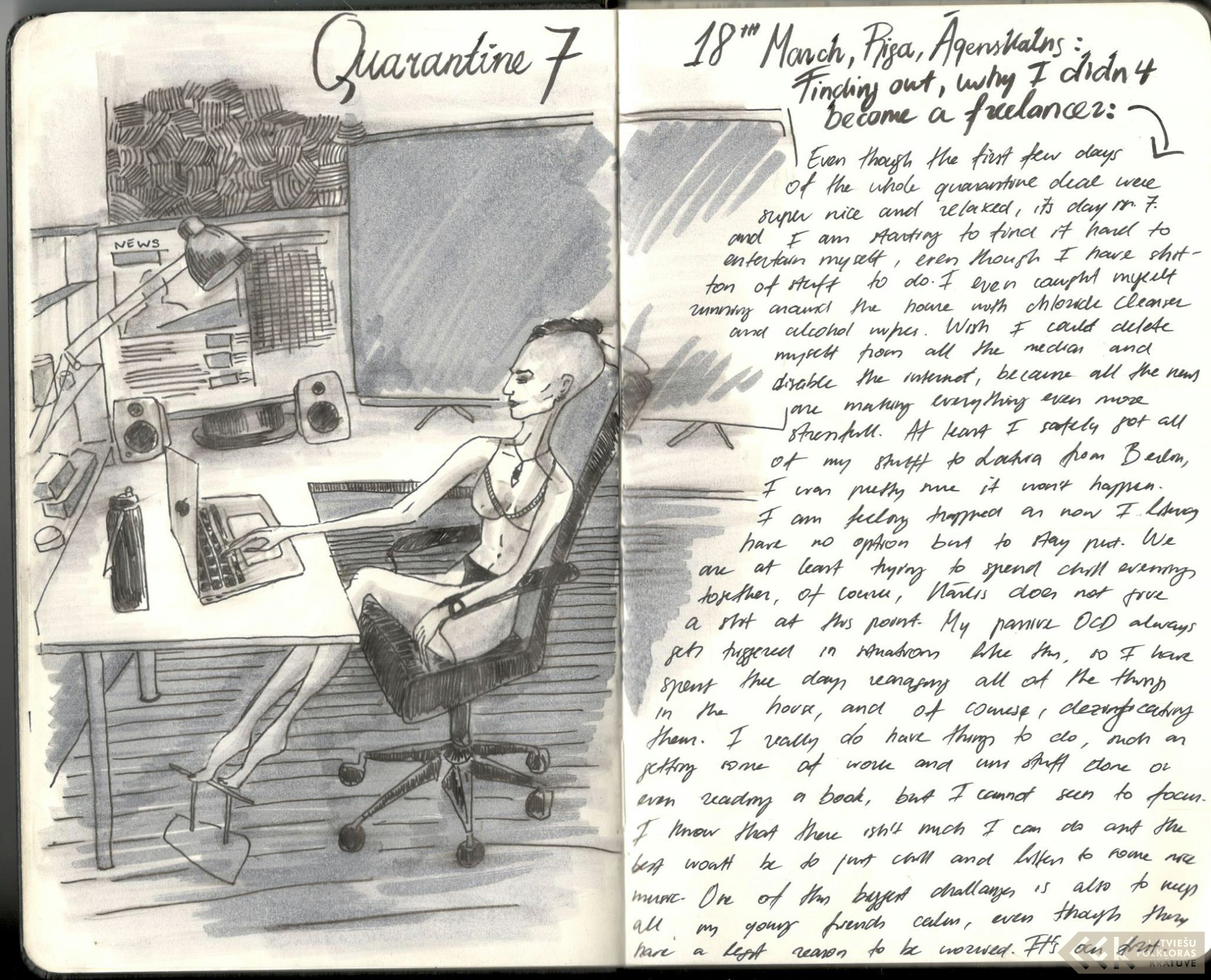
Submitted by: Laima Nitta

Explore collectionClose details

The collection contains autobiographical material written in Ludza in 1989 by Broņislava Bērziņa, née Ādmine (1903–1993), for her daughter Anna Apša, née Bērziņa (1940–2020). It recounts the history of the Ādmine family and that of her husband’s Bērziņš family from Pāliņi, called Puoleni in Latgalian and Poleņi in the text.

The collection also includes the old wedding song ‘Bitter, Bitter, Bitter!’, transcribed in 2018 by Laima Dimanta from a melody sung by Anna Apša. The song is said to be characteristic of the Rūbāni and Bērzpils areas.

Open on garamantas.lv (opens in a new tab)
First manuscript page: Diary of Arnolds Zērvens
LFK Ak 2211949–1950

Diary of Arnolds Zērvens

Diary author Arnolds Zērvens (1914–1985) was born at ‘Dīķi’ in Sīpele. He worked as a blacksmith, remained unmarried and was a chess champion in the Dobele district in the mid-1950s. His diary begins in 1949 and ends that same year when he is called up for military service.

Explore collectionClose details

Diary author Arnolds Zērvens (1914–1985) was born at ‘Dīķi’ in Sīpele. He worked as a blacksmith, remained unmarried and was a chess champion in the Dobele district in the mid-1950s. His diary begins in 1949 and ends that same year when he is called up for military service.

Open on garamantas.lv (opens in a new tab)
First manuscript page: Diaries of Ilgvars Ozols
LFK Ak 2221944–2016

Diaries of Ilgvars Ozols

Explore collectionClose details
Open on garamantas.lv (opens in a new tab)
First manuscript page: Diary of Katrīne Butenieks from 1904 to 1924
LFK Ak 2231904–1924

Diary of Katrīne Butenieks from 1904 to 1924

The diary of public employee Katrīne Buteniece (1884 – ?) – 365 pages, written from October 26, 1904, to July 2, 1924.

Explore collectionClose details

The diary of public employee Katrīne Buteniece (1884 – ?) – 365 pages, written from October 26, 1904, to July 2, 1924.

Open on garamantas.lv (opens in a new tab)
First manuscript page: Life story of Indriķis Rītiņš
LFK Ak 2241993

Life story of Indriķis Rītiņš

Explore collectionClose details
Open on garamantas.lv (opens in a new tab)
LFK Ak 2252012

Juris Vīksna’s family history research

Explore collectionClose details
Open on garamantas.lv (opens in a new tab)
LFK Ak 2261958–1968

Diary of Jūlija Celmiņa

Explore collectionClose details
Open on garamantas.lv (opens in a new tab)
First manuscript page: Memories of Pēteris Rubīns
LFK Ak 2272019–2022

Memories of Pēteris Rubīns

Explore collectionClose details
Open on garamantas.lv (opens in a new tab)
First manuscript page: Letters of Kārlis Vesmanis and life story of Anna Rosmane
LFK Ak 2281918–1934

Letters of Kārlis Vesmanis and life story of Anna Rosmane

Explore collectionClose details
Open on garamantas.lv (opens in a new tab)
First manuscript page: Memories of Olga Veģe
LFK Ak 2301973

Memories of Olga Veģe

In late 2023, Pēteris Veģis entrusted the Autobiography Collection with memoirs and photographs belonging to his grandmother, Latvian language teacher Olga Veģe. Born in 1904 in Vecmuiža, Vecpiebalga, in the Cēsis district, Olga wrote her memoirs in Sigulda in 1973. Written in rich Latvian, the account offers a vivid picture of life around Vecpiebalga in the early twentieth century and in Cēsis in later decades. It includes references to the works of Rainis, whose literary legacy Olga played a particular role in documenting.

Explore collectionClose details

In late 2023, Pēteris Veģis entrusted the Autobiography Collection with memoirs and photographs belonging to his grandmother, Latvian language teacher Olga Veģe. Born in 1904 in Vecmuiža, Vecpiebalga, in the Cēsis district, Olga wrote her memoirs in Sigulda in 1973. Written in rich Latvian, the account offers a vivid picture of life around Vecpiebalga in the early twentieth century and in Cēsis in later decades. It includes references to the works of Rainis, whose literary legacy Olga played a particular role in documenting.

Open on garamantas.lv (opens in a new tab)
First manuscript page: Diary of Milda Lauberte
LFK Ak 231

Diary of Milda Lauberte

Milda Lauberte’s diary was written from 25 March to 15 April 1949 during her deportation journey to Siberia, on pages from a drawing notebook. It is accompanied by poems, song lyrics and short accounts of life in Siberia.

Explore collectionClose details

Milda Lauberte’s diary was written from 25 March to 15 April 1949 during her deportation journey to Siberia, on pages from a drawing notebook. It is accompanied by poems, song lyrics and short accounts of life in Siberia.

Open on garamantas.lv (opens in a new tab)
First manuscript page: Diaries of Antons Grīnbergs
LFK Ak 2321944–1945

Diaries of Antons Grīnbergs

Explore collectionClose details
Open on garamantas.lv (opens in a new tab)
First manuscript page: Story by Betija Brasliņa
LFK Ak 2361960–1970

Story by Betija Brasliņa

Betija Brasliņa’s memoir is a deeply emotional and historically valuable account of a Latvian family's fate during the Soviet deportations. The story begins in the 1940s in Stroķi Parish, a rural area in the region of Kurzeme, and continues in the remote village of Čaldon in the Tomsk region of Siberia. This geographical shift—from a quiet Latvian homestead to an isolated settlement deep in the Siberian taiga—symbolizes the dramatic transformation of life from safety and familiarity to the harsh and alien reality of exile. At the heart of the narrative are Betija’s sister, Matilde, and her husband, Valdis, who is arrested and deported to Siberia. Matilde follows him despite immense obstacles, and together they build a new life in exile. Betija describes how, even under the most brutal conditions, the couple manages to preserve their humanity, strong work ethic, and mutual respect.

Explore collectionClose details

Betija Brasliņa’s memoir is a deeply emotional and historically valuable account of a Latvian family's fate during the Soviet deportations. The story begins in the 1940s in Stroķi Parish, a rural area in the region of Kurzeme, and continues in the remote village of Čaldon in the Tomsk region of Siberia. This geographical shift—from a quiet Latvian homestead to an isolated settlement deep in the Siberian taiga—symbolizes the dramatic transformation of life from safety and familiarity to the harsh and alien reality of exile.

At the heart of the narrative are Betija’s sister, Matilde, and her husband, Valdis, who is arrested and deported to Siberia. Matilde follows him despite immense obstacles, and together they build a new life in exile. Betija describes how, even under the most brutal conditions, the couple manages to preserve their humanity, strong work ethic, and mutual respect.

Open on garamantas.lv (opens in a new tab)
LFK Ak 2372021–2022

Life story of Francis Zvīdrs

Explore collectionClose details
Open on garamantas.lv (opens in a new tab)
First manuscript page: Einara Penča: “Viena vasara laukos” (“One Summer in the Countryside”)
LFK Ak 2401945

Einara Penča: “Viena vasara laukos” (“One Summer in the Countryside”)

Explore collectionClose details
Open on garamantas.lv (opens in a new tab)
LFK Ak 2422024–2025

Stories of Awakening (Atmoda)

The collection brings together memoirs and stories submitted to the 2024 competition ‘My First Steps in the Latvian National Awakening’.

Explore collectionClose details

The collection brings together memoirs and stories submitted to the 2024 competition ‘My First Steps in the Latvian National Awakening’.

Open on garamantas.lv (opens in a new tab)
First manuscript page: Diary of Ivanda Kūkusiliņa
LFK Ak 2431986–2006

Diary of Ivanda Kūkusiliņa

Explore collectionClose details
Open on garamantas.lv (opens in a new tab)
First manuscript page: Diaries of Edīte Sondoviča
LFK Ak 2441956–2023

Diaries of Edīte Sondoviča

Explore collectionClose details
Open on garamantas.lv (opens in a new tab)
First manuscript page: Letters by Ērika Krauja
LFK Ak 2451950–1952

Letters by Ērika Krauja

Explore collectionClose details
Open on garamantas.lv (opens in a new tab)
First manuscript page: Letters by Anna Kokks
LFK Ak 2461928–1948

Letters by Anna Kokks

Explore collectionClose details
Open on garamantas.lv (opens in a new tab)
First manuscript page: Letters by Bruno Stilbiņš
LFK Ak 2471941–1951

Letters by Bruno Stilbiņš

Explore collectionClose details
Open on garamantas.lv (opens in a new tab)
LFK Ak 2482020–2021

Memories by Gunda Kārkliņa

Submitted by: Gunda Kārkliņa

Explore collectionClose details
Open on garamantas.lv (opens in a new tab)
First manuscript page: Lilija Jansone's memories, written down by her son
LFK Ak 2491999

Lilija Jansone's memories, written down by her son

Submitted by: Andrejs Jansons

Explore collectionClose details
Open on garamantas.lv (opens in a new tab)
First manuscript page: Memories by Antons Plešs
LFK Ak 2501992–2017

Memories by Antons Plešs

Explore collectionClose details
Open on garamantas.lv (opens in a new tab)
First manuscript page: Memories by Edgars Šēnbergs
LFK Ak 2512016

Memories by Edgars Šēnbergs

Explore collectionClose details
Open on garamantas.lv (opens in a new tab)
First manuscript page: Diary by Arturs Olafds Pindzulis
LFK Ak 2531927–1928

Diary by Arturs Olafds Pindzulis

Explore collectionClose details
Open on garamantas.lv (opens in a new tab)
First manuscript page: Letters for Arturs Druva
LFK Ak 2541955–1959

Letters for Arturs Druva

Explore collectionClose details
Open on garamantas.lv (opens in a new tab)
First manuscript page: Autobiography by Pārsla Eglīte
LFK Ak 2552010–2012

Autobiography by Pārsla Eglīte

Explore collectionClose details
Open on garamantas.lv (opens in a new tab)